MALKIEL, Burton G.
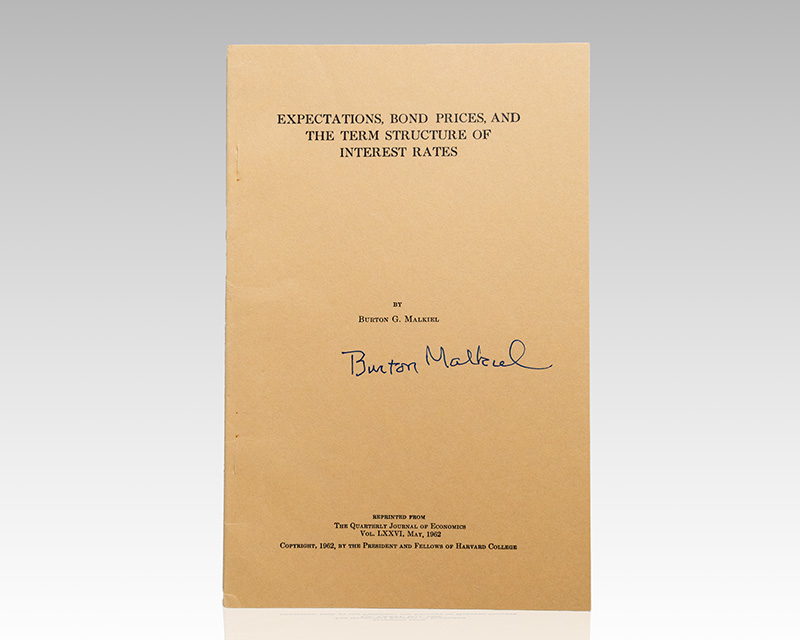
The Quarterly Journal of Economics: Expectations, Bond Prices, and the Term Structure of Interest Rates.
Cambridge, Massachusetts: The Quarterly Journal of Economics , 1962.
We're sorry, this item has sold.
+$450
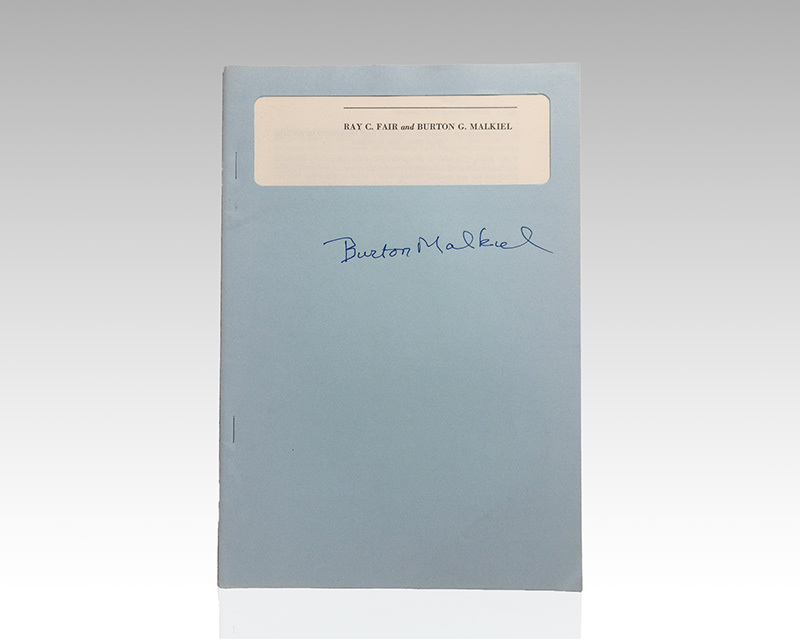
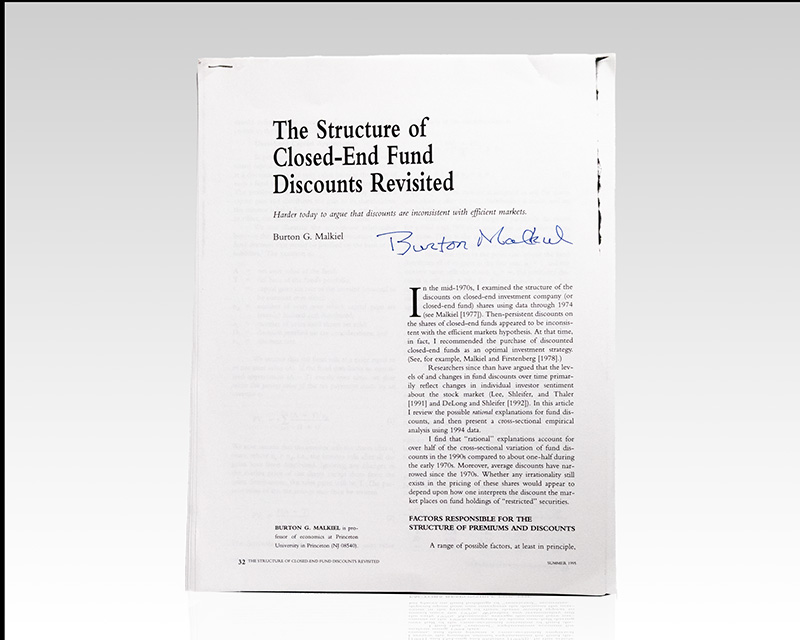
An Offprint of the May 1962 Issue of The Quarterly Journal of Economics, Containing Burton Malkiel's "Expectations, Bond Prices, and the Term Structure of Interest Rates"; Signed by Him and From His Own Personal Collection
Rare offprint of the May 1962 issue of The Quarterly Journal of Economics, containing Burton Malkiel's article "Expectations, Bond Prices, and the Term Structure of Interest Rates." Octavo, original wrappers, volume 76. Boldly signed by Burton Malkiel on the front wrapper. Burton Gordon Malkiel (born 1932) is one of the most consequential financial economists of the postwar American academy, whose career as scholar, institutional leader, and public intellectual has made him a central figure at the intersection of investment theory, market efficiency, and public policy. Educated at Harvard and Princeton, where he spent the most productive decades of his career as Chemical Bank Chairman's Professor of Economics, Malkiel also served as Dean of the Yale School of Management from 1981 to 1988 and as a member of the President's Council of Economic Advisers under Gerald Ford from 1975 to 1977. His scholarly output encompasses foundational contributions across the term structure of interest rates, convertible security valuation, corporate capital structure, closed-end fund discounts, mutual fund performance, and gender pay differentials in professional employment, producing a body of work whose empirical breadth places him among the most versatile financial economists of his generation. His long service on the board of directors of The Vanguard Group connects his academic advocacy for passive investing to the institutional infrastructure that has most fully realized it in practice. It is nevertheless A Random Walk Down Wall Street, first published in 1973 and now in its thirteenth edition, that secured his place in the broader culture: a work of lucid, empirically grounded argument for market efficiency and index fund investing that has sold over 1.5 million copies and permanently altered the investment behavior of millions of individual investors worldwide. From the personal collection of Burton Malkiel. In fine condition.
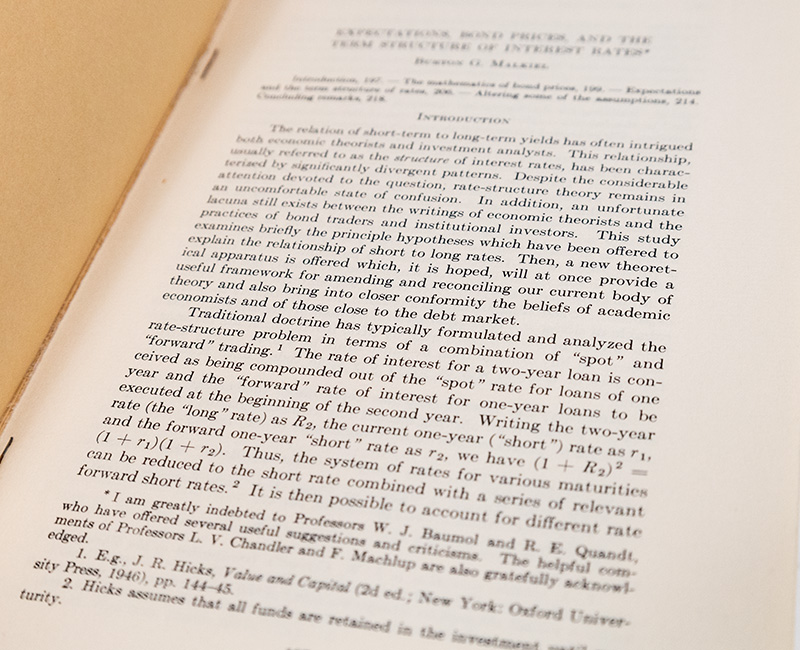
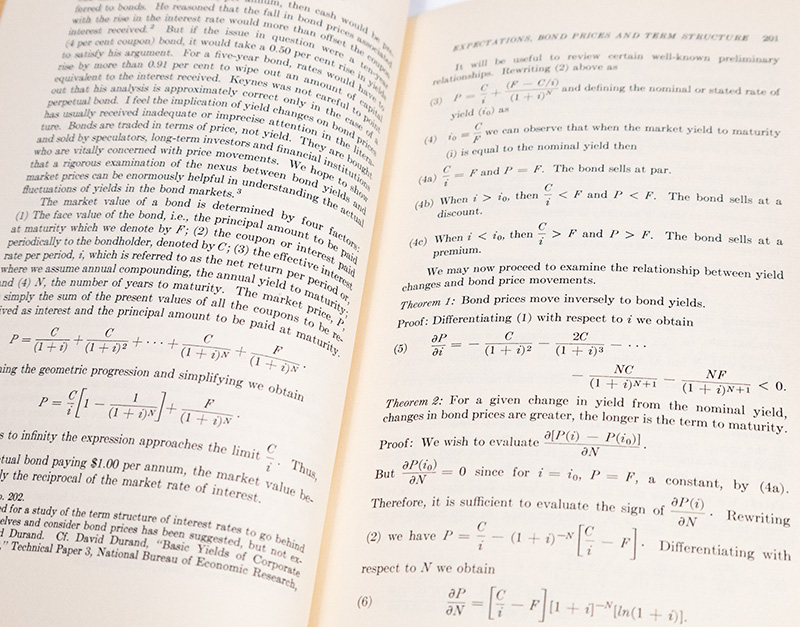
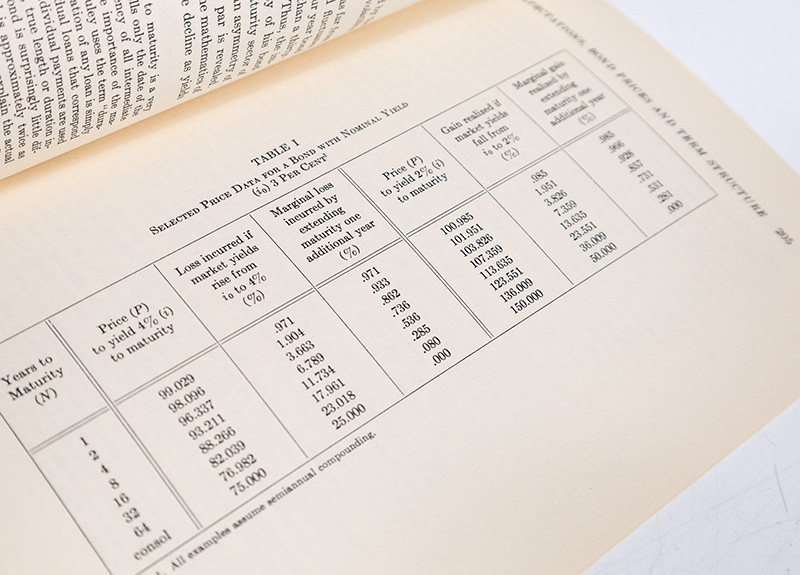
"Expectations, Bond Prices, and the Term Structure of Interest Rates," published in The Quarterly Journal of Economics, Volume 76, No. 2 (May 1962), is a foundational paper by Burton G. Malkiel — the Chemical Bank Chairman's Professor of Economics Emeritus at Princeton University and best known to the broader public as the author of A Random Walk Down Wall Street — that stands as one of the most rigorous and influential treatments of fixed income mathematics in the history of financial economics. The paper moves in three principal stages: a formal mathematical treatment of bond prices, an analysis of how investor expectations govern the term structure of interest rates, and a systematic relaxation of simplifying assumptions to bring the theoretical framework closer to the conditions of actual markets. Malkiel takes the position that the Lutz theory of basic behavioral postulate is correct and important in understanding the behavior of market interest rates of securities with different terms to maturity — arguing that investors decide whether to invest in bonds based on their expectations of future short rates, and that the term structure reflects investors' expectations as influenced by their sense of the normal range of interest rates. The paper's most enduring contribution is the formal derivation of what have come to be known as Malkiel's Bond Theorems — a set of propositions governing the relationship between bond prices, yields, maturity, and coupon rates that remain the standard pedagogical framework for fixed income analysis in finance curricula worldwide.
The Quarterly Journal of Economics: Expectations, Bond Prices, and the Term Structure of Interest Rates.
Out of Stock
Other Books by this Author