

GLAZER, Nathan.
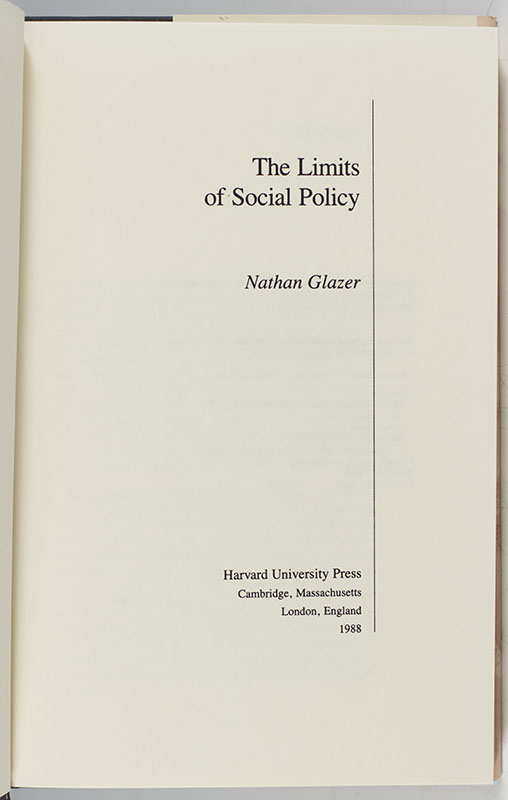
The Limits of Social Policy.
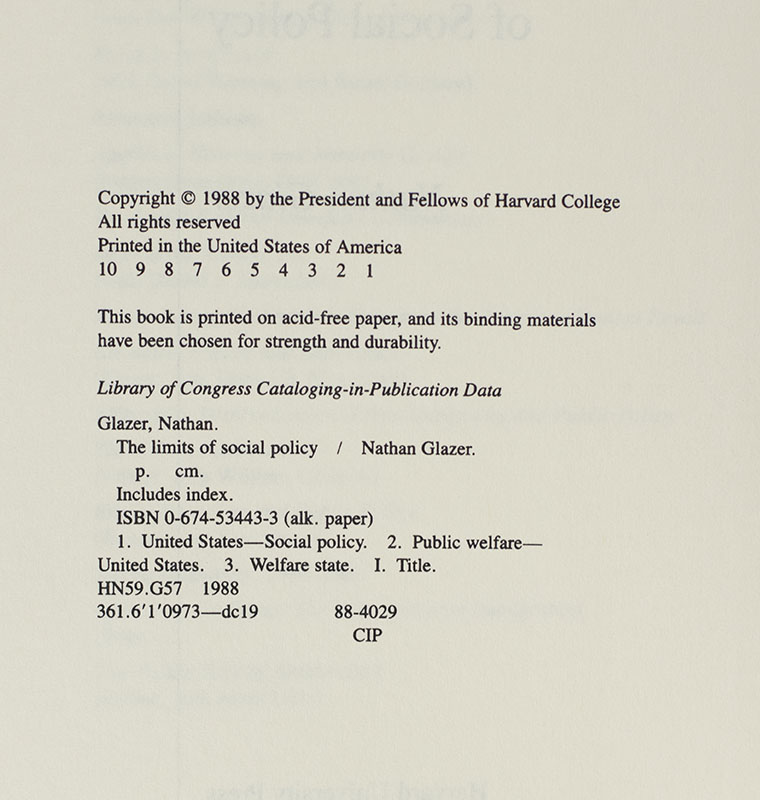
Cambridge, MA: Harvard University Press , 1988.
We're sorry, this item has sold.
+$450
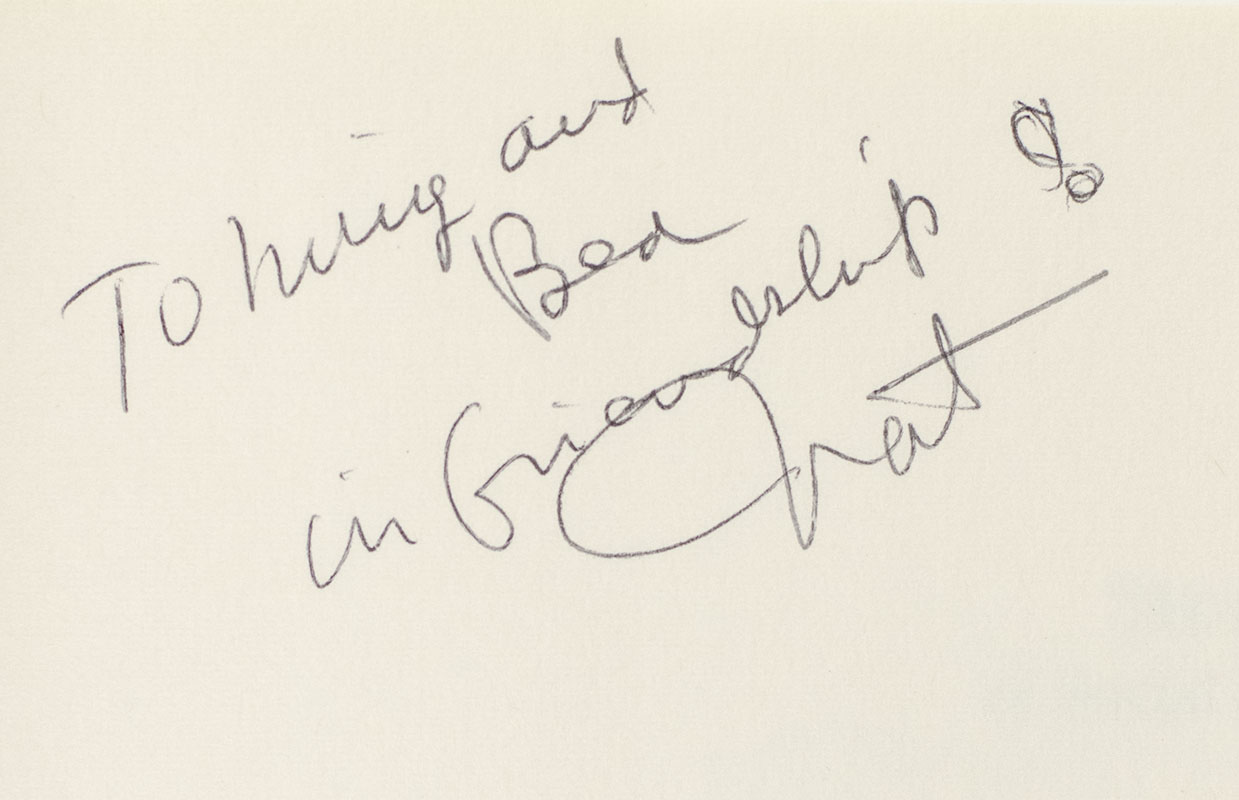
First Edition of Nathan Glazer's The Limits of Social Policy; Inscribed by him to Irving Kristol and Gertrude Himmelfarb
First edition of this work on the social sciences. Octavo, original cloth. Association copy, inscribed by the author on the front free endpaper, "To Irving and Bea in friendship Nat." The recipients were Irving Kristol and his wife Gertrude Himmelfarb, who were close friends of Glazer. Kristol was a journalist who was dubbed the “godfather of neoconservatism.” Historian Gertrude Himmelfarb, also known as Bea Kristol, was an American historian who was a leader of conservative interpretations of history and historiography. Near fine in a near fine dust jacket. Jacket design by Joyce C. Weston. An excellent association.
Many social policies of the 1960s and 1970s, designed to overcome poverty and provide a decent minimum standard of living for all Americans, ran into trouble in the 1980s—with politicians, with social scientists, and with the American people. Nathan Glazer was a leading analyst and critic of those measures. Here he looks back at what went wrong, arguing that our social policies, although targeted effectively on some problems, ignored others that are equally important and contributed to the weakening of the structures—family, ethnic and neighborhood ties, commitment to work—that form the foundations of a healthy society. What keeps society going, after all, is that most people feel they should work, however well they might do without working, and that they should take care of their families, however attractive it might appear on occasion to desert them. Glazer proposes new kinds of social policies that would strengthen social structures and traditional restraints. Thus, to reinforce the incentive to work, he would attach to low-income jobs the same kind of fringe benefits—health insurance, social security, vacations with pay—that now make higher-paying jobs attractive and that paradoxically are already available in some form to those on welfare. More generally, he would reorient social policy to fit more comfortably with deep and abiding tendencies in American political culture: toward volunteerism, privatization, and decentralization.
The Limits of Social Policy.
$350.00
Out of Stock