FITZGERALD, F. Scott.
The Great Gatsby.
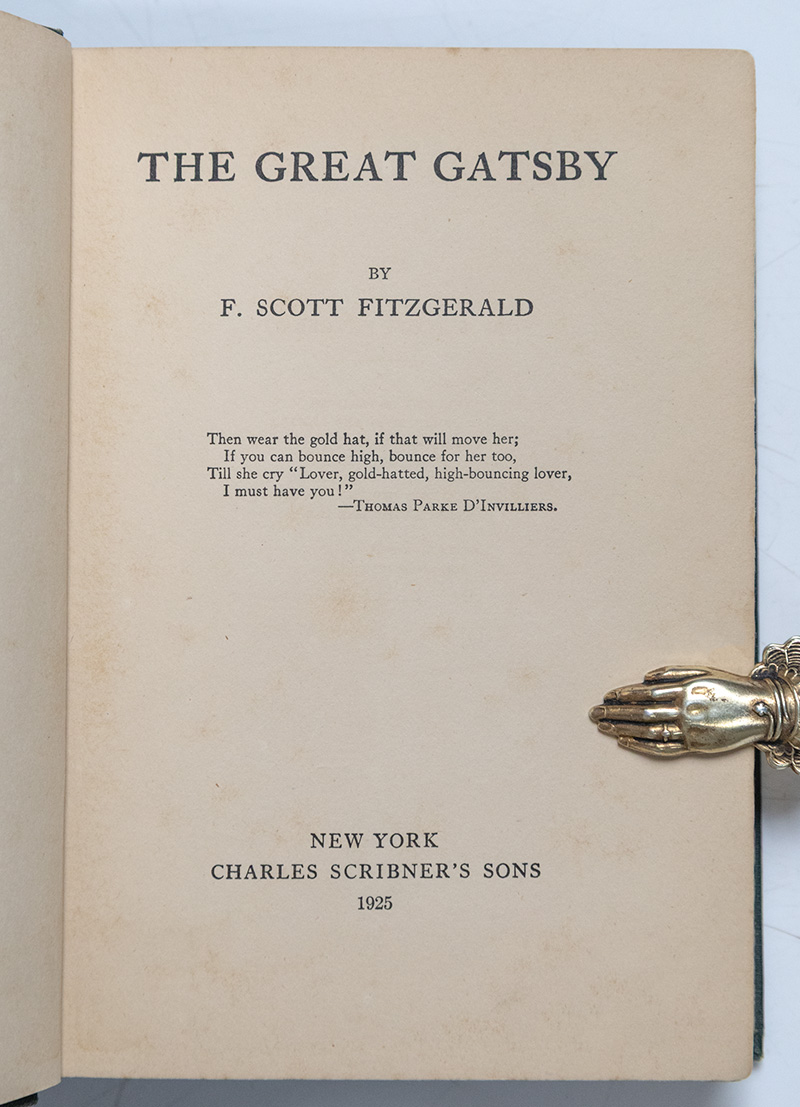
New York: Charles Scribner's Sons , 1925.
We're sorry, this item has sold.
+$450
First edition of F. Scott Fitzgerald's The Great Gatsby; Inscribed by F. Scott Fitzgerald to Celebrated Actor John Barrymore
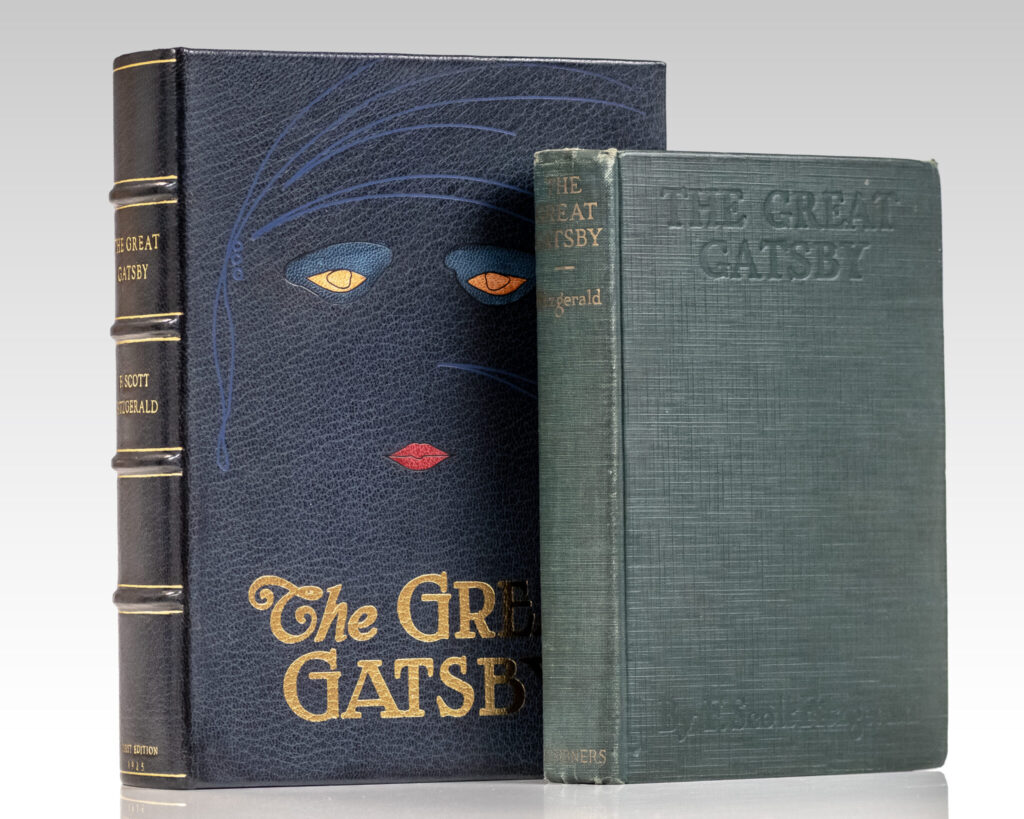
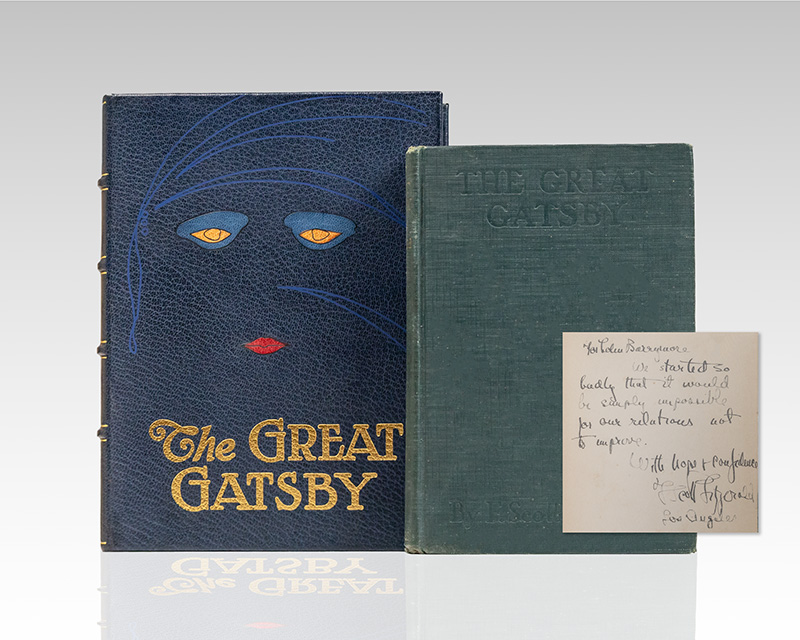
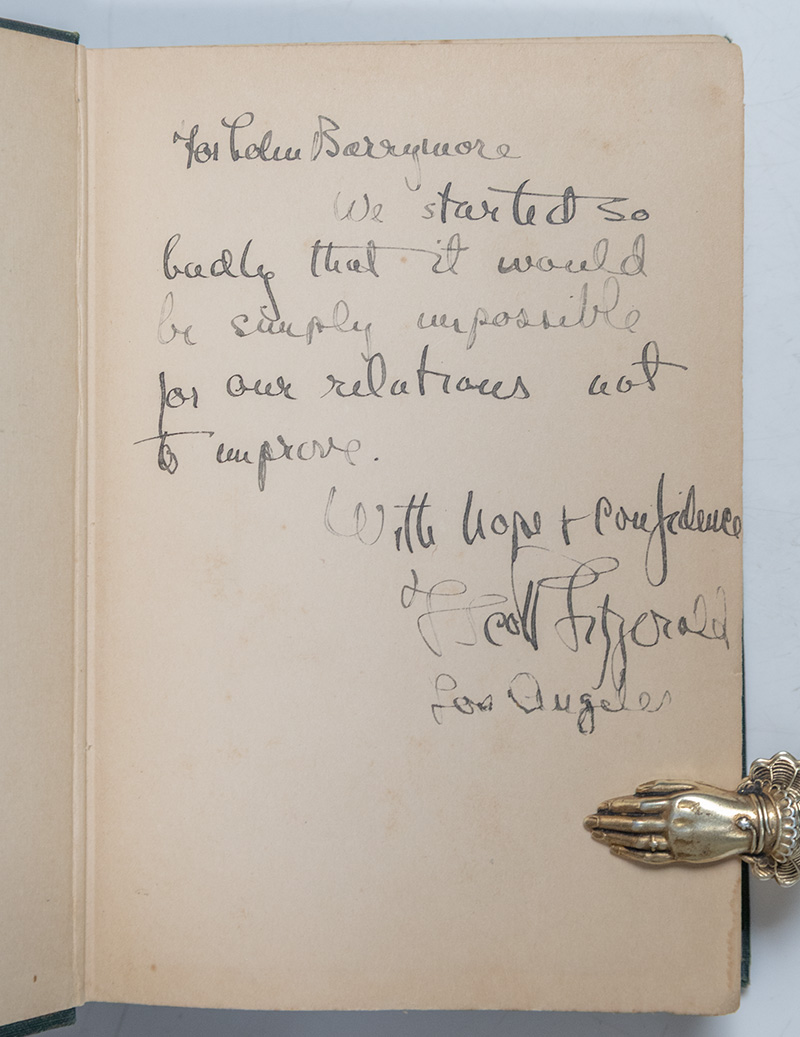
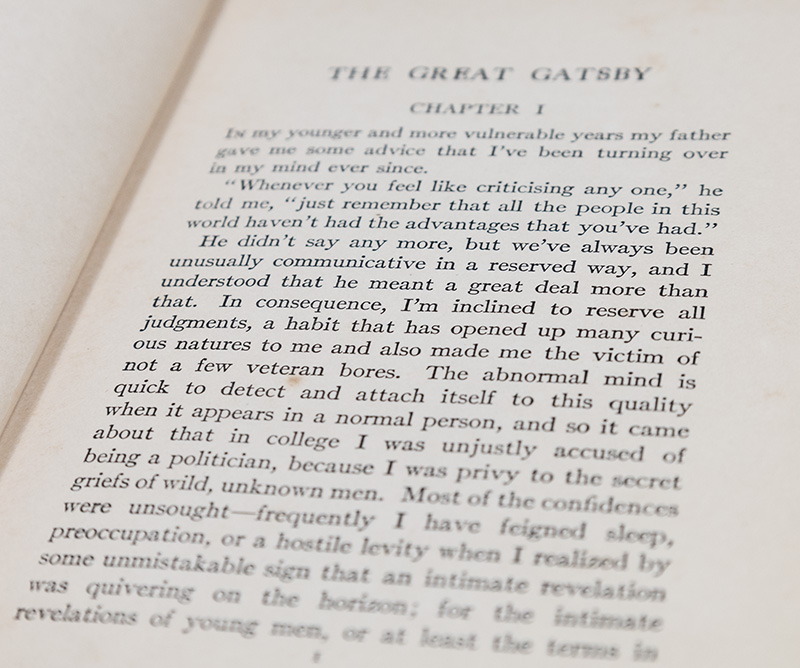
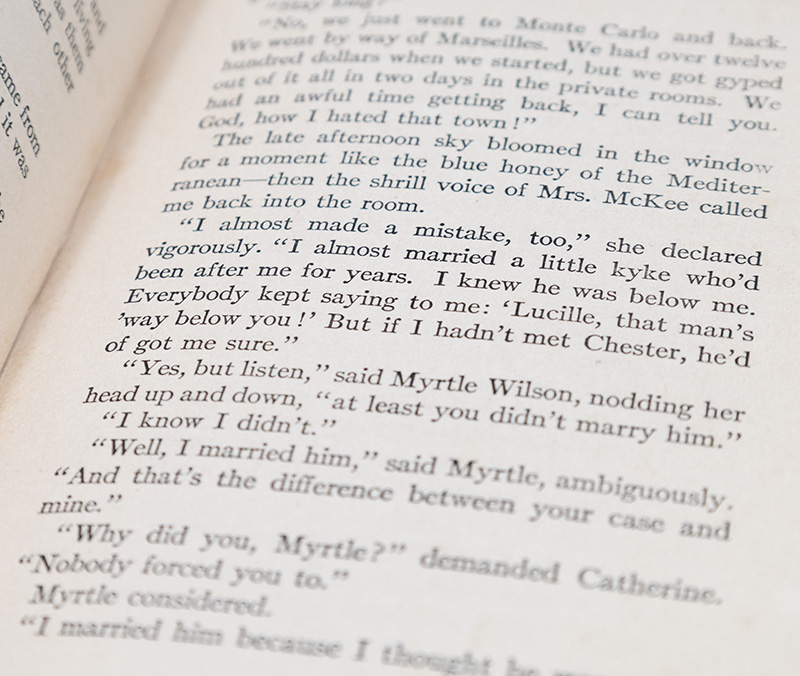
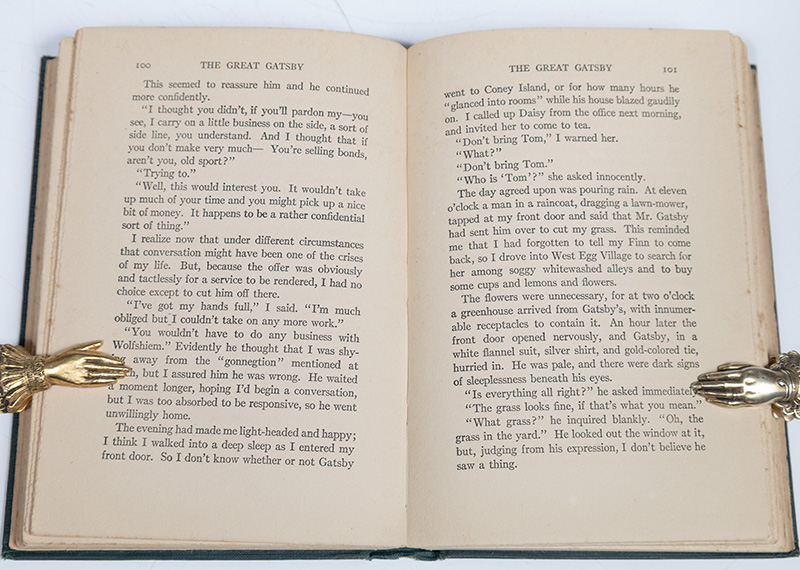
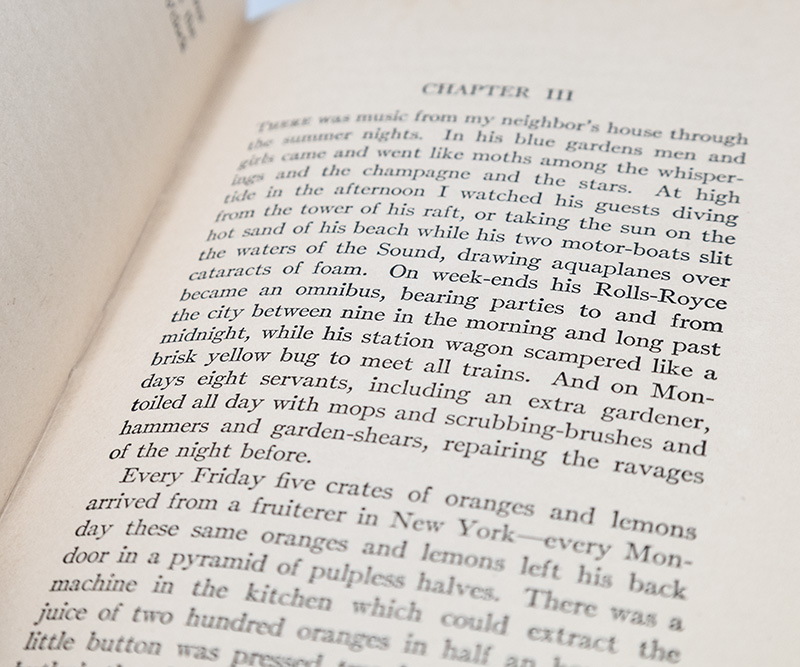
First edition, first state of Fitzgerald's masterpiece with "chatter" p.60, "northern" p.119, "sick in tired" p.205, and "Union Street station" p.211. Octavo, original dark green cloth with gilt titles to the spine. Association copy, inscribed by F. Scott Fitzgerald on the front free endpaper, "For John Barrymore We started so badly that it would be simply impossible for our relations not to improve. With hope & confidence F. Scott Fitzgerald. Los Angeles." John Barrymore (1882–1942), one of the most celebrated American actors of his generation, was renowned for his performances on both the stage and screen, particularly in Shakespearean roles like Hamlet and Richard III, which established his reputation as a leading interpreter of classical drama. Born into the prominent Barrymore theatrical family, he was part of a distinguished lineage of actors including his granddaughter Drew Barrymore and helped extend its legacy through his commanding presence and expressive style. Although he began his career on the stage, Barrymore achieved widespread fame in both silent and early sound films, appearing in productions such as Dr. Jekyll and Mr. Hyde (1920) and Grand Hotel (1932). His performances were noted for their combination of technical precision and emotional intensity, as well as for a certain theatrical grandeur that reflected his stage training. A central figure in early twentieth-century theatrical culture, Barrymore also moved within the literary and social circles of the Jazz Age, where he developed connections with writers including F. Scott Fitzgerald, Dorothy Parker, Robert Benchley, and Edna Ferber. During the 1920s and 1930s, Barrymore and Fitzgerald became acquainted in Los Angeles, where an emerging social culture of studio parties, private salons, and expatriate gatherings brought together figures from Hollywood and the literary world. Barrymore’s wit, reputation for excess, and cultivated public persona made him a conspicuous presence in these circles, where conversation, performance, and social display were closely intertwined. In near fine condition.
In terms of provenance, the copy presents a well-documented and unbroken chain of ownership of considerable biographical interest. The volume was received by the actor John Barrymore as a personal gift from F. Scott Fitzgerald in 1927, a transaction that places it at the intersection of two of the most celebrated and self-destructive talents of the Jazz Age. Upon the dissolution of Barrymore's marriage to the actress Dolores Costello, she appropriated his library in 1935 and removed the books to her residence in Hancock Park upon her departure from Bella Vista, Barrymore's Tower Road estate in Beverly Hills. The volume passed by bequest to the couple's daughter, Dolores Ethel Mae Barrymore, upon Dolores Costello's death in 1979, and was gifted earlier this year to her daughter Hillary, the fourth consecutive generation of the Barrymore-Costello family to hold the book, and a provenance chain that carries it from Fitzgerald's hand in 1927 to the present day across nearly a century of one of Hollywood's most storied dynasties.
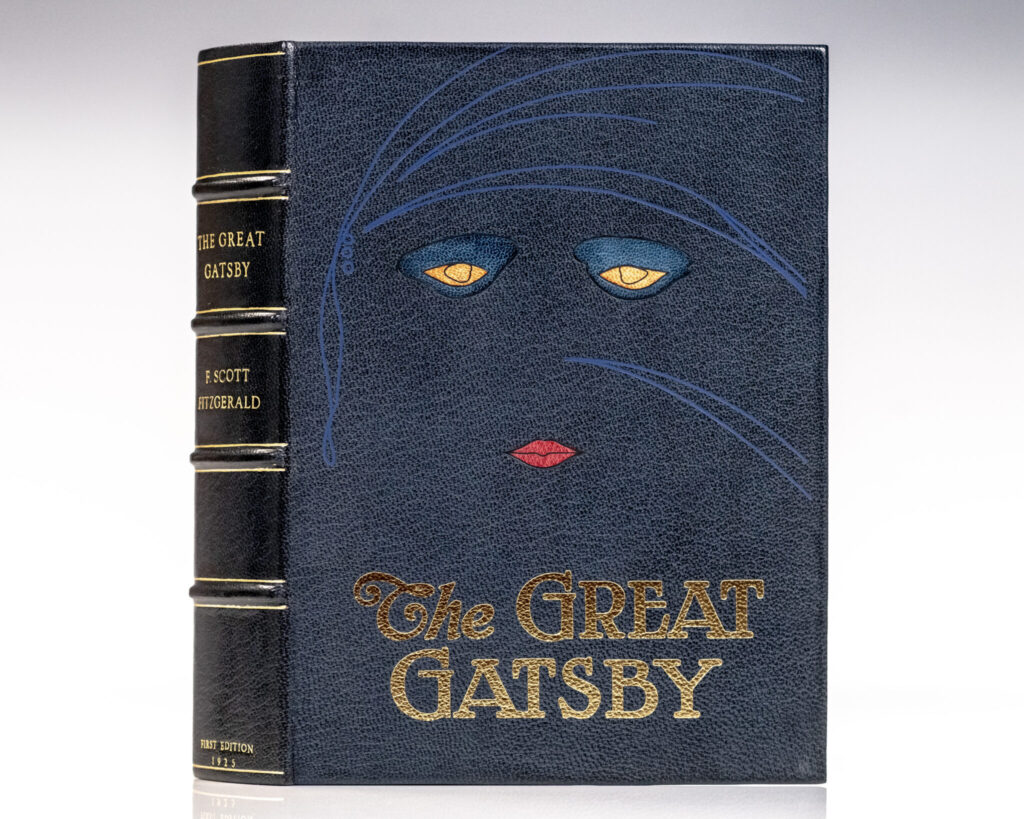
Housed in a custom full morocco pictorial clamshell box by The Harcourt Bindery with gilt titles and an onlay of the illustration from the original dust jacket to the front panel. An exceptional association copy.
In 1922, Fitzgerald announced his decision to write "something new--something extraordinary and beautiful and simple and intricately patterned." That extraordinary, beautiful, intricately patterned, and above all, simple novel became The Great Gatsby, arguably Fitzgerald's finest work and certainly the book for which he is best known. A portrait of the Jazz Age in all of its decadence and excess, Gatsby captured the spirit of the author's generation and earned itself a permanent place in American mythology. Cyril Connolly called The Great Gatsby one of the half dozen best American novels: "Gatsby remains a prose poem of delight and sadness which has by now introduced two generations to the romance of America, as Huckleberry Finn and Leaves of Grass introduced those before it" (Modern Movement 48). Consistently gaining popularity after World War II, the novel became an important part of American high school curricula. Today it is widely considered to be a literary classic and a contender for the title "Great American Novel". In 1998, the Modern Library editorial board voted it the 20th century's best American novel and second best English-language novel of the same time period. It was the basis for numerous stage and film adaptations. Gatsby had four film adaptations, with two exceptionally big-budget versions: the 1974 version starring Robert Redford and Mia Farrow, as well as Baz Luhrmann’s 2013 version starring Leonardo DiCaprio, Tobey Maguire and Carrie Mulligan. Fitzgerald’s granddaughter praised Lurhmann’s adaptation, stating “Scott would be proud.”
The Great Gatsby.
Out of Stock
Other Books by this Author