
PHELPS, Edmund S. [Paul A. Samuelson].
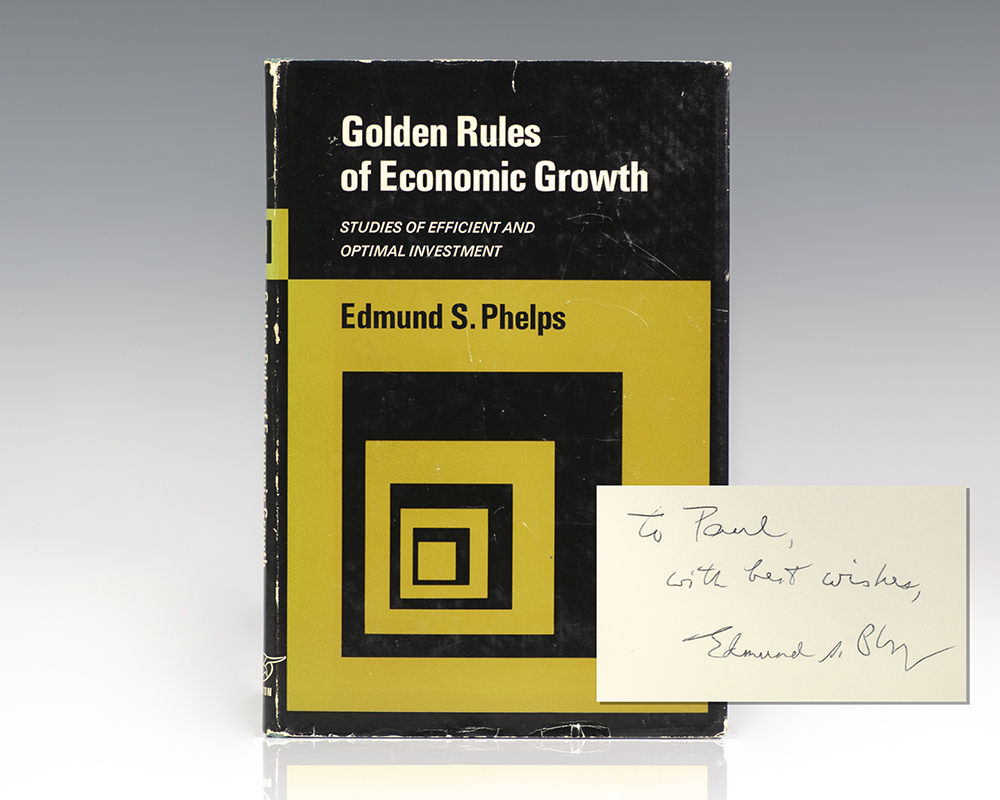
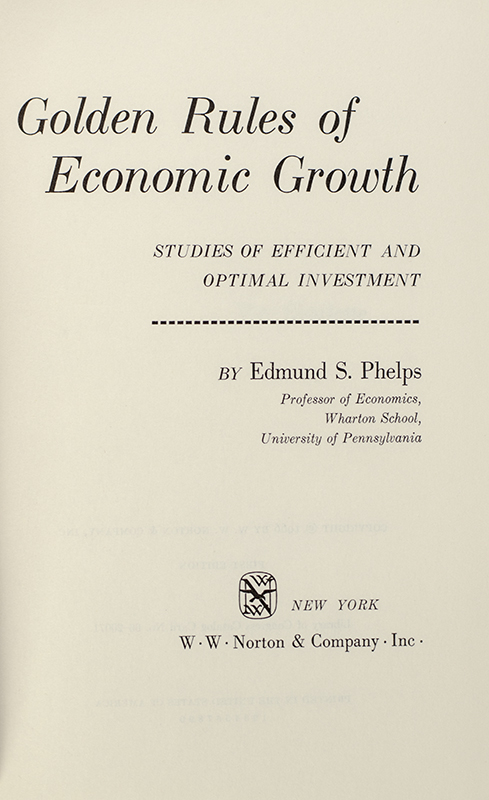
Golden Rules of Economic Growth: Studies of Efficient and Optimal Investment.
New York: W.W. Norton & Norton Company, Inc. , 1966.
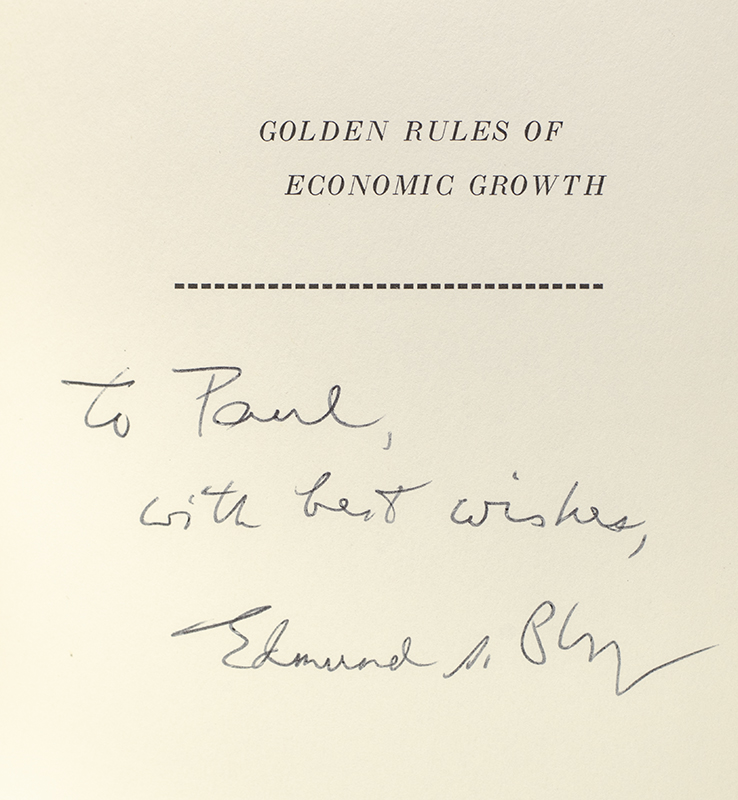
First edition of the Nobel Laureate's first book, a collection of twelve interlocked essays in mathematical economics. Octavo, original cloth, dust jacket; xv, 189 pp., with bibliography. A distinguished association copy, inscribed by the author on the half-title page to fellow Nobel Laureate Paul A. Samuelson: "To Paul with best wishes Edmund Phelps." From the library of Paul A. Samuelson. Near fine in a near fine, price-clipped dust jacket.
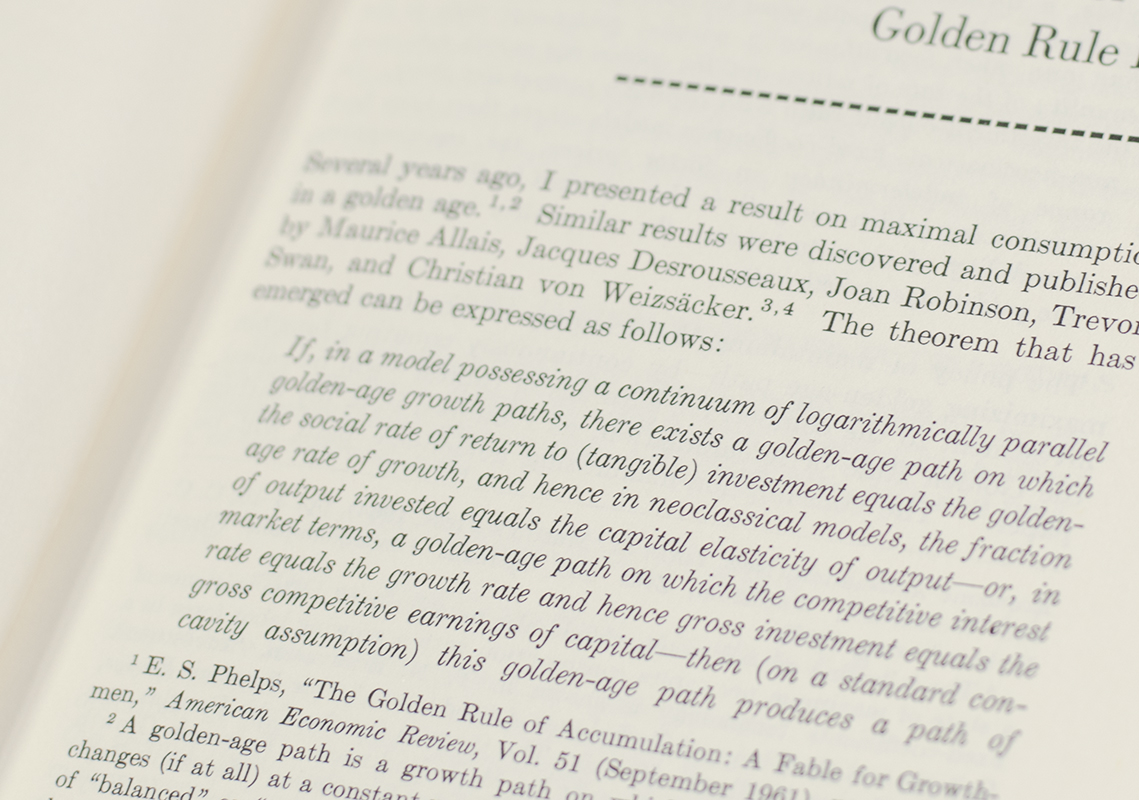
The present volume gathers and extends the work for which Phelps had first drawn notice. In a 1961 article memorably subtitled "A Fable for Growthmen," he had set out the Golden Rule of capital accumulation, the rate of saving that sustains the highest attainable level of consumption for a society across successive generations, neither starving the present to enrich the future nor consuming so freely that future output is undermined. The essays assembled here expound that concept in full and pursue its analogues, demonstrating that the notion of a "commanding" growth path persists even in models admitting no simple Golden Rule. Together they address a central preoccupation of postwar economic theory: the search for a path to an optimum rate of economic growth. The book remains essential reading for students of macroeconomic theory, growth, development, and capital theory.
Phelps and Samuelson stand among the central figures of twentieth-century economics, and the copy offered here carries a particular resonance. Samuelson, with Robert Solow, had done much to introduce the Phillips curve into American policy thinking at the start of the 1960s, presenting the inflation-unemployment tradeoff as a menu available to policymakers. Within the decade, Phelps's work on the expectations-augmented Phillips curve and the natural rate of unemployment would revise that interpretation, showing that no durable reduction in unemployment could be purchased through inflation once expectations adjusted - the contribution that earned him the Nobel Prize in 2006. Both men were likewise architects of modern growth theory, Samuelson through the overlapping-generations model and Phelps through the Golden Rule developed at length in these pages.
Samuelson was the first American to receive the Nobel Prize in Economic Sciences and remained, across half a century at the Massachusetts Institute of Technology, the most influential economist of the postwar American academy. Books from his working library, particularly those inscribed to him by fellow laureates, occupy a notable place among twentieth-century economics association material. An inscribed copy passing directly from the younger economist to the elder, and preserved in Samuelson's own library, quietly unites two enduring strands of a shared discipline.