Mark Rivera Book Signing.
On May 14, 2026, Raptis Rare Books and Churchill Cigar Company had the extraordinary privilege of hosting legendary musician, musical director, and rock icon Mark Rivera for an…
Read more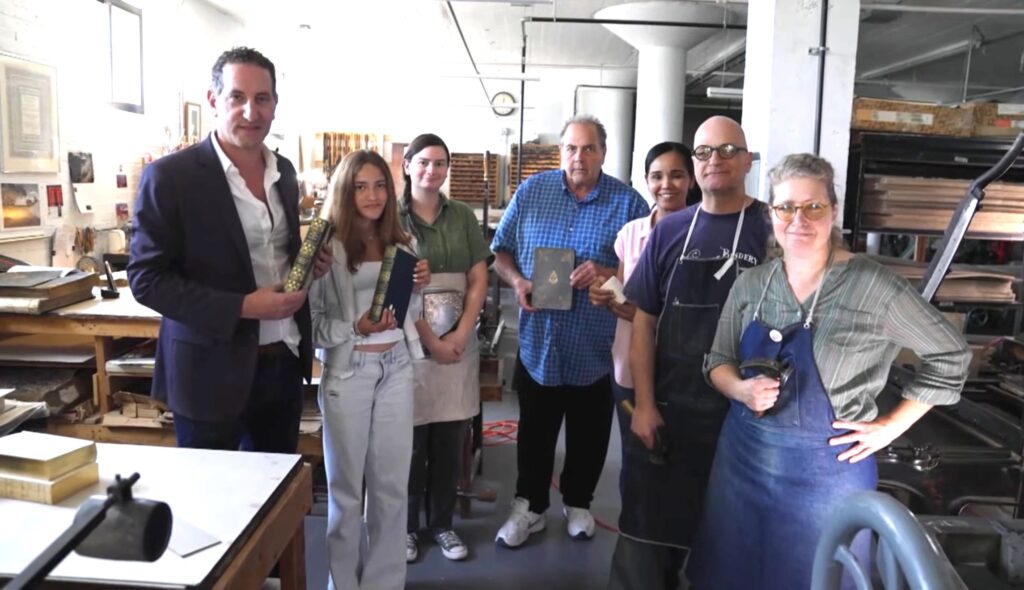 What unites the makers is not a region or a medium but a refusal: each of them has declined the obvious efficiencies of factory production in favor of work that takes longer, costs more, and lasts. Made With Love presents that refusal as central to the American story rather than peripheral to it. The handmade object, the program argues, is not a quaint exception to modern life but the thread that connects the workshops of the eighteenth century to the workshops of today.
 The Press, the Page, and the Bindery
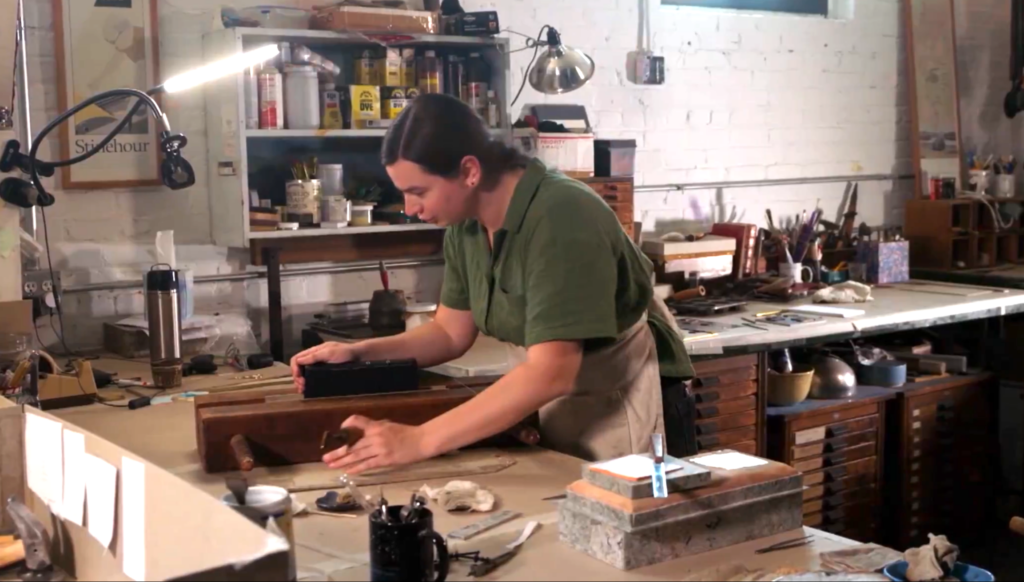
The decision to bring the cameras to the Harcourt Bindery follows naturally from that thesis. If any single technology shaped the political culture of the founding generation, it was the printing press. The pamphlets of Thomas Paine, the essays of Hamilton and Madison and Jay, the broadside printings of the Declaration itself – none of it would have reached the public without the presses of Philadelphia, Boston, New York, and a dozen smaller towns, and none of it would have survived as bound books to be read by later generations without the binders who stitched, glued, and covered the printed sheets. The book, in the American eighteenth century, was a piece of physical infrastructure for the spread of an idea. To preserve the craft that made it is, in a sense, to preserve the medium that made the country.
The Harcourt Bindery has been doing precisely that, without interruption, since 1900. Housed today in a repurposed Charlestown warehouse, it is widely regarded as the oldest traditional hand bookbindery in the United States and among the largest devoted exclusively to fine binding done by hand rather than by machine. In 2025 the firm quietly marked its 125th anniversary, a span that reaches from the age of the horse-drawn delivery wagon to the age of the e-reader, and through which the essential motions of the craft have changed remarkably little. Leaves are still folded and gathered by hand. Type is still set for the gold-stamped lettering of a spine. Leather is still pared with a knife to the precise thinness required to turn cleanly over a board. The tools on the benches are, in many cases, as old as the company itself, and the only computer in routine use sits on the manager’s desk.
For Raptis Rare Books, this is not a remote subject. In 2022, Adrienne and Matthew Raptis acquired the Harcourt Bindery, drawn by a conviction that the preservation of bookbinding as a living craft is inseparable from the work of dealing in rare books at all. A first edition is an artifact; keeping it sound, and sometimes giving it the binding its importance deserves, requires hands that know how. The PBS feature, in turning its lens on Charlestown, has confirmed in a national setting what we have understood from the beginning: that the future of the physical book depends on the small number of people willing to keep an old skill alive.
The Press, the Page, and the Bindery
The decision to bring the cameras to the Harcourt Bindery follows naturally from that thesis. If any single technology shaped the political culture of the founding generation, it was the printing press. The pamphlets of Thomas Paine, the essays of Hamilton and Madison and Jay, the broadside printings of the Declaration itself – none of it would have reached the public without the presses of Philadelphia, Boston, New York, and a dozen smaller towns, and none of it would have survived as bound books to be read by later generations without the binders who stitched, glued, and covered the printed sheets. The book, in the American eighteenth century, was a piece of physical infrastructure for the spread of an idea. To preserve the craft that made it is, in a sense, to preserve the medium that made the country.
The Harcourt Bindery has been doing precisely that, without interruption, since 1900. Housed today in a repurposed Charlestown warehouse, it is widely regarded as the oldest traditional hand bookbindery in the United States and among the largest devoted exclusively to fine binding done by hand rather than by machine. In 2025 the firm quietly marked its 125th anniversary, a span that reaches from the age of the horse-drawn delivery wagon to the age of the e-reader, and through which the essential motions of the craft have changed remarkably little. Leaves are still folded and gathered by hand. Type is still set for the gold-stamped lettering of a spine. Leather is still pared with a knife to the precise thinness required to turn cleanly over a board. The tools on the benches are, in many cases, as old as the company itself, and the only computer in routine use sits on the manager’s desk.
For Raptis Rare Books, this is not a remote subject. In 2022, Adrienne and Matthew Raptis acquired the Harcourt Bindery, drawn by a conviction that the preservation of bookbinding as a living craft is inseparable from the work of dealing in rare books at all. A first edition is an artifact; keeping it sound, and sometimes giving it the binding its importance deserves, requires hands that know how. The PBS feature, in turning its lens on Charlestown, has confirmed in a national setting what we have understood from the beginning: that the future of the physical book depends on the small number of people willing to keep an old skill alive.
 Counteracting Mass Production
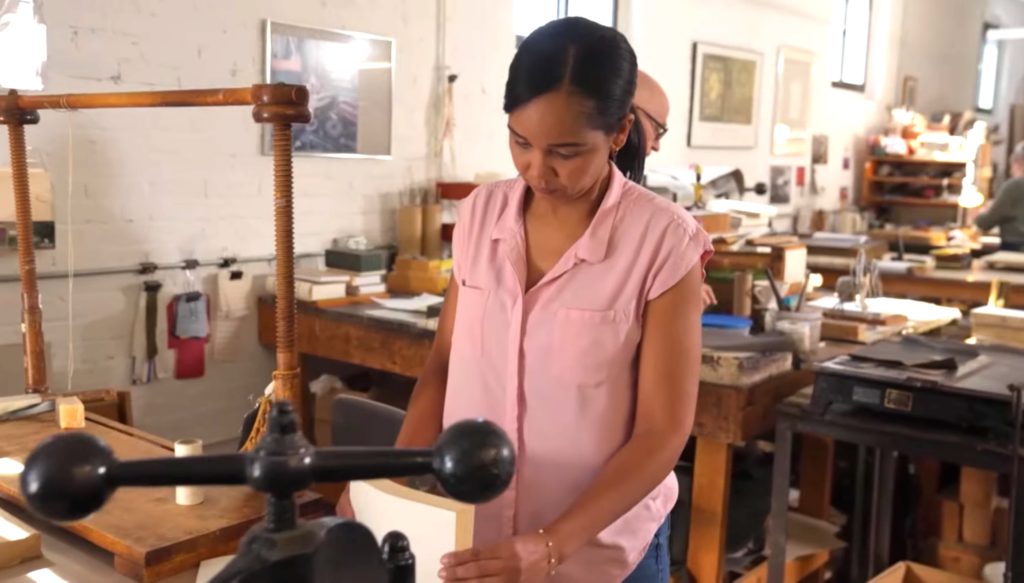
The segment’s framing of the Harcourt Bindery as an enterprise dedicated to counteracting mass production captures something essential about what the work means today. Mass production has its undeniable virtues. It has made books, in their most basic form, available at prices and in quantities no eighteenth-century reader could have imagined, and the diffusion of the printed word that has followed is among the great achievements of the modern world. But mass production has also produced a particular kind of book: one assembled by machine from materials chosen for cost rather than longevity, one that begins to fall apart as soon as it is read more than a few times, one to which no individual hand has been applied between the manufacturer and the reader.
The hand-bound book is a deliberate refusal of every step in that process. Its leaves are sewn rather than glued, its boards are covered in materials chosen to last centuries rather than seasons, and its binding is the work of a single set of hands from first stitch to final stamping. The labor is slow and the result is expensive, but the object that emerges is built to outlive its maker by a considerable margin. The standard against which it is measured is not next quarter’s catalog but the bindings of a century or two ago, which still sit unblemished on the shelves of every great library and which are still serviceable enough to read.
This is what the Made With Love segment captures, and why the PBS production was right to include Harcourt in a series devoted to America’s enduring traditions. The bindery does not exist to keep an old craft alive as a curiosity. It exists because the work it does cannot be done any other way, and because the books that matter most – the first editions of the founding era, the association copies that pass through scholars’ and collectors’ hands, the family records that are meant to survive into the next century – depend on its survival.
Counteracting Mass Production
The segment’s framing of the Harcourt Bindery as an enterprise dedicated to counteracting mass production captures something essential about what the work means today. Mass production has its undeniable virtues. It has made books, in their most basic form, available at prices and in quantities no eighteenth-century reader could have imagined, and the diffusion of the printed word that has followed is among the great achievements of the modern world. But mass production has also produced a particular kind of book: one assembled by machine from materials chosen for cost rather than longevity, one that begins to fall apart as soon as it is read more than a few times, one to which no individual hand has been applied between the manufacturer and the reader.
The hand-bound book is a deliberate refusal of every step in that process. Its leaves are sewn rather than glued, its boards are covered in materials chosen to last centuries rather than seasons, and its binding is the work of a single set of hands from first stitch to final stamping. The labor is slow and the result is expensive, but the object that emerges is built to outlive its maker by a considerable margin. The standard against which it is measured is not next quarter’s catalog but the bindings of a century or two ago, which still sit unblemished on the shelves of every great library and which are still serviceable enough to read.
This is what the Made With Love segment captures, and why the PBS production was right to include Harcourt in a series devoted to America’s enduring traditions. The bindery does not exist to keep an old craft alive as a curiosity. It exists because the work it does cannot be done any other way, and because the books that matter most – the first editions of the founding era, the association copies that pass through scholars’ and collectors’ hands, the family records that are meant to survive into the next century – depend on its survival.
 An Anniversary, an Inheritance
The 250th anniversary of American independence has occasioned a great deal of public attention to the documents and figures of the founding era, and rightly so. At Raptis Rare Books we are observing the moment with our own America 250 exhibition, gathering works that bear directly on the story the country is celebrating – a first edition of The Federalist Papers, a sixteen-page autograph letter of John Adams, documents signed by Jefferson, Hamilton, Hancock, and Lincoln, the Rembrandt Peale portrait of George Washington, and the rare association volumes that connect us most tangibly to the men who built the republic.
That work and the work of the bindery belong to the same enterprise. Both depend on the conviction that the past is not a sealed chapter but a physical inheritance, transmitted in objects that have to be cared for if they are to be passed along. A document signed by Hamilton needs to be housed properly. A first edition in the original boards needs to be conserved, not rebound. A great library, public or private, depends on a tradition of skilled hands that knows how to keep books bound, lettered, boxed, and intact across the generations. The PBS special grasps this in a way that documentary television rarely does, and it is no accident that the program’s portrait of America at 250 turns, repeatedly, toward the workshops where the country’s craft traditions are still being practiced.
An Anniversary, an Inheritance
The 250th anniversary of American independence has occasioned a great deal of public attention to the documents and figures of the founding era, and rightly so. At Raptis Rare Books we are observing the moment with our own America 250 exhibition, gathering works that bear directly on the story the country is celebrating – a first edition of The Federalist Papers, a sixteen-page autograph letter of John Adams, documents signed by Jefferson, Hamilton, Hancock, and Lincoln, the Rembrandt Peale portrait of George Washington, and the rare association volumes that connect us most tangibly to the men who built the republic.
That work and the work of the bindery belong to the same enterprise. Both depend on the conviction that the past is not a sealed chapter but a physical inheritance, transmitted in objects that have to be cared for if they are to be passed along. A document signed by Hamilton needs to be housed properly. A first edition in the original boards needs to be conserved, not rebound. A great library, public or private, depends on a tradition of skilled hands that knows how to keep books bound, lettered, boxed, and intact across the generations. The PBS special grasps this in a way that documentary television rarely does, and it is no accident that the program’s portrait of America at 250 turns, repeatedly, toward the workshops where the country’s craft traditions are still being practiced.
 What the Cameras Found
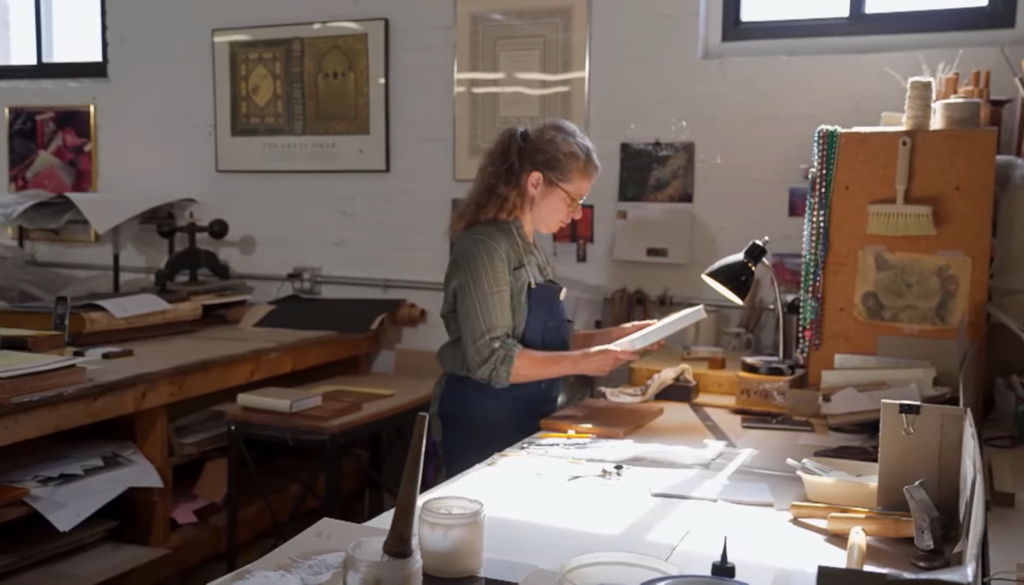
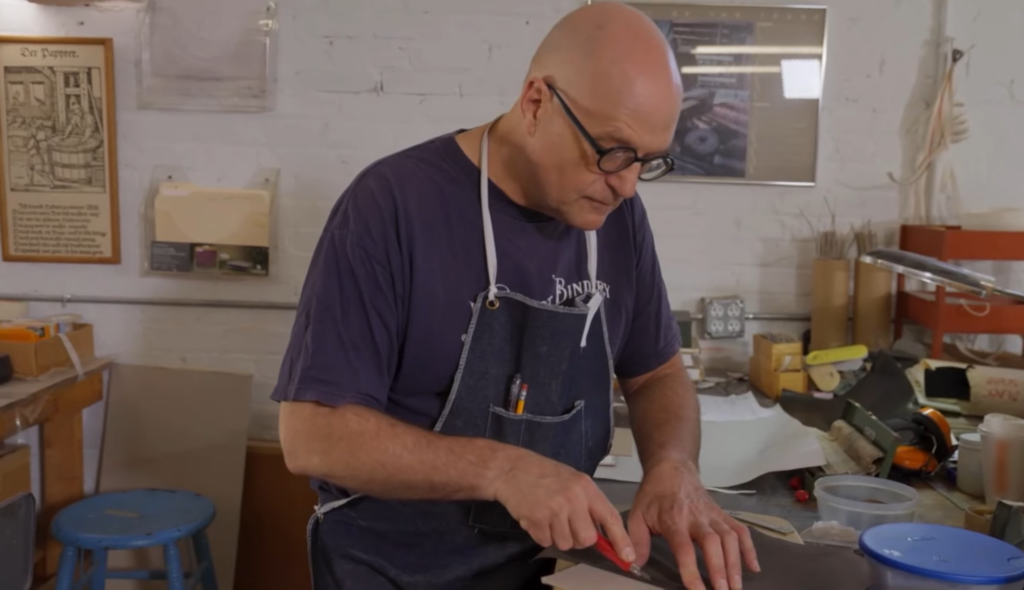
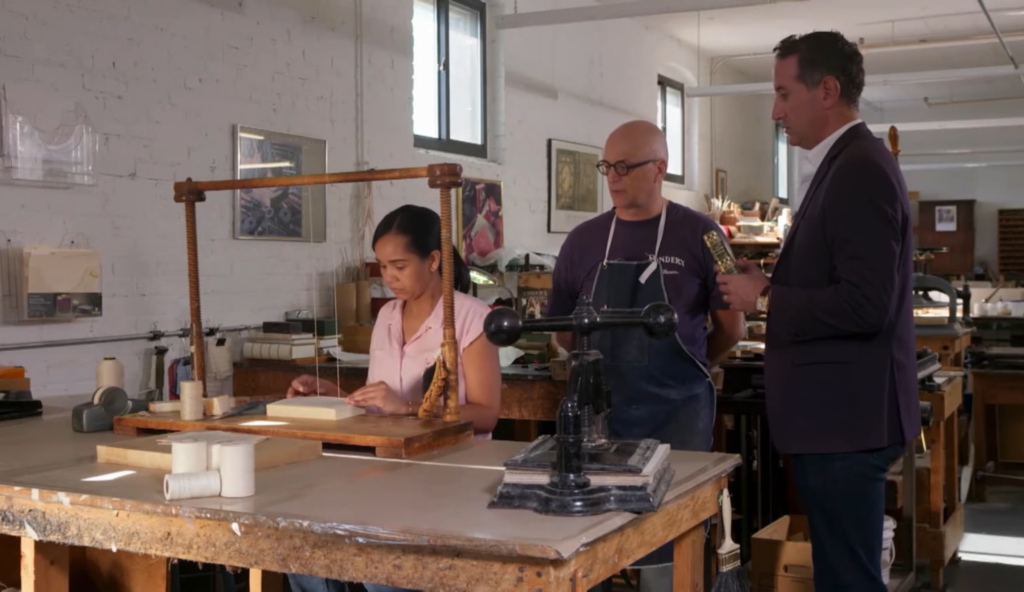
Visitors to the Harcourt Bindery, whether on television or in person, find a working shop rather than a stage set. A small team of binders works in concentrated quiet on the tables along the windows; a wall of leathers in every weight and hue stands ready for the next commission; the smells of beeswax, paste, and tanned hide carry across the room as they have for more than a hundred years. Some of the books in process are humble – the kind of municipal ledger that, by executive order, must still be hand-bound and shelved in a county clerk’s office. Others are rare editions destined to sit beside fires and behind glass, finished in goatskin, lettered in gold, and protected in custom clamshell boxes built to outlast every reader who will ever open them.
What unites the work is that every book leaves the shop better protected, better presented, and better positioned to survive than it arrived. That is the answer the bindery offers to the question PBS’s series asks. America at 250 looks, in Made With Love, less like a slogan than a workshop, and the workshops are still here.
What the Cameras Found
Visitors to the Harcourt Bindery, whether on television or in person, find a working shop rather than a stage set. A small team of binders works in concentrated quiet on the tables along the windows; a wall of leathers in every weight and hue stands ready for the next commission; the smells of beeswax, paste, and tanned hide carry across the room as they have for more than a hundred years. Some of the books in process are humble – the kind of municipal ledger that, by executive order, must still be hand-bound and shelved in a county clerk’s office. Others are rare editions destined to sit beside fires and behind glass, finished in goatskin, lettered in gold, and protected in custom clamshell boxes built to outlast every reader who will ever open them.
What unites the work is that every book leaves the shop better protected, better presented, and better positioned to survive than it arrived. That is the answer the bindery offers to the question PBS’s series asks. America at 250 looks, in Made With Love, less like a slogan than a workshop, and the workshops are still here.
 We are grateful to PBS, to Symbio Studios, and to the producers of Celebrating America 250: Made With Love for turning a national audience toward Charlestown, and for understanding that the binder’s bench is one of the places where the founding traditions of the country are kept alive. The work continues, one book at a time.
More blogs on Harcourt Bindery:
Inside the Ancient Art of Bookbinding: How Harcourt Bindery Gives Rare Books New Life.
In the News: Harcourt Bindery Featured on CBS News.
In the News: Harcourt Book Bindery in Charlestown Preserving Craft for 125 Years.
Explore more of Harcourt Bindery
We are grateful to PBS, to Symbio Studios, and to the producers of Celebrating America 250: Made With Love for turning a national audience toward Charlestown, and for understanding that the binder’s bench is one of the places where the founding traditions of the country are kept alive. The work continues, one book at a time.
More blogs on Harcourt Bindery:
Inside the Ancient Art of Bookbinding: How Harcourt Bindery Gives Rare Books New Life.
In the News: Harcourt Bindery Featured on CBS News.
In the News: Harcourt Book Bindery in Charlestown Preserving Craft for 125 Years.
Explore more of Harcourt Bindery
Browse our current collection of books finely bound by the Harcourt Bindery
On May 14, 2026, Raptis Rare Books and Churchill Cigar Company had the extraordinary privilege of hosting legendary musician, musical director, and rock icon Mark Rivera for an…
Read moreMay 18, 2026 BY VALERIE STAGGS FLORIDA WEEKLY CORRESPONDENT Inside Raptis Rare Book Store on Worth Avenue, stacks of FOX News Commentator Dana Perino’s new book, “Purple…
Read moreIn April 2026, the CBS affiliate WBZ-TV turned its cameras on a subject that might seem, at first glance, an unlikely candidate for a lifestyle feature: a modest…
Read more