Inside the Ancient Art of Bookbinding: How Harcourt Bindery Gives Rare Books New Life.
In April 2026, the CBS affiliate WBZ-TV turned its cameras on a subject that might seem, at first glance, an unlikely candidate for a lifestyle feature: a modest workshop in Charlestown, Massachusetts, where books are still sewn, rounded, backed, and tooled entirely by hand. The segment, produced for the station’s New England Living series and reported by Rachel Holt, carried a quietly provocative title – Bookbinding finds new life at Harcourt Bindery in Charlestown – and it found, in a craft most people assume long extinct, something unexpectedly current.
That a television feature should describe an ancient art as finding “new life” is itself worth pausing over. We live in an age in which the word “book” increasingly denotes a file rather than an object – something summoned to a screen, stored in a cloud, and never touched. Against that backdrop, the Harcourt Bindery is not a museum piece but a working enterprise, and the CBS report captured precisely why it endures. Visiting the studio, Holt observed how, at Harcourt, a deep respect for history drives a passion for perfection. That single phrase explains a great deal about why hand bookbinding still matters, and why the people who care about books most are not abandoning the physical object but returning to it.
Hand bookbinding evolved alongside human communication, transitioning from scrolls and early stitched codices in the ancient world to the revered artisan craft still practiced today. The core techniques established thousands of years ago remain foundational to modern book construction.
A Craft as Old as the Book Itself
Bookbinding is not an accessory to the history of the book. It is, in a real sense, what made the book possible. For most of antiquity, the written word traveled on the scroll, a continuous roll of papyrus that had to be unwound to be read and rewound to be stored. The transformation came with the codex: gatherings of folded leaves, sewn together along one edge and protected by covers. This was the form that allowed a reader to turn directly to a passage, to annotate margins, to hold an entire text in one hand. Nearly every book printed since has been, structurally, a descendant of that innovation.
Through the medieval centuries, the binding of books was the work of monastic scriptoria, where leaves of vellum were sewn onto raised cords, laced into heavy wooden boards, and covered in tanned leather. Such bindings were built to survive. The clasps that held them shut were not decoration but engineering, designed to keep the parchment from drawing damp and warping. When the printing press arrived in the fifteenth century and the number of books multiplied beyond anything the medieval world had imagined, the binder’s trade multiplied with it. Binding became a profession in its own right, organized into guilds, with distinct national styles and a vocabulary of decoration – gold tooling, blind stamping, marbled papers – that a knowledgeable eye can still read like a signature.
The decisive break came in the nineteenth century. Industrialization introduced the publisher’s case binding: covers produced separately from the text block, mass-manufactured in cloth, and affixed by machine. For the first time, books arrived from the publisher already bound and ready for sale, rather than being sold as loose sheets for the purchaser to have bound to taste. This was a democratizing change, and it is the reason the “original cloth” of a Victorian first edition is so significant to collectors today. But it also meant that hand binding, once universal, became a specialized craft – reserved for fine editions, for rebinding treasured texts, and for the conservation of books whose value warranted individual attention. That is the tradition the Harcourt Bindery has carried, without interruption, for more than a century.
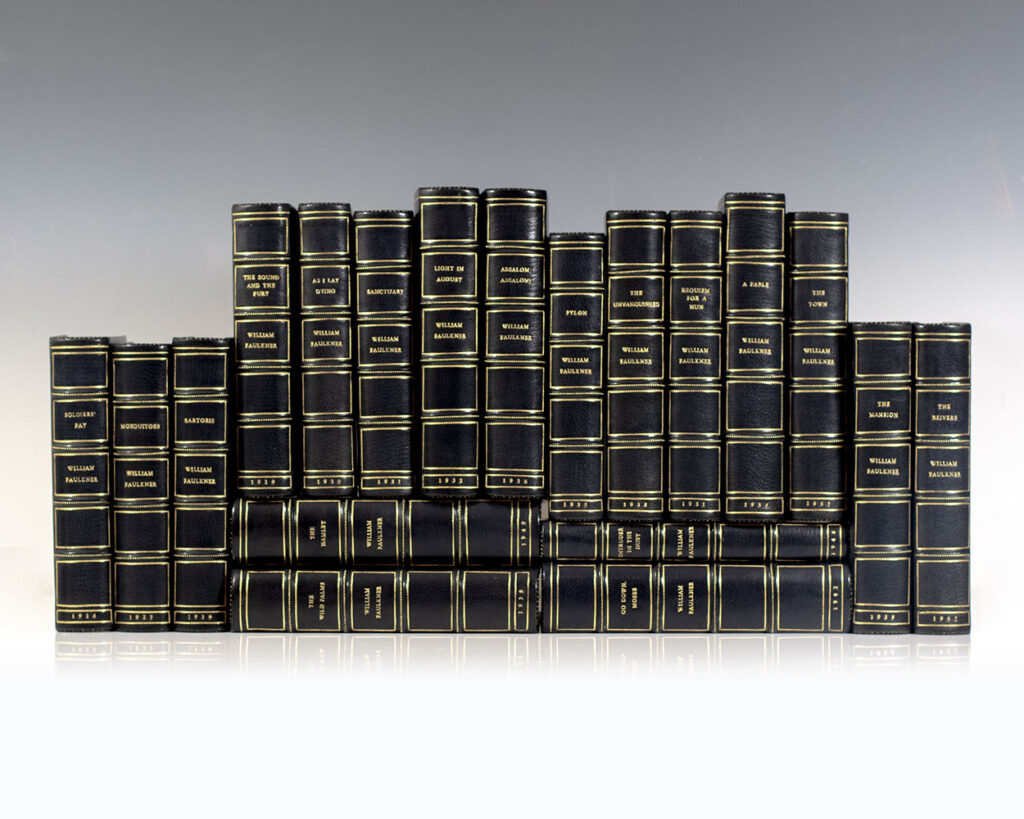
First Editions of Each Novel By William Faulkner; Finely Bound by The Harcourt BinderyCharlestown’s Living Workshop
The Harcourt Bindery has been binding books by hand since 1900. Housed today in a repurposed Charlestown warehouse, it is widely regarded as the oldest traditional hand bookbindery in the United States, and among the largest devoted exclusively to fine binding done by hand rather than by machine. In 2025 the firm marked its 125th anniversary – a span that reaches from the age of the horse-drawn delivery wagon to the age of the e-reader, and through which the essential motions of the craft have changed remarkably little.
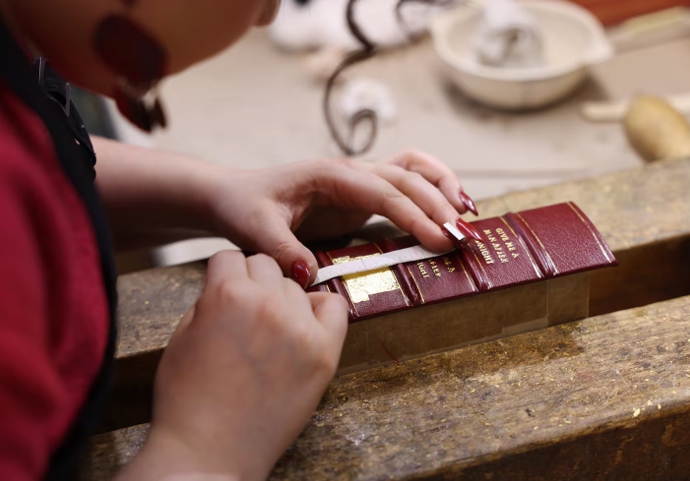
Walk into the workshop and the first thing one notices is the near-total absence of the digital. The tools on the benches are, in many cases, as old as the company itself. Type is set by hand for the gold-stamped lettering of a spine. Leather is pared with a knife to a precise thinness so that it will turn cleanly over a board. Sewing frames, finishing presses, and brass tools worn smooth by a century of use do the work that no machine has ever done as well. The bindery’s craftspeople learn their trade slowly, often through apprenticeship and through programs such as Boston’s North Bennet Street School, one of the few institutions in the country still teaching the discipline at a professional level. Skilled binders are scarce, and each one represents years of accumulated judgment that cannot be downloaded or automated.
For Raptis Rare Books, this is not a distant subject. In 2022, Adrienne and Matthew Raptis acquired the Harcourt Bindery, drawn by a conviction that the preservation of bookbinding as a living craft is inseparable from the work of dealing in rare books at all. A first edition is an artifact; keeping it sound, and sometimes giving it the binding its importance deserves, requires hands that know how. The CBS feature, in turning its attention to Charlestown, documented something we see every day: that the future of the physical book depends on a small number of people willing to keep an old skill alive.
Explore more of Harcourt Bindery
In the spring of 2026, PBS’s Emmy Award-winning Made With Love series turned its attention to a question that has rarely felt more timely: in a country marking the 250th…
On May 14, 2026, Raptis Rare Books and Churchill Cigar Company had the extraordinary privilege of hosting legendary musician, musical director, and rock icon Mark Rivera for an…
May 18, 2026 BY VALERIE STAGGS FLORIDA WEEKLY CORRESPONDENT Inside Raptis Rare Book Store on Worth Avenue, stacks of FOX News Commentator Dana Perino’s new book, “Purple…
Join our growing list of satisfied clients who have leveraged
our multi-cloud and hybrid cloud strategies to achieve greater
agility and efficiency in their operations.

 Through the medieval centuries, the binding of books was the work of monastic scriptoria, where leaves of vellum were sewn onto raised cords, laced into heavy wooden boards, and covered in tanned leather. Such bindings were built to survive. The clasps that held them shut were not decoration but engineering, designed to keep the parchment from drawing damp and warping. When the printing press arrived in the fifteenth century and the number of books multiplied beyond anything the medieval world had imagined, the binder’s trade multiplied with it. Binding became a profession in its own right, organized into guilds, with distinct national styles and a vocabulary of decoration – gold tooling, blind stamping, marbled papers – that a knowledgeable eye can still read like a signature.
The decisive break came in the nineteenth century. Industrialization introduced the publisher’s case binding: covers produced separately from the text block, mass-manufactured in cloth, and affixed by machine. For the first time, books arrived from the publisher already bound and ready for sale, rather than being sold as loose sheets for the purchaser to have bound to taste. This was a democratizing change, and it is the reason the “original cloth” of a Victorian first edition is so significant to collectors today. But it also meant that hand binding, once universal, became a specialized craft – reserved for fine editions, for rebinding treasured texts, and for the conservation of books whose value warranted individual attention. That is the tradition the Harcourt Bindery has carried, without interruption, for more than a century.
Through the medieval centuries, the binding of books was the work of monastic scriptoria, where leaves of vellum were sewn onto raised cords, laced into heavy wooden boards, and covered in tanned leather. Such bindings were built to survive. The clasps that held them shut were not decoration but engineering, designed to keep the parchment from drawing damp and warping. When the printing press arrived in the fifteenth century and the number of books multiplied beyond anything the medieval world had imagined, the binder’s trade multiplied with it. Binding became a profession in its own right, organized into guilds, with distinct national styles and a vocabulary of decoration – gold tooling, blind stamping, marbled papers – that a knowledgeable eye can still read like a signature.
The decisive break came in the nineteenth century. Industrialization introduced the publisher’s case binding: covers produced separately from the text block, mass-manufactured in cloth, and affixed by machine. For the first time, books arrived from the publisher already bound and ready for sale, rather than being sold as loose sheets for the purchaser to have bound to taste. This was a democratizing change, and it is the reason the “original cloth” of a Victorian first edition is so significant to collectors today. But it also meant that hand binding, once universal, became a specialized craft – reserved for fine editions, for rebinding treasured texts, and for the conservation of books whose value warranted individual attention. That is the tradition the Harcourt Bindery has carried, without interruption, for more than a century.