Where Modern Fantasy Began: Tolkien’s Signed 1937 Hobbit.
In 1937, a quiet revolution in storytelling began. George Allen & Unwin published a small book by an Oxford professor—The Hobbit, or There and Back Again—in a modest print run of only 1,500 copies. Every copy sold out within three months. Few could have predicted that this unassuming children’s story would redefine an entire literary genre.
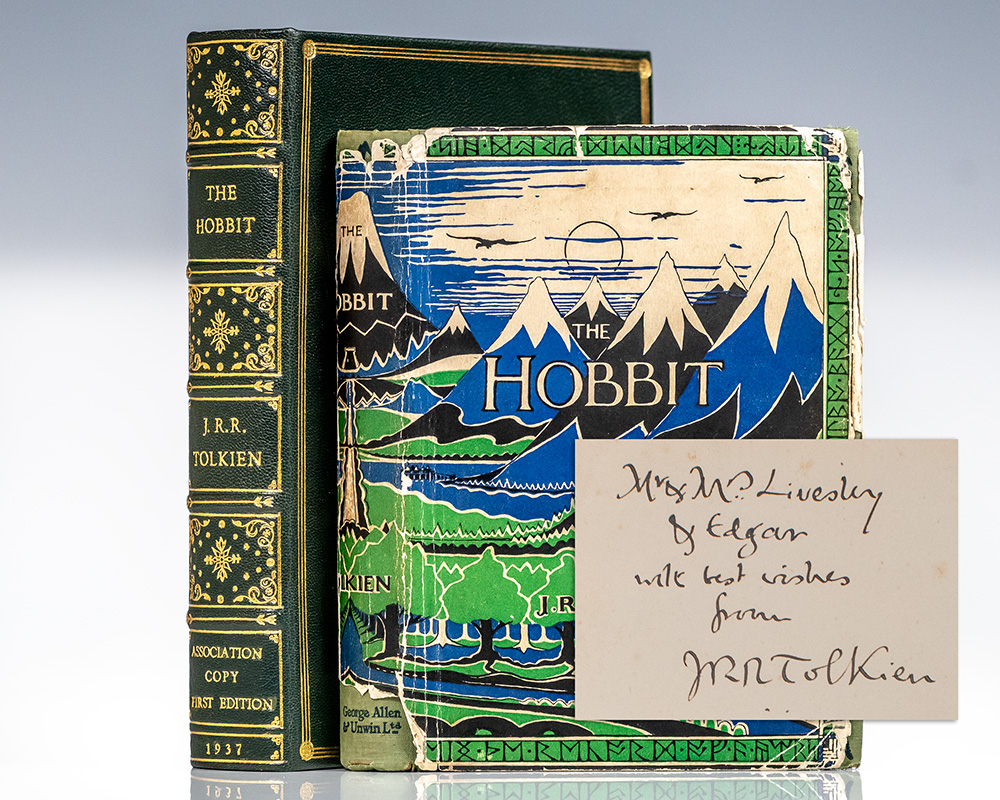
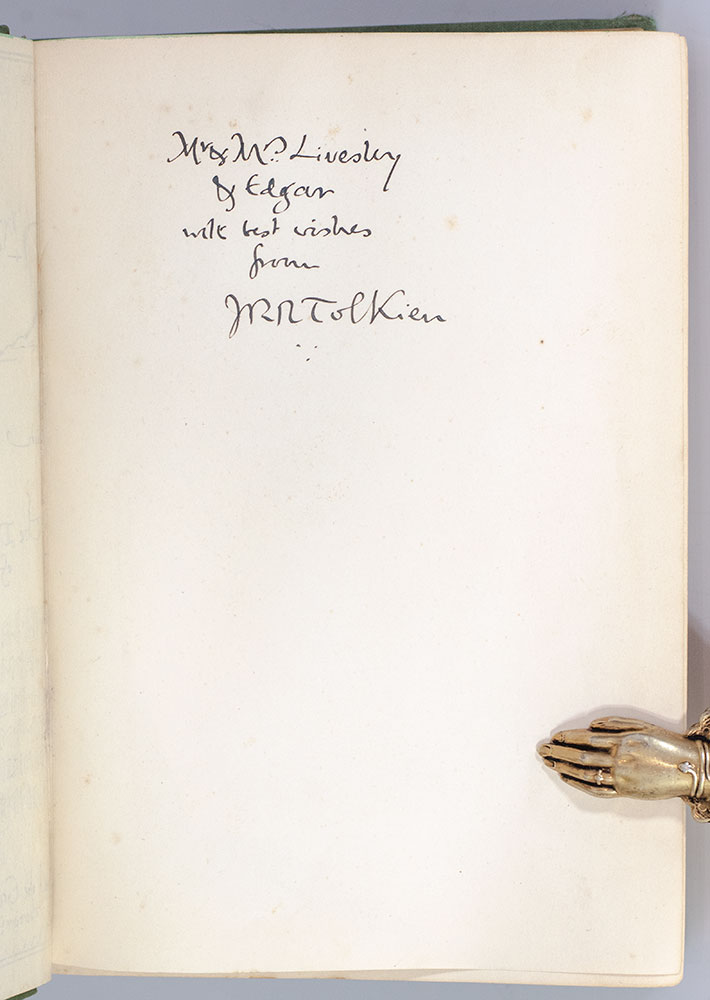
The volume offered here is one of those original 1,500 copies. Even more remarkably, it bears the signature of J. R. R. Tolkien himself, placing it among only a handful of known signed first editions in existence.
First edition, first issue of The Hobbit; inscribed by J.R.R. Tolkien to the Livesleys
The Birth of Modern Fantasy
Before The Hobbit, fantasy fiction largely occupied the margins of literature—whimsical, allegorical, and rarely afforded serious critical attention. Tolkien changed that. Drawing upon his deep expertise in philology and medieval myth, he constructed a fully realized “secondary world” complete with its own languages, histories, cultures, and geography.
Through the reluctant journey of Bilbo Baggins, Tolkien demonstrated that fantasy could sustain narrative realism as convincingly as any contemporary novel. Adventure became a vehicle for moral inquiry; myth carried intellectual depth. In doing so, Tolkien bridged the imaginative with the profound.
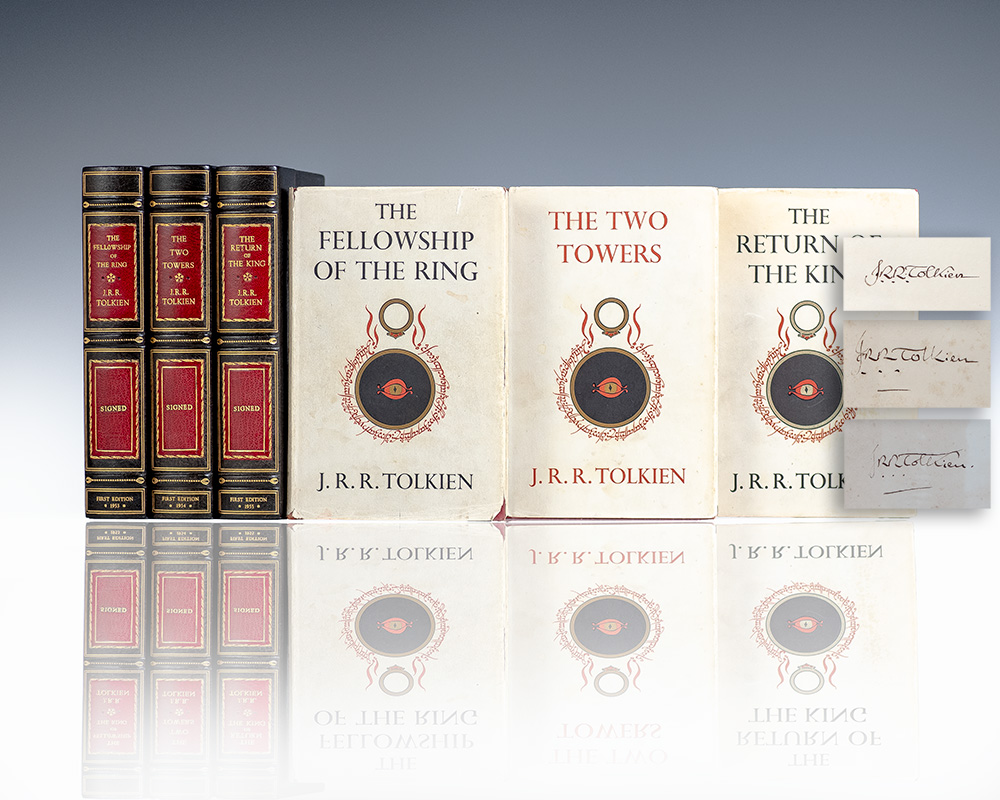
First editions, first states of each title comprising the The Lord of the Rings Trilogy; all three signed by J.R.R. Tolkien
A Turning Point in Literary History
The publication of The Hobbit marked a decisive turning point. What began as a children’s tale soon became the foundation for a far greater legendarium—culminating in The Lord of the Rings and reshaping imaginative literature for generations to come.
Tolkien’s success legitimized modern fantasy, proving that myth could once again serve as a vehicle for truth, heroism, and enduring human questions. Entire worlds of contemporary fantasy trace their lineage to this single, slender volume published in 1937.
A Material Witness to Literary Transformation
A signed first edition of The Hobbit is far more than a collectible rarity. It is a tangible artifact from the moment imaginative fiction claimed its place within serious literature. It stands at the origin of Middle-earth—and at the birth of modern fantasy itself.
For collectors and admirers of literary history, few books offer such a direct connection to a transformative cultural moment. This extraordinary copy of The Hobbit is available to view and purchase in our Worth Avenue gallery and on our website, RaptisRareBooks.com.
In an era defined by data—by texts sent in milliseconds, videos streamed across continents, and algorithms shaping daily life—it is easy to forget that the digital age rests…
In February of 1798, as the young American republic stood in a period of mounting political anxiety, Elkanah Watson sent a small book to Mount Vernon. Inside, on…
In the study of rare books, age alone is seldom the decisive measure of significance. Far more consequential is provenance — the documented history of ownership that situates…
Join our growing list of satisfied clients who have leveraged
our multi-cloud and hybrid cloud strategies to achieve greater
agility and efficiency in their operations.