
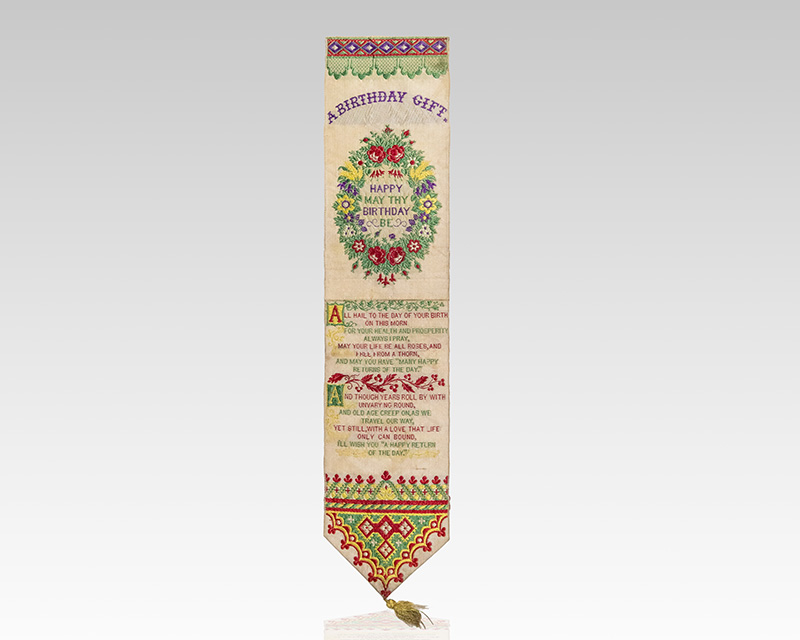
Stevengraph Bookmark "A Birthday Gift."
We're sorry, this item has sold.
+$450
"May your life be all roses, and free from a thorn": Rare Stevengraph Bookmark Titled "A Birthday Gift"
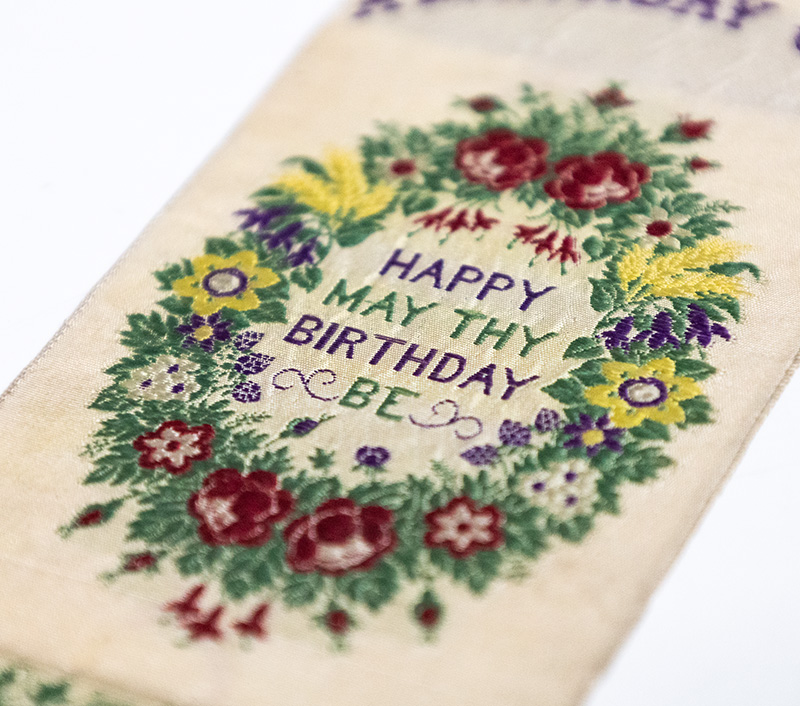
Rare Stevengraph bookmark titled "A Birthday Gift." Jacquard-woven from silk with "A Birthday Gift" in decorative letters at the top above a floral wreath, a 16 line poem to the lower half, colorful detailing, circa 1876. In near fine condition. The piece measures 2.25 inches by 9.5 inches.
Stevengraphs are small pictures woven in silk using the Jacquard loom process, produced and popularized by Thomas Stevens (1828–1888) of Coventry, England, beginning in the early 1860s and reaching the peak of their commercial and cultural prominence during the 1870s and 1880s. Stevens, a ribbon weaver by trade who had spent years perfecting the technical possibilities of the Jacquard loom — a mechanized weaving system capable of producing complex pictorial designs through a sequence of punch cards — first exhibited his silk woven pictures at the York Exhibition of 1879, where they attracted immediate public enthusiasm and launched what would become a thriving cottage industry of decorative textile art. The subjects depicted ranged widely: sporting scenes, portraits of political and military figures, religious imagery, historical events, and commemorative subjects — among them a substantial series produced for the American market in connection with the 1876 Philadelphia Centennial Exhibition, where Stevengraphs proved enormously popular with visitors seeking decorative souvenirs that combined technical novelty with patriotic sentiment. Produced in both bookmark and mounted picture formats, they were affordable, visually striking, and technically remarkable — the Jacquard process permitted a fidelity of pictorial detail in woven silk that contemporaries found genuinely astonishing. After Stevens's death in 1888 the firm continued production under his sons, and Stevengraphs were manufactured in various forms until the Coventry factory was destroyed in the German bombing raids of 1940. Today they are actively collected as artifacts of Victorian decorative art and industrial craft history.
Stevengraph Bookmark "A Birthday Gift."
Out of Stock