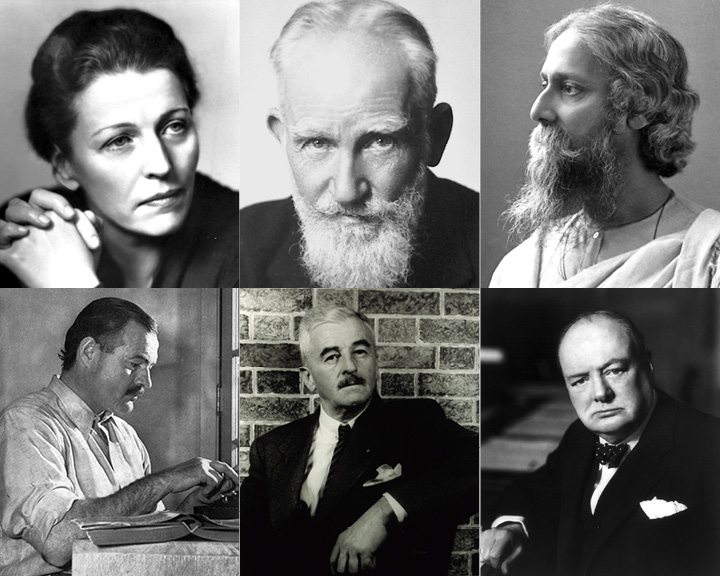
Nobel Prize in Literature Laureates Pearl S. Buck, George Bernard Shaw, Rabindranath Tagore, Ernest Hemingway, William Faulkner, and Winston S. Churchill
Awarded annually since 1901, The Nobel Prize in Literature is given to any author “in the field of literature the most outstanding work in an ideal direction” (Alfred Nobel). One of five Nobel Prizes established by Alfred Nobel and awarded by the Swedish Academy, laureates of the Nobel Prize in Literature include William Faulkner, Albert Camus, Ernest Hemingway, Gabriel García Márquez, Toni Morrison, and most recently Kazuo Ishiguro.
Below is a list of Nobel Prize Laureates in Literature currently in our collection with links to their works:
The Nobel Prize in Literature 2016 Bob Dylan “for having created new poetic expressions within the great American song tradition”
The Nobel Prize in Literature 2014 Patrick Modiano “for the art of memory with which he has evoked the most ungraspable human destinies and uncovered the life-world of the occupation”
The Nobel Prize in Literature 2013 Alice Munro “master of the contemporary short story”
The Nobel Prize in Literature 2012 Mo Yan “who with hallucinatory realism merges folk tales, history and the contemporary”
The Nobel Prize in Literature 2010 Mario Vargas Llosa “for his cartography of structures of power and his trenchant images of the individual’s resistance, revolt, and defeat”
The Nobel Prize in Literature 2009 Herta Müller “who, with the concentration of poetry and the frankness of prose, depicts the landscape of the dispossessed”
The Nobel Prize in Literature 2008 Jean-Marie Gustave Le Clézio “author of new departures, poetic adventure and sensual ecstasy, explorer of a humanity beyond and below the reigning civilization”
The Nobel Prize in Literature 2007 Doris Lessing “that epicist of the female experience, who with scepticism, fire and visionary power has subjected a divided civilisation to scrutiny”
The Nobel Prize in Literature 2006 Orhan Pamuk “who in the quest for the melancholic soul of his native city has discovered new symbols for the clash and interlacing of cultures”
The Nobel Prize in Literature 2005 Harold Pinter “who in his plays uncovers the precipice under everyday prattle and forces entry into oppression’s closed rooms”
The Nobel Prize in Literature 2004 Elfriede Jelinek “for her musical flow of voices and counter-voices in novels and plays that with extraordinary linguistic zeal reveal the absurdity of society’s clichés and their subjugating power”
The Nobel Prize in Literature 2003 John M. Coetzee “who in innumerable guises portrays the surprising involvement of the outsider”
The Nobel Prize in Literature 2002 Imre Kertész “for writing that upholds the fragile experience of the individual against the barbaric arbitrariness of history”
The Nobel Prize in Literature 2001 Sir Vidiadhar Surajprasad Naipaul “for having united perceptive narrative and incorruptible scrutiny in works that compel us to see the presence of suppressed histories”
The Nobel Prize in Literature 2000 Gao Xingjian “for an æuvre of universal validity, bitter insights and linguistic ingenuity, which has opened new paths for the Chinese novel and drama”
The Nobel Prize in Literature 1999 Günter Grass “whose frolicsome black fables portray the forgotten face of history”
The Nobel Prize in Literature 1998 José Saramago “who with parables sustained by imagination, compassion and irony continually enables us once again to apprehend an elusory reality”
The Nobel Prize in Literature 1997 Dario Fo “who emulates the jesters of the Middle Ages in scourging authority and upholding the dignity of the downtrodden”
The Nobel Prize in Literature 1996 Wislawa Szymborska “for poetry that with ironic precision allows the historical and biological context to come to light in fragments of human reality”
The Nobel Prize in Literature 1995 Seamus Heaney “for works of lyrical beauty and ethical depth, which exalt everyday miracles and the living past”
The Nobel Prize in Literature 1993 Toni Morrison “who in novels characterized by visionary force and poetic import, gives life to an essential aspect of American reality”
The Nobel Prize in Literature 1992 Derek Walcott “for a poetic oeuvre of great luminosity, sustained by a historical vision, the outcome of a multicultural commitment”
The Nobel Prize in Literature 1991 Nadine Gordimer “who through her magnificent epic writing has – in the words of Alfred Nobel – been of very great benefit to humanity”
The Nobel Prize in Literature 1989 Camilo José Cela “for a rich and intensive prose, which with restrained compassion forms a challenging vision of man’s vulnerability”
The Nobel Prize in Literature 1988 Naguib Mahfouz “who, through works rich in nuance – now clear-sightedly realistic, now evocatively ambiguous – has formed an Arabian narrative art that applies to all mankind”
The Nobel Prize in Literature 1986 Wole Soyinka “who in a wide cultural perspective and with poetic overtones fashions the drama of existence”
The Nobel Prize in Literature 1985 Claude Simon “who in his novel combines the poet’s and the painter’s creativeness with a deepened awareness of time in the depiction of the human condition”
The Nobel Prize in Literature 1983 William Golding “for his novels which, with the perspicuity of realistic narrative art and the diversity and universality of myth, illuminate the human condition in the world of today”
The Nobel Prize in Literature 1982 Gabriel García Márquez “for his novels and short stories, in which the fantastic and the realistic are combined in a richly composed world of imagination, reflecting a continent’s life and conflicts”
The Nobel Prize in Literature 1981 Elias Canetti “for writings marked by a broad outlook, a wealth of ideas and artistic power”
The Nobel Prize in Literature 1979 Odysseus Elytis “for his poetry, which, against the background of Greek tradition, depicts with sensuous strength and intellectual clear-sightedness modern man’s struggle for freedom and creativeness”
The Nobel Prize in Literature 1978 Isaac Bashevis Singer “for his impassioned narrative art which, with roots in a Polish-Jewish cultural tradition, brings universal human conditions to life”
The Nobel Prize in Literature 1976 Saul Bellow “for the human understanding and subtle analysis of contemporary culture that are combined in his work”
The Nobel Prize in Literature 1973 Patrick White “for an epic and psychological narrative art which has introduced a new continent into literature”
The Nobel Prize in Literature 1971 Pablo Neruda “for a poetry that with the action of an elemental force brings alive a continent’s destiny and dreams”
The Nobel Prize in Literature 1970 Aleksandr Isayevich Solzhenitsyn “for the ethical force with which he has pursued the indispensable traditions of Russian literature”
The Nobel Prize in Literature 1969 Samuel Beckett “for his writing, which – in new forms for the novel and drama – in the destitution of modern man acquires its elevation”
The Nobel Prize in Literature 1963 Giorgos Seferis “for his eminent lyrical writing, inspired by a deep feeling for the Hellenic world of culture”
The Nobel Prize in Literature 1962 John Steinbeck “for his realistic and imaginative writings, combining as they do sympathetic humour and keen social perception”
The Nobel Prize in Literature 1958 Boris Leonidovich Pasternak “for his important achievement both in contemporary lyrical poetry and in the field of the great Russian epic tradition”
The Nobel Prize in Literature 1957 Albert Camus “for his important literary production, which with clear-sighted earnestness illuminates the problems of the human conscience in our times”
The Nobel Prize in Literature 1955 Halldór Kiljan Laxness “for his vivid epic power which has renewed the great narrative art of Iceland”
The Nobel Prize in Literature 1954 Ernest Hemingway “for his mastery of the art of narrative, most recently demonstrated in The Old Man and the Sea, and for the influence that he has exerted on contemporary style”
The Nobel Prize in Literature 1953 Sir Winston Leonard Spencer Churchill “for his mastery of historical and biographical description as well as for brilliant oratory in defending exalted human values”
The Nobel Prize in Literature 1952 François Mauriac “for the deep spiritual insight and the artistic intensity with which he has in his novels penetrated the drama of human life”
The Nobel Prize in Literature 1950 Earl (Bertrand Arthur William) Russell “in recognition of his varied and significant writings in which he champions humanitarian ideals and freedom of thought”
The Nobel Prize in Literature 1949 William Faulkner “for his powerful and artistically unique contribution to the modern American novel”
The Nobel Prize in Literature 1946 Hermann Hesse “for his inspired writings which, while growing in boldness and penetration, exemplify the classical humanitarian ideals and high qualities of style”
The Nobel Prize in Literature 1938 Pearl S. Buck “for her rich and truly epic descriptions of peasant life in China and for her biographical masterpieces”
The Nobel Prize in Literature 1936 Eugene Gladstone O’Neill “for the power, honesty and deep-felt emotions of his dramatic works, which embody an original concept of tragedy”
The Nobel Prize in Literature 1925 George Bernard Shaw “for his work which is marked by both idealism and humanity, its stimulating satire often being infused with a singular poetic beauty”
The Nobel Prize in Literature 1913 Rabindranath Tagore “because of his profoundly sensitive, fresh and beautiful verse, by which, with consummate skill, he has made his poetic thought, expressed in his own English words, a part of the literature of the West”
The Nobel Prize in Literature 1907 Rudyard Kipling “in consideration of the power of observation, originality of imagination, virility of ideas and remarkable talent for narration which characterize the creations of this world-famous author”
[/fusion_text][separator style_type=”double” top_margin=”5″ bottom_margin=”5″ sep_color=”#dda95a” border_size=”” icon=”” icon_circle=”” icon_circle_color=”” width=”” alignment=”center” class=”” id=””][fusion_text]Also, see our list of
In an era defined by data—by texts sent in milliseconds, videos streamed across continents, and algorithms shaping daily life—it is easy to forget that the digital age rests…
In February of 1798, as the young American republic stood in a period of mounting political anxiety, Elkanah Watson sent a small book to Mount Vernon. Inside, on…
In the study of rare books, age alone is seldom the decisive measure of significance. Far more consequential is provenance — the documented history of ownership that situates…
Join our growing list of satisfied clients who have leveraged
our multi-cloud and hybrid cloud strategies to achieve greater
agility and efficiency in their operations.