We’re honored to be featured in today’s Boston Globe article celebrating Harcourt Bindery’s 125th anniversary — the oldest hand bookbindery in America and a proud member of the Raptis Rare Books family.
For over a century, Harcourt has preserved the artistry of traditional hand binding – gilded spines, hand-tooled leather, and meticulous restoration – breathing new life into rare and historic volumes.
At Raptis Rare Books, we’re carrying that legacy forward: uniting fine craftsmanship with literary history, ensuring that the world’s most remarkable books continue to inspire generations to come.
We’re deeply grateful to The Boston Globe for spotlighting this timeless art and our shared commitment to preserving the written word.
Read the full story here: Boston’s Harcourt Bindery turns 125
One for the books: Boston Bindery turns 125
Harcourt Bindery in Charlestown says it’s the oldest in the U.S.
By Hiawatha Bray, The Boston Globe — November 10, 2025
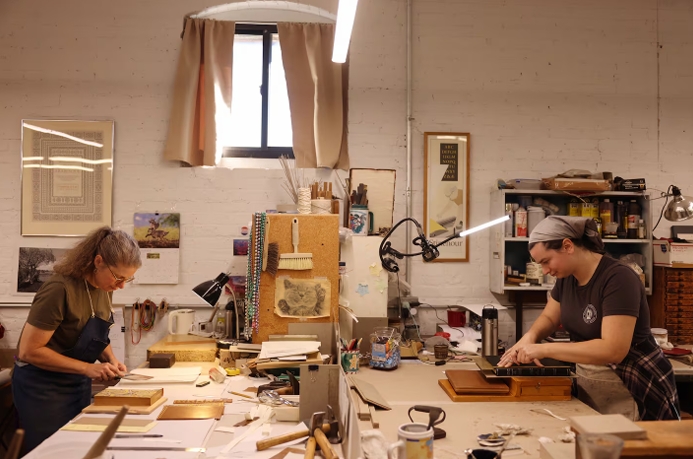
Photo by Jessica Rinaldi / Globe Staff
On a shelf in the Harcourt Bindery sit the kind of books that seem to call for an armchair, a glass of port, and a roaring fire. Bound in leather and decorated with gold leaf, their spines reinforced with hand-sewn stitches, these are ornaments as well as books—rare editions that can sell for hundreds or even thousands of dollars.
At 125 years old, Harcourt claims to be the oldest firm in the United States that binds books entirely by hand. “Everything is hand-tooled at the Harcourt Bindery,” said owner Matthew Raptis. “The whole process is just anachronistic.”
When he was eight years old, Raptis paid $50 for a rare copy of Ulysses Grant’s Memoirs. It was the beginning of a lifelong obsession. A quarter-century ago, he and his wife Adrienne launched Raptis Rare Books in Vermont as a mail-order business. Ten years ago, they moved the company to Palm Beach, Florida, and opened a retail store. All the while, Raptis relied on Harcourt to repair and rebind some of his latest acquisitions before offering them to collectors.
Inside Harcourt’s Charlestown workshop, a handful of artisans create these special volumes one at a time. There are no robots here—only hand tools, many as old as the company itself. If Charles Dickens wandered in, he’d feel right at home.
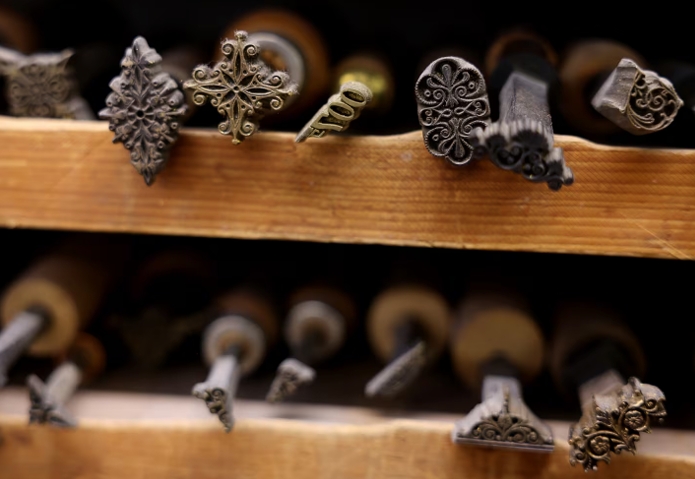
Photo by Jessica Rinaldi / Globe Staff
Ownership of Harcourt has passed through many hands since its founding in 1900. In 2022, Raptis acquired the company, and his stores remain the bindery’s largest customer.
There are no printing presses here—the books are already printed, often decades earlier. Carts in one corner are stacked with “text blocks,” the pages of books stripped of their worn covers.
Jeidy Ryan, a 21-year veteran, stitches pages together by hand at a wooden sewing frame. Frank Jones, 63, compresses the books in a hand-cranked press, pounding the spines into shape with a broad-headed hammer. “I’ll die at my desk, most likely,” he joked.
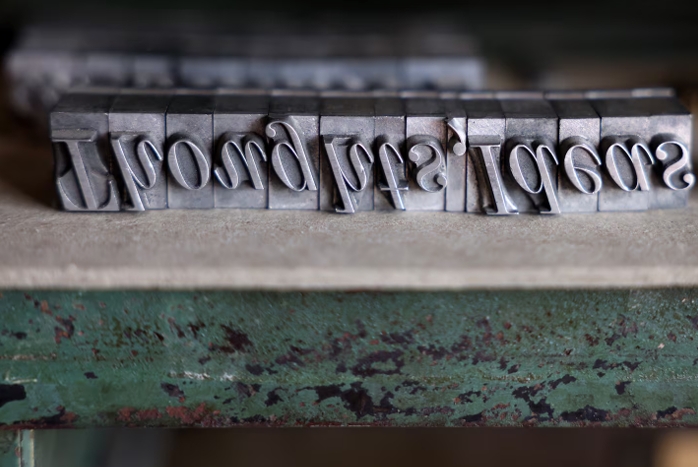
Photo by Jessica Rinaldi / Globe Staff
Later, Jones selects from shelves of calfskin, goat, sheep, and even kangaroo hides, trimming and thinning them by hand. One slip of the knife, and the leather is ruined.
Nearby, Samantha Griglack heats her stamping tools on a small gas stove, pressing letters into spines with sheets of palladium—cheaper than gold, but still precious.
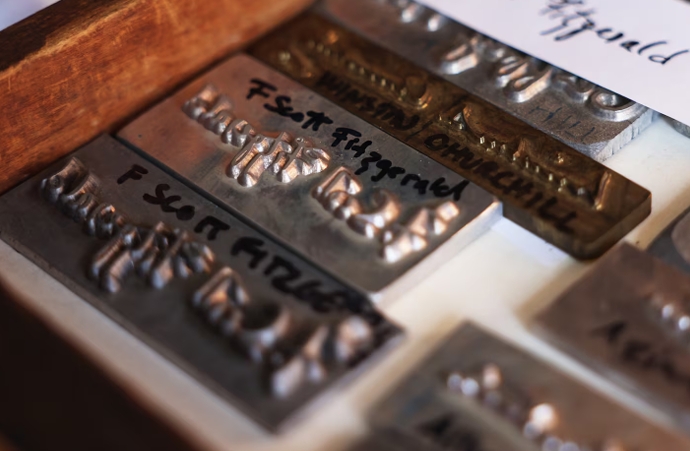
Photo by Jessica Rinaldi / Globe Staff
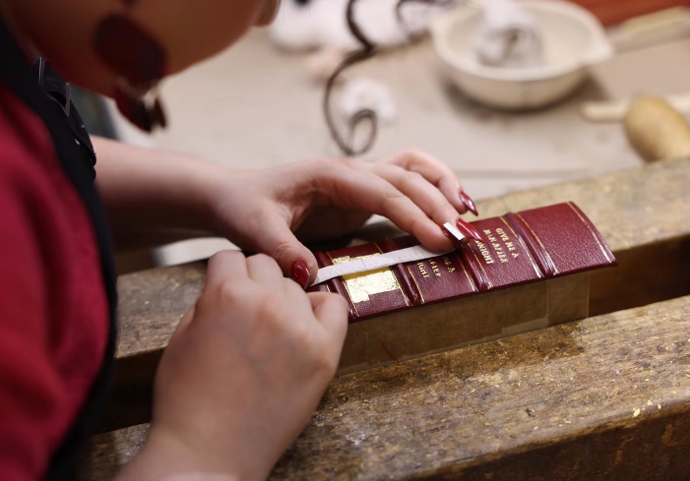
Photo by Jessica Rinaldi / Globe Staff
Their current project: rebinding Delirious New York, a 1978 architectural classic by Harvard’s Rem Koolhaas, in black goatskin and palladium. A first edition can sell for over $3,000.
The markups can be extraordinary. Raptis once resold a Harcourt-bound 19-volume set of William Faulkner’s works—originally made for the author’s daughter—for $350,000.
It costs up to $1,000 to hand-bind a book, but for collectors who prefer to preserve the original covers, Harcourt also makes handcrafted clamshell boxes that mimic fine bindings for around $500 each.
Griglack and new apprentice Francesca Santiago recently crafted three such boxes—one for the libretto of West Side Story and two for early James Bond novels featuring covers by watercolorist Richard Chopping.
Flecks of gold and palladium dust the benches and floor. Every scrap is swept up and sold to Rhode Island’s Pease & Curren, which recovers precious metal. When Harcourt moved shops in the 1970s, they even tore up the old floorboards to reclaim $3,000 worth of gold dust—worth roughly $30,000 today.
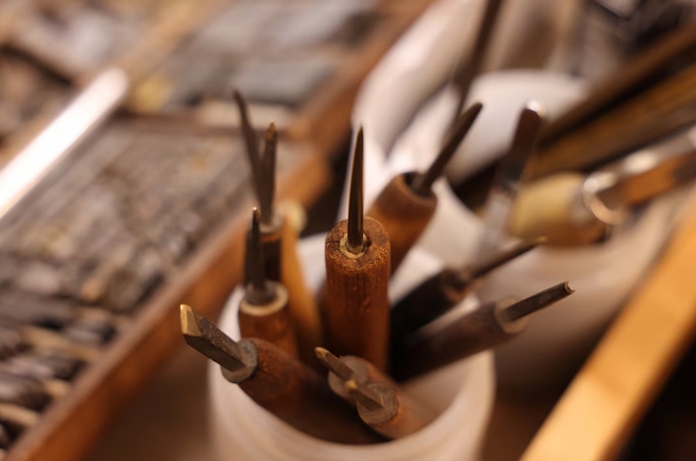
Photo by Jessica Rinaldi / Globe Staff
Beyond supplying Raptis Rare Books, Harcourt serves private collectors, hobbyists, and archivists. It even repairs damaged works, including a 1953 asbestos-bound edition of Ray Bradbury’s Fahrenheit 451—“the most dangerous book I’ve ever handled,” recalls longtime binder Patricia Rosen.
The bindery also owes part of its longevity to a 1990 executive order from Governor Michael Dukakis, requiring vital state records to be bound in books. Many of those sturdy buckram-covered volumes came from Harcourt.
Today, Harcourt employs six artisans and is seeking more. Griglack trained at North Bennet Street School, and the bindery now trains its own apprentices, including Santiago, a recent MassArt graduate.
According to one estimate, the global rare-book market will reach $2 billion this year—enough to keep Harcourt’s time-honored craft thriving for decades to come.