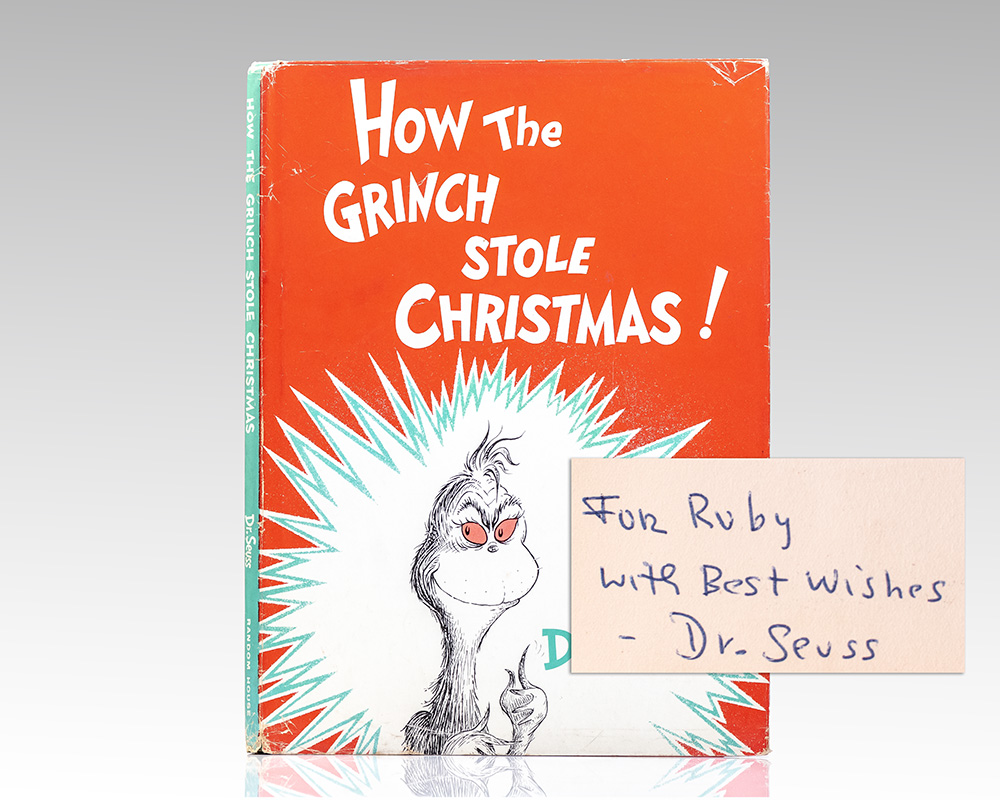
How the Grinch Stole Christmas!: Collecting a Mythical Masterpiece.
In 1957, Dr. Seuss introduced one of the most enduring figures in twentieth-century children’s literature: the Grinch, whose heart was “two sizes too small” until a moment of unexpected moral awakening altered both character and community. What began as a seasonal tale has since assumed the status of modern myth — a narrative of alienation, consumer critique, and redemption embedded within the idiom of mid-century American picture books.
The present volume is a true first edition, first printing of How the Grinch Stole Christmas! All primary bibliographical points are intact: the rear dust jacket advertises fourteen titles in the Cat in the Hat series; thirteen titles are listed on the verso of the half-title; and the original unclipped dust jacket bears the correct price of 250/250. These markers firmly situate the book within its initial 1957 publication state, issued by Random House.
First edition, first printing of How the Grinch Stole Christmas! inscribed by Dr. Seuss
Inscription and Presentation
What distinguishes this copy from the majority of surviving first printings is its inscription. Opposite the title page, Dr. Seuss has written:
“For Ruby With Best Wishes — Dr. Seuss.”
Signed in the year of publication, the inscription transforms the volume from a bibliographical artifact into an association copy — one that bears witness to a moment of personal exchange. Presentation copies of Seuss’s most celebrated works, particularly in the year of issue, are notably scarce in the marketplace. Such copies invite inquiry not only into publication history but also into the author’s social world and the networks through which his books circulated.
Autobiography in Allegory
Beyond its material rarity, How the Grinch Stole Christmas! occupies a significant place in Seuss’s intellectual and creative development. The author later acknowledged that the Grinch originated in a moment of personal introspection. Reflecting on the morning after Christmas, he remarked that he saw “a very Grinch-ish face in the mirror” — recognizing in himself a dissatisfaction or cynicism that the story would ultimately seek to resolve.
The narrative can thus be read as a form of autobiographical allegory. The Grinch’s transformation — catalyzed not by coercion but by the Whos’ communal resilience — reframes Christmas as a phenomenon independent of material consumption. In the context of postwar American prosperity and expanding consumer culture, Seuss’s critique acquires additional resonance. The text negotiates tensions between commerce and meaning, spectacle and sincerity, isolation and belonging.
Dr. Seuss’s classic illustration of The Grinch, from the first edition, first printing of How the Grinch Stole Christmas!
Adaptation and Cultural Afterlife
The Grinch’s migration from page to screen further solidified the work’s cultural authority. The 1966 animated adaptation, directed by Chuck Jones and memorably narrated by Boris Karloff, established the character’s visual and vocal identity for generations. Decades later, the 2000 live-action film starring Jim Carrey reinterpreted the story for a new audience, expanding its narrative scope while reaffirming its core moral structure.
Through these adaptations, the Grinch evolved from literary figure to cultural icon — a seasonal archetype representing both resistance to and reconciliation with communal joy.
Condition and Collectibility
This first edition survives in exceptionally fine condition, with glossy illustrated boards, bright pictorial endpapers, and a near-fine dust jacket. In the field of twentieth-century children’s literature — where books were frequently handled, gifted, and read to pieces — such preservation is itself notable.
For collectors, the convergence of first printing status, superior condition, cultural importance, and a year-of-publication inscription places this volume in a distinct category of desirability. It represents not merely a beloved holiday story, but a primary artifact of American literary and visual culture in the mid-twentieth century.
An original illustration from the first edition, first printing of Dr. Seuss’s How the Grinch Stole Christmas!
The Grinch’s Legacy
A signed first edition of How the Grinch Stole Christmas! invites analysis on multiple levels: bibliographical, autobiographical, cultural, and material. It stands at the intersection of children’s literature and social commentary, private inscription and public myth.
In its pages, one encounters not only the redemption of a fictional curmudgeon, but also the enduring capacity of illustrated narrative to shape collective memory — and to remind successive generations that transformation remains possible, even for hearts grown small.
In an era defined by data—by texts sent in milliseconds, videos streamed across continents, and algorithms shaping daily life—it is easy to forget that the digital age rests…
In February of 1798, as the young American republic stood in a period of mounting political anxiety, Elkanah Watson sent a small book to Mount Vernon. Inside, on…
In the study of rare books, age alone is seldom the decisive measure of significance. Far more consequential is provenance — the documented history of ownership that situates…
Join our growing list of satisfied clients who have leveraged
our multi-cloud and hybrid cloud strategies to achieve greater
agility and efficiency in their operations.