
HEISENBERG, Werner Karl [Behram Kursonoglu].
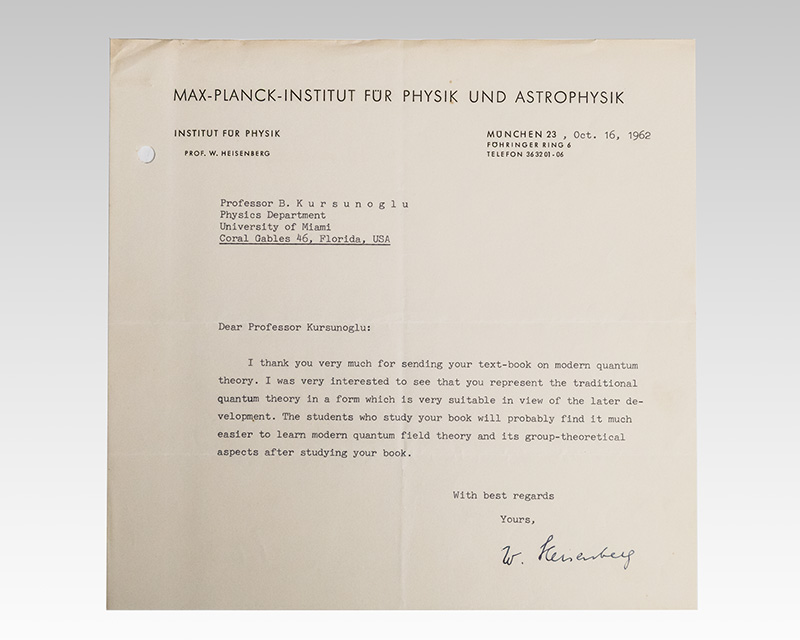
Werner Karl Heisenberg Typed Letter Signed.
We're sorry, this item has sold.
+$450
Rare Original Typed Letter Signed by German Theoretical Physicist Werner Karl Heisenberg to Turkish Theoretical Physicist Behram Kursonoglu
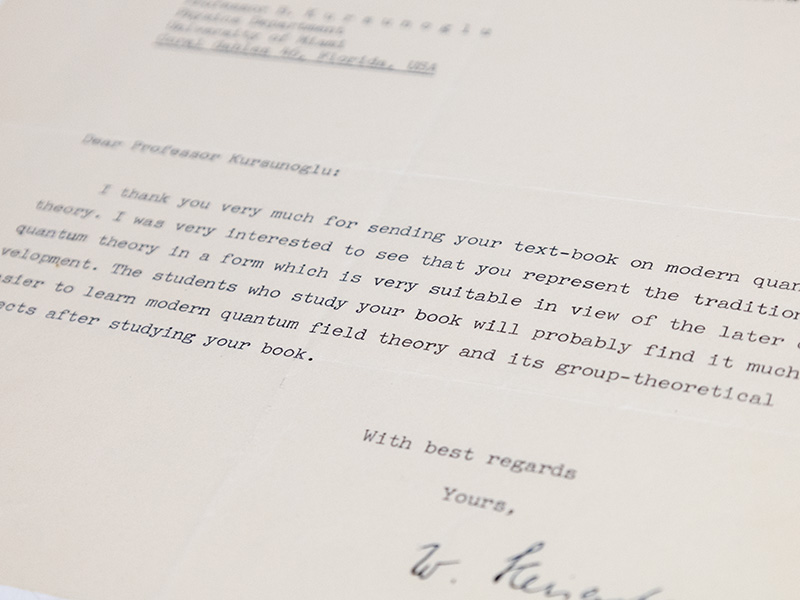
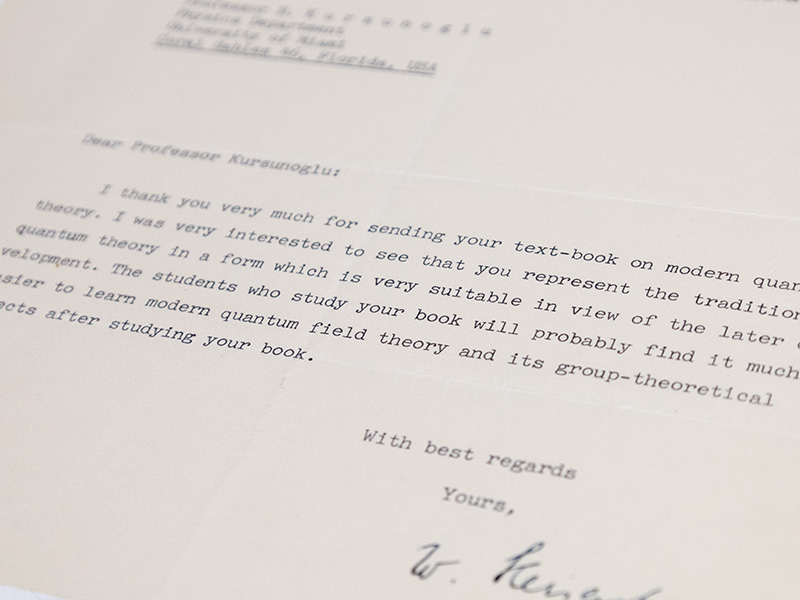
Rare original typed letter signed by German theoretical physicist Werner Karl Heisenberg to Turkish theoretical physicist Behram Kursonoglu. One page, on Max-Planck-Institut letterhead, and dated October 16, 1962. The letter is regarding Heisenberg thanking Kursonoglu for sending his textbook on modern quantum theory for his students to study. Boldly signed by Werner Karl Heisenberg. The recipient, Behram Kurşunoğlu (1922–2003), was a Turkish theoretical physicist whose career made him one of the most internationally connected and institutionally consequential scientists produced by the Republic of Turkey in the twentieth century. Born in the small town of Çaykara on Turkey’s border with Georgia, he was sent on scholarship to the University of Istanbul, where he graduated in 1945, before proceeding on a Turkish government scholarship to the University of Edinburgh — his arrival in London in August 1945 coinciding with the news of the bombing of Hiroshima, an event he later recalled as defining his sense of the moral stakes of theoretical physics. He pursued postdoctoral work under Paul Dirac at Cambridge — a mentorship that shaped his lifelong preoccupation with unified field theory — before joining the University of Miami as a professor of physics in 1958 and founding its Center for Theoretical Studies in 1965, which he directed until 1992 and which he built into a genuine mecca for theoretical physics, hosting Nobel laureates including Dirac, Lars Onsager, and Robert Hofstadter. He organized the celebrated annual Coral Gables Conferences beginning in 1964, which brought together leading scientists from across the world and established South Florida as an unlikely but genuine node in the international network of theoretical physics. He also participated in the discovery of two different types of neutrinos in the late 1950s, served as a founding member of the Turkish Atomic Energy Commission, and received the Turkish Presidential Science Prize in 1972. His most significant scholarly contribution — his generalization of Einstein’s unified field theory incorporating a fundamental length parameter — occupied him throughout his career and reflected a characteristically ambitious attempt to reconcile gravitation with the quantum world that few of his contemporaries were willing to pursue with equal persistence. In near fine condition with mail folds and creasing. The piece measures 8 inches by 8 inches.
Werner Karl Heisenberg (1901–1976) was a German theoretical physicist whose contributions to the foundations of quantum mechanics place him among the most consequential scientists of the twentieth century, and whose wartime role as the leading figure in Germany's nuclear weapons program has made him simultaneously one of its most debated and morally complex. Born in Würzburg and educated at the University of Munich under Arnold Sommerfeld and at Göttingen under Max Born and James Franck, Heisenberg produced at the age of twenty-three one of the most audacious theoretical innovations in the history of physics: the matrix mechanics formulation of quantum mechanics, which abandoned the attempt to visualize electron orbits in classical terms and replaced them with an abstract mathematical framework capable of accurately predicting atomic spectra. This work, further developed in collaboration with Born and Pascual Jordan, earned him the Nobel Prize in Physics in 1932. His 1927 formulation of the uncertainty principle proved to be one of the most philosophically consequential statements in the history of science, permanently displacing the deterministic framework of classical Newtonian physics and opening questions about the nature of physical reality that philosophers and physicists continue to debate today. During the Second World War Heisenberg led Germany's Uranverein nuclear research program, a role whose precise intentions — whether he sought to build a bomb, deliberately sabotaged the effort, or simply failed — has been the subject of sustained historical controversy. After the war Heisenberg remained a central figure in the reconstruction of German science, serving as director of the Max Planck Institute for Physics and playing a leading role in the establishment of CERN, the European Organization for Nuclear Research.
Werner Karl Heisenberg Typed Letter Signed.
Out of Stock