The Book That Built the Digital Age: Claude Shannon’s The Mathematical Theory of Communication.
In an era defined by data—by texts sent in milliseconds, videos streamed across continents, and algorithms shaping daily life—it is easy to forget that the digital age rests on a theoretical foundation laid in the mid-twentieth century. Few works have shaped modern computing and telecommunications as profoundly as The Mathematical Theory of Communication.
Originally published in 1948 as a groundbreaking paper in the Bell System Technical Journal and expanded into book form in 1949 with an introduction by Warren Weaver, Shannon’s work established the field now known as information theory. Scientific American would later call it “the Magna Carta of the Information Age”—a description that reflects not hyperbole, but historical reality.
The Problem Before Shannon
Before Shannon’s intervention, engineers lacked a unified mathematical framework for understanding information. Communication systems—telegraphy, telephony, and early radio—were advancing rapidly, yet there was no rigorous way to:
Measure information quantitatively
Define and calculate uncertainty
Model noise and interference
Determine the limits of reliable data transmission
Communication was treated largely as an engineering craft. What it lacked was a theory.
Shannon’s Breakthrough
Claude E. Shannon posed a deceptively simple question:
Can information itself be defined mathematically so that it can be transmitted reliably—even through noise?
His answer transformed science.
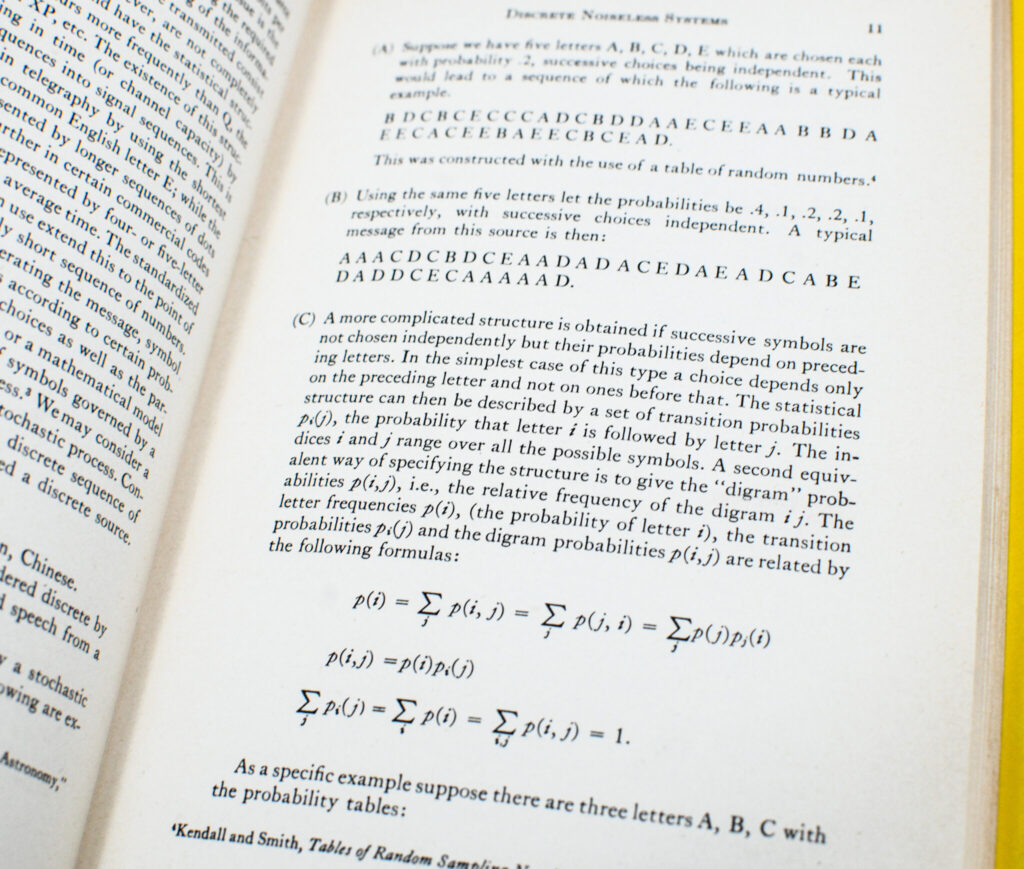
Shannon introduced the concept of measuring information in bits, a term now ubiquitous in computing. He formalized the idea of entropy as a measure of uncertainty and defined channel capacity—the maximum rate at which information can be transmitted over a communication channel with an arbitrarily low probability of error.
These ideas were not merely abstract. As James Gleick and Jon Gertner have observed, Shannon provided “a mathematical guide for the system’s engineers [at Bell Labs], a blueprint for how to move data around with optimal efficiency.” His theorems showed not just how systems worked, but what was fundamentally possible.
Foundations of the Digital World
Every major domain of modern digital life traces back to Shannon’s insights:
Telecommunications: Reliable long-distance transmission of voice and data
Data compression: Reducing redundancy in files, images, and video
Error-correcting codes: Ensuring integrity in noisy environments
Computer science: Binary logic and information processing
The Internet: Efficient packet-based communication
When you send a text message, upload a file, or stream high-definition video, you are operating within the limits Shannon defined more than seventy-five years ago.
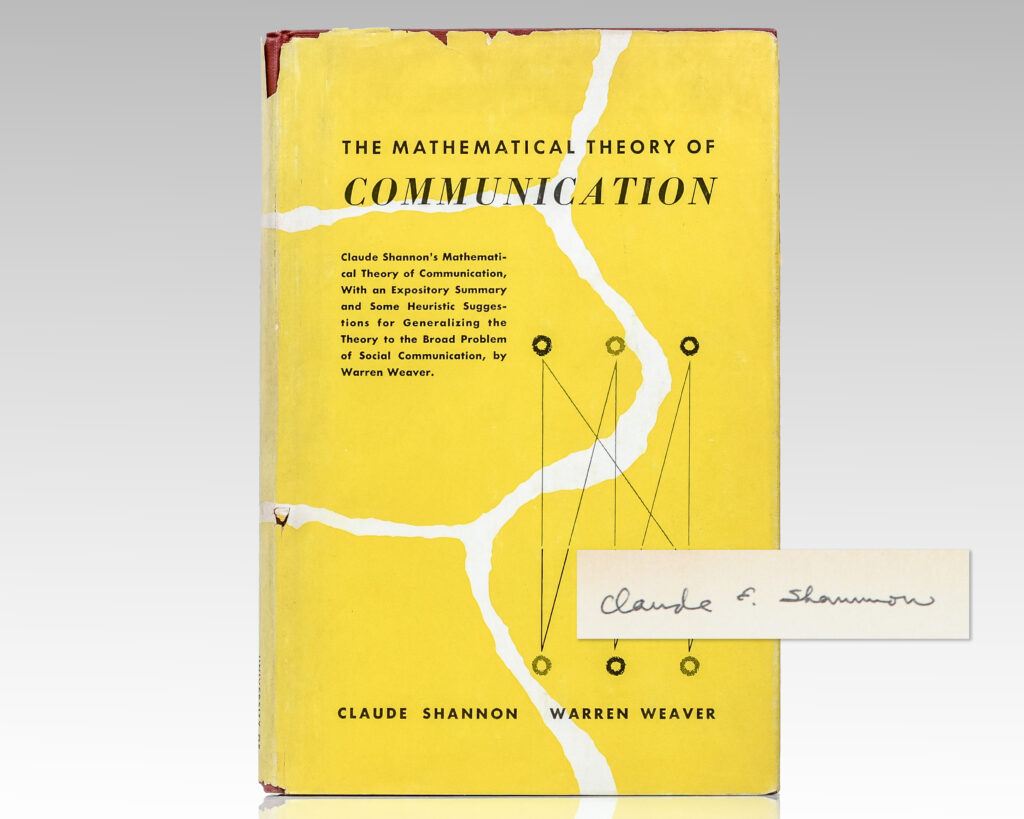
First edition of The Mathematical Theory of Communication; signed by Claude Shannon
A Landmark First Edition
The first edition of The Mathematical Theory of Communication stands as a landmark of twentieth-century scientific publishing. Boldly signed by Claude E. Shannon, this exceptionally rare example represents not merely a collectible volume, but the origin point of a discipline that underpins artificial intelligence, cryptography, digital media, and global networks.
Scientific knowledge grows at a phenomenal pace, but few books retain both technical relevance and historical centrality across generations. Shannon’s work has gone through multiple hardcover and paperback printings, yet its core arguments remain as contemporary as ever. This extraordinary signed first edition of Claude Shannon’s The Mathematical Theory of Communication is available to view and purchase in our Worth Avenue gallery and on our website, RaptisRareBooks.com.
In February of 1798, as the young American republic stood in a period of mounting political anxiety, Elkanah Watson sent a small book to Mount Vernon. Inside, on…
In the study of rare books, age alone is seldom the decisive measure of significance. Far more consequential is provenance — the documented history of ownership that situates…
In 1937, a quiet revolution in storytelling began. George Allen & Unwin published a small book by an Oxford professor—The Hobbit, or There and Back Again—in a modest…
Join our growing list of satisfied clients who have leveraged
our multi-cloud and hybrid cloud strategies to achieve greater
agility and efficiency in their operations.