In February of 1798, as the young American republic stood in a period of mounting political anxiety, Elkanah Watson sent a small book to Mount Vernon.
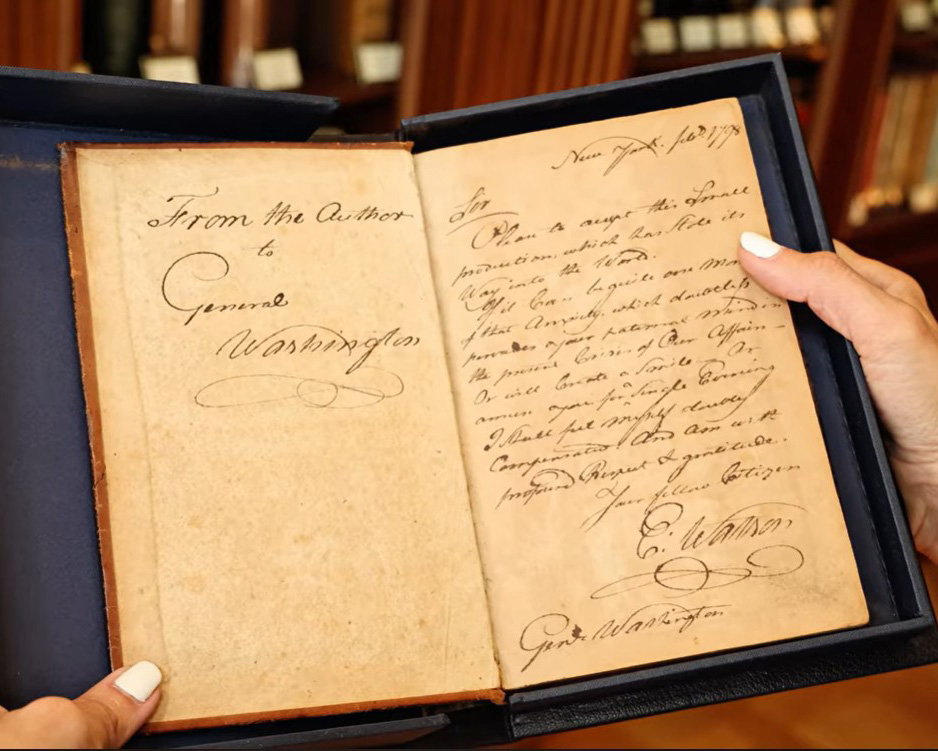
Inside, on the front pastedown, he had written simply:
“From the Author to General Washington.”
On the facing leaf, he added a longer, more personal message:
“New York, Feb. 1798. Sir, Please to accept this small production which has stole its way into the world. If it can beguile one moment of that anxiety which doubtless pervades your paternal mind in the present crisis of our affairs, or will create a smile or amuse you for a single evening, I shall put myself doubly compensated and am with profound respect & gratitude. Your fellow Citizen, E. Watson.”
The volume was the first edition of
Tour in Holland in MDCCLXXXIV, privately printed in Worcester in 1790 in an edition of approximately 350 copies. Modest in format and limited in circulation, it was not a grand political treatise or formal state document. It was a travel narrative. Yet in the hands of
George Washington — and inscribed in the context of national uncertainty — it became something far more revealing.
A Revolutionary Connection
Watson’s relationship with Washington stretched back more than a decade. During the American Revolution, Watson served commercial interests in Nantes, France, representing the Providence merchant John Brown. He later established a mercantile partnership in London with François Cossoul, a fellow Freemason.
In 1782, Watson and his associates proposed sending Washington “elegant Masonic ornaments” in honor of his “glorious efforts in support of American liberty.” Washington, himself deeply committed to Freemasonry, responded with solemn gratitude, attributing any success not to personal merit but to the “Grand Architect of the Universe.” The exchange reveals an early bond rooted in shared ideals and fraternal symbolism.
Mount Vernon, 1785
In January 1785, Watson visited Mount Vernon. He carried books from Granville Sharp and letters from mutual acquaintances in London. What he encountered left a lasting impression.
In his later memoir,
Men and Times of the Revolution, Watson described approaching Mount Vernon with something like pilgrimage fervor. He found
Washington dining with Mrs. Washington and members of the household, received with dignity yet warmth. The former commander soon “unbent” in conversation, displaying affability without ostentation.
Watson observed a domestic sphere characterized by order, harmony, and quiet discipline. Servants anticipated Washington’s wishes; his longtime attendant Billy stood near him; contentment seemed to animate the household. The detail that most struck Watson was a small gesture: Washington himself carried an evening cup of tea to his guest’s room.
It was a portrait of authority tempered by civility — of public greatness rooted in private composure.
The Book Itself
Tour in Holland in MDCCLXXXIV emerged from Watson’s travels in the Dutch Republic in 1784, including time spent in the company of John Adams. Published anonymously in 1790, the work reflects a young nation studying older commercial republics.
Watson examined Dutch banking, trade networks, agriculture, and civic organization — topics of practical importance to an American republic still defining its economic and institutional identity. In a letter to Adams in December 1790, Watson noted that most of the 350-copy edition had “run off beyond my expectations.”
Copies were presented to Adams, Thomas Jefferson, and, eventually, Washington.
Yet Washington did not receive his copy immediately. It was not until the late 1790s — near the end of his presidency — that Watson sent the volume through Jeremiah Van Rensselaer, an associate in banking and canal advocacy. In doing so, Watson reiterated his hope that the book might provide momentary relief from the “weighty concerns of our new born Nation.”
The inscription of February 1798 reflects a republic under strain. The Quasi-War with France loomed, partisan divisions sharpened, and the stability of the constitutional experiment remained uncertain. Watson’s language — “your paternal mind” — acknowledges Washington not only as former president but as a symbolic father of the nation.
From Mount Vernon to Posterity
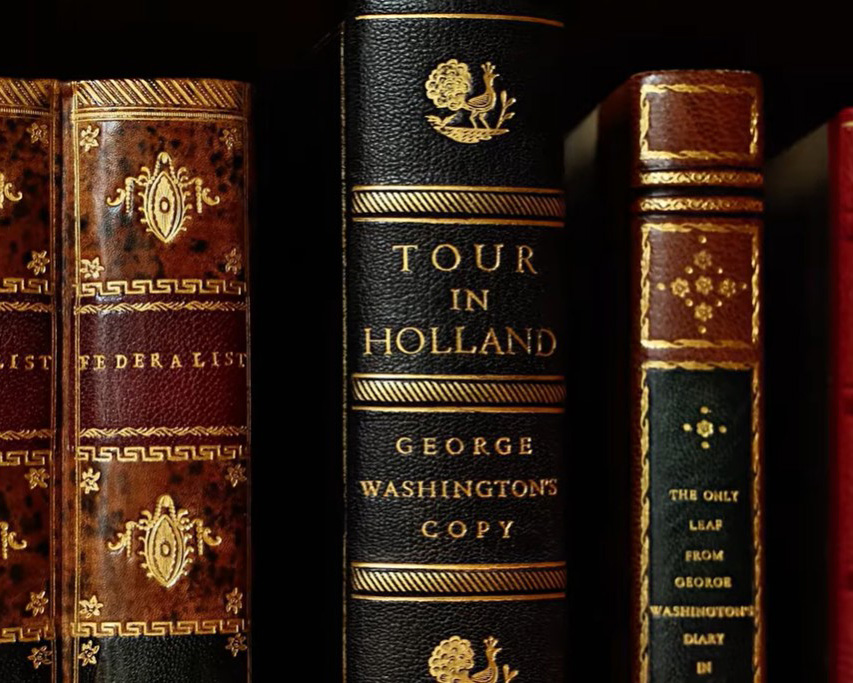
In his will, Washington bequeathed his “library of Books and Pamphlets of every kind” to his nephew Bushrod Washington. The library remained largely intact at Mount Vernon until 1829, after which it was divided among heirs. Portions were sold to Henry Stevens in 1848 and placed in the Boston Athenaeum; other sections were dispersed at auction later in the nineteenth century.
This presentation copy of
Tour in Holland descends from that Mount Vernon library, preserving its association with Washington prior to the dispersals.
Conclusion
This presentation copy of
Tour in Holland in MDCCLXXXIV stands at the intersection of print culture, political history, and personal association. Its first edition status, limited original printing, dual inscriptions, and documented provenance from Washington’s Mount Vernon library together establish its bibliographic and historical importance. Yet its deeper significance lies in what it reveals about the networks that sustained the early republic: merchants, Freemasons, reformers, and statesmen connected through correspondence, travel, and shared civic purpose.
Watson’s gift to Washington was both literary and symbolic. It reflects the circulation of ideas between Europe and America, the intellectual curiosity of the founding generation, and the enduring respect held for Washington in the closing years of his public life. As a surviving artifact from Washington’s own library, the volume offers scholars and collectors a rare and direct link to the intellectual world of the first President and to the lived experience of leadership in the formative decades of the United States.
Browse our complete collections of rare first editions and portraits related to
George Washington here.