FISHER, Irving.
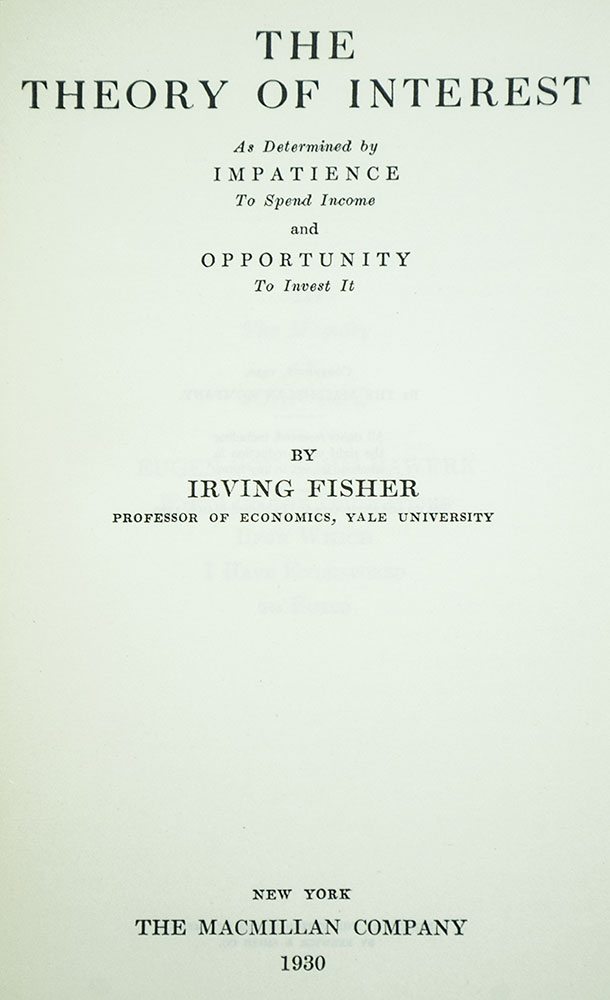
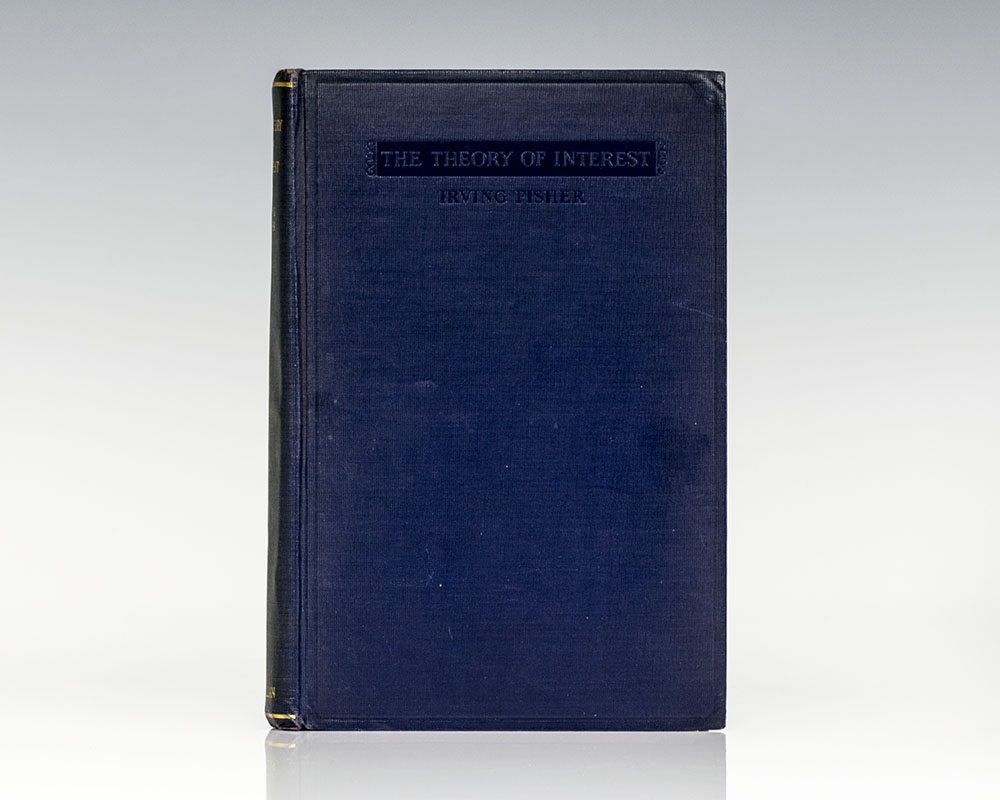
Theory of Interest: As Determined by Impatience to Spend Income and Opportunity to Invest In It.
New York: The MacMillan Company , 1930.
We're sorry, this item has sold.
+$450
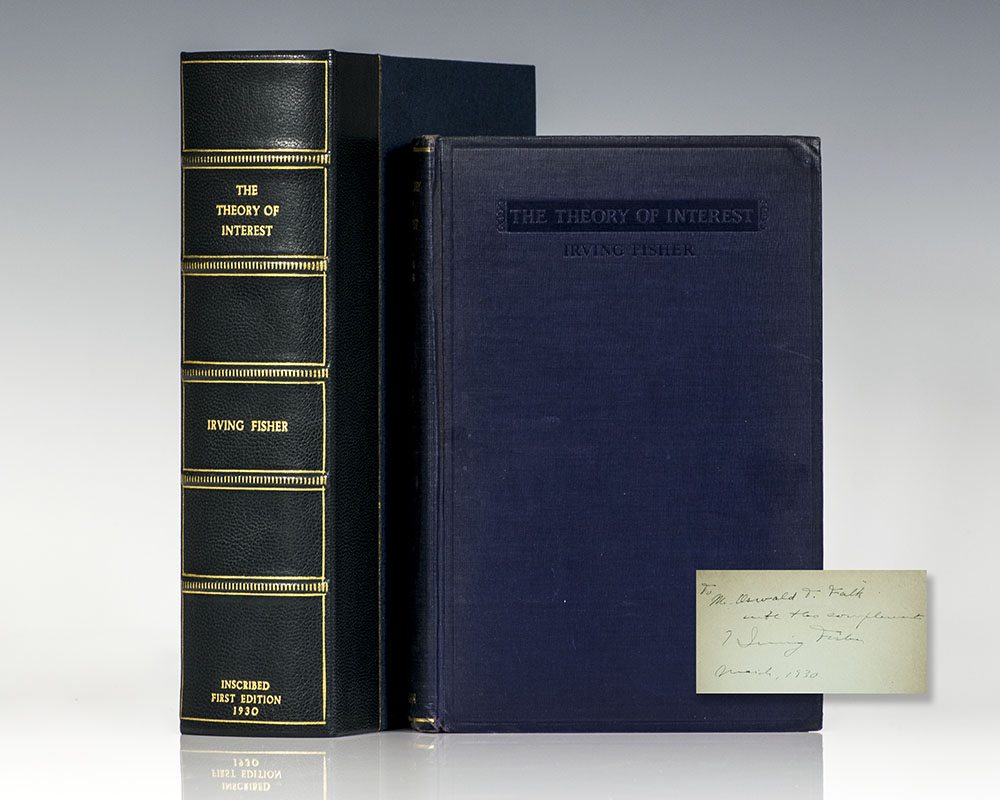
“As a matter of fact, what investment can we find which offers real fixity or certainty of income?": First Edition of Theory of Interest; Inscribed by Irving Fisher to fellow Economist Oswald T. Falk
First edition of Irving Fisher's groundbreaking work. Octavo, original blue cloth, fourteen tables in the text, seventeen tables in appendices fifty-eight charts in text, including three fold-out. Inscribed by the author on the front free endpaper in the year of publication, "To Mr. Oswald T. Falk with compliments of Irving Fisher March 1930." The recipient, Oswald Falk was an economist and stockbroker Oswald Falk is regarded by Robert Skidelsky as the man who understood John Maynard Keynes' mind more than any of his contemporaries. He argues that it was Falk who gave Keynes' "his superb understanding of the unruly financial mechanism of capitalism" which distinguished his work from that of his contemporaries (Skidelsky, 1992, 25). The London stockbroker, Nicholas Davenport, recalled that Falk spent a lot of time with Keynes speculating in currency and commodity deals. According to the economist Tommy Balogh who worked for Falk it was his mentor who gave Keynes the insights to develop his theory of liquidity preference by understanding the gilt-edged securities market. Skidelsky (2000, 495). In near fine condition. Housed in a custom half morocco clamshell box. Rare signed and inscribed.
Irving Fisher was the greatest economist the United States has ever produced. He made important contributions to utility theory, general equilibrium, theory of capital, the quantity theory of money and interest rates. Fisher was also a pioneer of the development of index numbers for stock markets. Fisher equation, the Fisher hypothesis, the international Fisher effect, and the Fisher separation theorem were named after him. Following David Ricardo and John Keynes, Fisher was also one of those rare people who were deeply involved in investing and researching stock markets. Fisher’s theory of debt deflation was widely used to explain the cause of the Great Depression and became more popular after the 2008 recession. One of Fisher’s key contributions is Interest Theory. Fisher presented the theory of interest by giving a full demonstration of the principles that determine an interest rate in the book The Theory of Interest. Irving Fisher used the book to answer the fundamental changes in the nature of the world economy including financing, the sensational inflation of the currencies of the combatants, and the remarkable developments in new scientific, industrial and agricultural revolution. Fisher pioneered a new theory that integrated all the aspects of the fundamental changes. He called it the theory of interest and defined the interest as "an index of a community's preference for a dollar of present income over a dollar of future income." He labeled his theory of interest the "impatience and opportunity" theory that is result from the interaction of two forces: the "time preference" people have for capital now, and the investment opportunity principle (that income invested now will yield greater income in the future).
Theory of Interest: As Determined by Impatience to Spend Income and Opportunity to Invest In It.
$8,800.00
Out of Stock
Other Books by this Author