
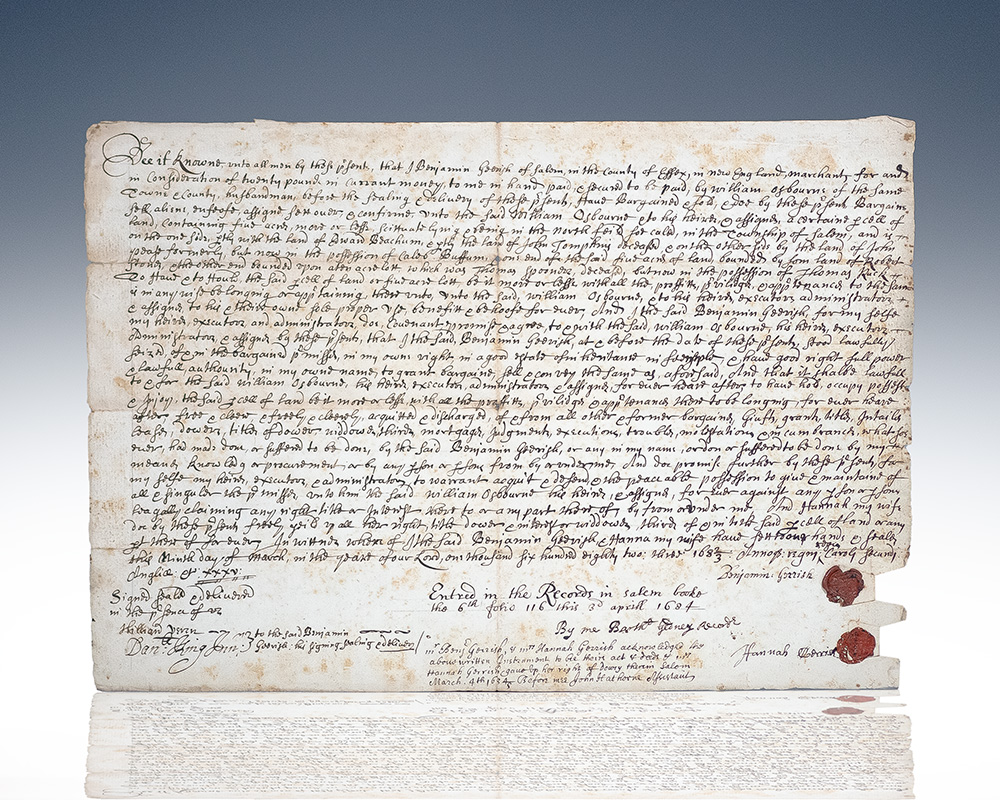
HATHORNE, John; Bartholomew Gedney; Benjamin Gerrish.
Salem Witch Trials Manuscript Land Deed Signed By Colonial Massachusetts Magistrates John Hathorne and Bartholomew Gedney.
Salem, MA: , 1682.
$18,000.00
In Stock
Item Number: RRB-148416
+$450
Rare original Salem Witch Trials Manuscript Land Deed Signed By John Hathorne and Bartholomew Gedney
Rare original manuscript land deed signed by colonial Massachusetts magistrates John Hathorne and Bartholomew Gedney of the Salem Witch Trials. Oblong octavo, one page, dated March 9, 1682/3 and entering the Salem record books on April 3rd 1684, manuscript document in the hand of Recorder Bartholomew Gedney, for the certified transfer of land between Benjamin Gerrish and William Osbourne for five acres of land in the Township of Salem, Massachusetts, docketed on verso. Signed at bottom by John Hathorne, as a member of the Massachusetts council of assistants, attesting to the transaction; signed by Bartholomew Gedney as Recorder; signed by Benjamin Gerrish and his wife, Hannah Gerrish (nee Ruck), at bottom right, with their red wax seals intact; signed by witnesses Hilliard Veren, Jr., and Daniel King, Jr. Benjamin Gerrish was son of Captain William Gerrish, born at Newbury in 1652, and was collector of his majesty's customs. He married Hannah Ruck in 1676, and had five sons and six daughters. Benjamin, his eldest son was born in 1683, and was later appointed governor of Bermuda in 1754. In very good condition. The piece measures 15 inches by 10.5 inches.
John Hathorne (great-great-grandfather of writer Nathaniel Hawthorne) was one of the most vocal participants during the witch hunts that swept Salem, Massachusetts between February 1692 and May 1693. One of eight judges who presided over the Court of Oyer and Terminer that tried people accused of witchcraft, Hathorne was also the chief interrogator of the accused, and conducted the first interrogations of suspected witches in Salem, on Sarah Osbourne and Sarah Good, as well as West Indian slave Tituba, owned by the father of the girls who kickstarted the witch hysteria. Hathorne was relentless in his pursuit of cleansing the colony of the devil and his minions, and presumed the guilt of the accused, allowed the use of "spectral evidence" in court (testimony in which witnesses claimed that the accused appeared to them and did them harm in a dream or a vision), and often harassed the accused until they confessed. During the Trials, over 200 individuals were accused of witchcraft, 30 were found guilty, and 20 were executed. Following the Trials, Hathorne continued his ascent in colonial politics, but he never repented for his actions during the hysteria. Nathaniel Hawthorne would go on to change the spelling of his family name to distance himself from their disreputable past. Bartholomew Gedney was a merchant, physician, and military officer who also served on the Court of Oyer and Terminer alongside Hathorne. During the Trials he questioned numerous accused witches, including Captain John Alden, Mary Ireson, Ann Dolliver, Job Tookey, amongst others.
Salem Witch Trials Manuscript Land Deed Signed By Colonial Massachusetts Magistrates John Hathorne and Bartholomew Gedney.
$18,000.00
In Stock