
![Liber Chronicarum. [The Nuremberg Chronicle].](https://raptis.bvbeta.com/wp-content/uploads/2026/01/RRB-149818.jpg)
![Liber Chronicarum. [The Nuremberg Chronicle].](https://raptis.bvbeta.com/wp-content/uploads/2026/01/RRB-149818_2.jpg)
![Liber Chronicarum. [The Nuremberg Chronicle].](https://raptis.bvbeta.com/wp-content/uploads/2026/01/RRB-149818_3.jpg)
![Liber Chronicarum. [The Nuremberg Chronicle].](https://raptis.bvbeta.com/wp-content/uploads/2026/01/RRB-149818_4.jpg)
![Liber Chronicarum. [The Nuremberg Chronicle].](https://raptis.bvbeta.com/wp-content/uploads/2026/01/RRB-149818_5.jpg)
![Liber Chronicarum. [The Nuremberg Chronicle].](https://raptis.bvbeta.com/wp-content/uploads/2026/01/RRB-149818_6.jpg)
![Liber Chronicarum. [The Nuremberg Chronicle].](https://raptis.bvbeta.com/wp-content/uploads/2026/01/RRB-149818_7.jpg)
![Liber Chronicarum. [The Nuremberg Chronicle].](https://raptis.bvbeta.com/wp-content/uploads/2026/01/RRB-149818_8.jpg)
![Liber Chronicarum. [The Nuremberg Chronicle].](https://raptis.bvbeta.com/wp-content/uploads/2026/01/RRB-149818_9.jpg)
![Liber Chronicarum. [The Nuremberg Chronicle].](https://raptis.bvbeta.com/wp-content/uploads/2026/01/RRB-149818_10.jpg)
![Liber Chronicarum. [The Nuremberg Chronicle].](https://raptis.bvbeta.com/wp-content/uploads/2026/01/RRB-149818_11.jpg)
![Liber Chronicarum. [The Nuremberg Chronicle].](https://raptis.bvbeta.com/wp-content/uploads/2026/01/RRB-149818_12.jpg)
![Liber Chronicarum. [The Nuremberg Chronicle].](https://raptis.bvbeta.com/wp-content/uploads/2026/01/RRB-149818_14.jpg)
![Liber Chronicarum. [The Nuremberg Chronicle].](https://raptis.bvbeta.com/wp-content/uploads/2026/01/RRB-149818_15.jpg)
![Liber Chronicarum. [The Nuremberg Chronicle].](https://raptis.bvbeta.com/wp-content/uploads/2026/01/RRB-149818_16.jpg)
![Liber Chronicarum. [The Nuremberg Chronicle].](https://raptis.bvbeta.com/wp-content/uploads/2026/01/RRB-149818_17.jpg)
![Liber Chronicarum. [The Nuremberg Chronicle].](https://raptis.bvbeta.com/wp-content/uploads/2026/01/RRB-149818_18.jpg)
![Liber Chronicarum. [The Nuremberg Chronicle].](https://raptis.bvbeta.com/wp-content/uploads/2026/01/RRB-149818_19.jpg)
SCHEDEL, Hartmann.
Liber Chronicarum. [The Nuremberg Chronicle].
Nuremberg: Anton Koberger for Sebald Schreyer and Sebastian Kammermeister , 1493.
$125,000.00
In Stock
Item Number: RRB-149818
+$450
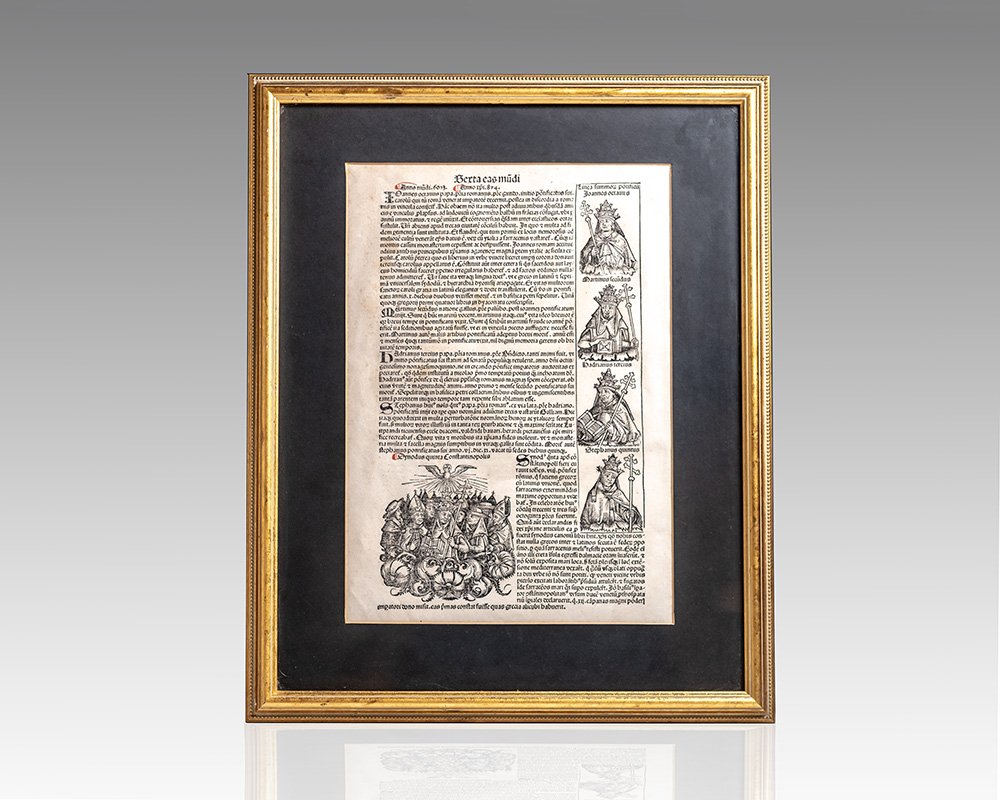
A LANDMARK IN THE HISTORY OF PRINTING, AND ONE OF THE GREATEST ILLUSTRATED BOOKS EVER PUBLISHED: Rare first edition of the monumental Nuremberg Chronicle; Published in 1493, containing over 1800 splendid woodcuts, and with the first full-page plate hand-painted in full color
First edition of the Nuremberg Chronicle, the most extensively illustrated book of the 15th century, from the St. Petersburg library of William Tooke. Imperial folio, bound in three quarter calf over paper-covered boards, morocco spine label lettered in gilt, elaborate gilt tooling to the spine, five gilt-tooled raised bands, rebacked, decorated with 1809 woodcut illustrations by Michael Wolgemut, Wilhelm Pleydenwurff and their workshop, 320 leaves (of 326, without V, IX, CCLXV, CCXCVII, CCXCVIII and final blank), two double-page maps (map of Europe and colophon laid in with chipped fore-edges), illuminated initial on first text leaf, first full-page woodcut in contemporary color, table's initials in red and blue, red and blue paraphs (additions including Maximilian supplement inserted after CCLXVI.
The first edition of the Nuremberg Chronicle, printed in both Latin and German, is estimated to have had between 1,400 and 1,500 Latin copies and 700 to 1,000 German copies. Only about 400 Latin and 300 German copies are known to have survived into the 21st century. The publication history of the Nuremberg Chronicle is perhaps the best documented of any book printed in this period: the contracts between Schedel and his partners Schreyer and Kammermaister, and between Schedel and the artists, all survive in the Nuremberg Stadtsbibliothek, as do detailed manuscript exemplars of both the Latin and the German editions. The Nuremberg Chronicle includes two double-page maps: a world map (Shirley 19) based on Mela's Cosmographia (1482), and a map of northern and central Europe by Hieronymus Munzer (1437--1508) after Nicolas Khyrpffs. The world map is one of only three 15th-century maps showing Portuguese knowledge of the Gulf of Guinea of about 1470. The map of Europe is closely associated with Nicolas of Cusa's Eichstatt map, with which it is thought to share a common manuscript source of c.1439--54. It is therefore claimed to be the first modern map of this region to appear in print. Although published later than the map of Germany in the 1482 Ulm Ptolemy, it was constructed earlier (Campbell, The Earliest Printed Maps, 1472--1500, 1987).
Provenance: early Latin inscriptions on title-page -- John (18th-century inscription and pen trials on blank after Maximilian supplement) -- William Tooke (1744--1820; inscription on title-page dated 1772) -- Phyllis Goodhart Gordan (1913--1994; leather label); by descent. William Tooke (1744--1820) was a British historian of Russia, living in St. Petersburg for periods of his life while researching and writing his works. The present copy formed part of his library at St. Petersburg and is dated 1772.
With the binding very good condition, text block near fine with the map of Europe and colophon laid in with chipped fore-edges and 320 leaves (of 326, without V, IX, CCLXV, CCXCVII, CCXCVIII and final blank). A very nice example of this landmark work in the history or printing with noted provenance.
Published in 1493, the monumental Nuremberg Chronicle remains the most extensively illustrated book of the 15th century. Albrecht Durer, godson of the printer Anton Koberger, is thought to have contributed to the celebrated series of c.1800 woodcuts while working for the workshop of Michael Wolgemut. The publication history of the Nuremberg Chronicle is perhaps the best documented of any book printed in this period: the contracts between Schedel and his partners Schreyer and Kammermaister, and between Schedel and the artists, all survive in the Nuremberg Stadtsbibliothek, as do detailed manuscript exemplars of both the Latin and the German editions (see A. Wilson, The Making of the Nuremberg Chronicle, Amsterdam: 1976). The Nuremberg Chronicle also includes two double-page maps: a world map (Shirley 19) based on Mela's Cosmographia (1482), and a map of northern and central Europe by Hieronymus Munzer (1437-1508) after Nicolas Khyrpffs. The world map is one of only three 15th-century maps showing Portuguese knowledge of the Gulf of Guinea of about 1470. The map of Europe is closely associated with Nicolas of Cusa's Eichstatt map, with which it is thought to share a common manuscript source of c. 1439-54. It is therefore claimed to be the first modern map of this region to appear in print. Although published later than the map of Germany in the 1482 Ulm Ptolemy, it was constructed earlier (Campbell, The Earliest Printed Maps, 1472-1500, 1987). BMC II, 437; Schreiber 5203; Goff S-307; ISTC is00307000. Hartmann Schedel was a medical doctor, humanist and book collector. He earned a doctorate in medicine in Padua in 1466, then settled in Nuremberg to practice medicine and collect books. According to an inventory done in 1498, Schedel's personal library contained 370 manuscripts and 670 printed books. He compiled this elaborate history of the world from “the first day of creation” to his own time in an effort to correct what he felt was a slight to German history by other chroniclers. He divided his work into the usual six ages of the history of mankind, adding a seventh in which he foretold the coming of the Antichrist, the destruction of the world, and judgment day. The invention of printing is mentioned on verso of leaf CCLII: “born in Germany… in the city near the Rhine [i.e. Mainz]… in the year 1440”; on verso of leaf CCXC is a brief account (not appearing in the subsequent German edition of the same year) of the “Portuguese voyage of discovery along the coast of Africa in 1483 [1484], under the direction of Diego Cam and Martin Behaim of Nuremberg, which has been used as a basis for the unwarranted theory that the expedition reached America” (Sabin). The legacy of the volume rests on its illustrations. “There are 1809 woodcuts printed from 645 different blocks. They picture the major events of the Old and New Testaments, episodes in the lives of many saints, portraits of prophets, kings, popes, heroes, and great men of all centuries, freaks of nature, and panoramic views of cities. Nuremberg artists Michael Wolgemut and Wilhelm Pleydenwurff were responsible for the production of the book… The wood blocks were designed by the two masters and their assistants, including the young Albrecht Dürer, who was apprenticed to Wolgemut at the time. The printing was carried out under the supervision of the great scholar-printer Anton Koberger, whose illustrated books were famous throughout Europe” (Legacies of Genius 5).
Liber Chronicarum. [The Nuremberg Chronicle].
$125,000.00
In Stock
Other Books by this Author
![Liber Chronicarum. [The Nuremberg Chronicle].](https://raptis.bvbeta.com/wp-content/uploads/2026/01/RRB-146920.jpg)