COOK, James.
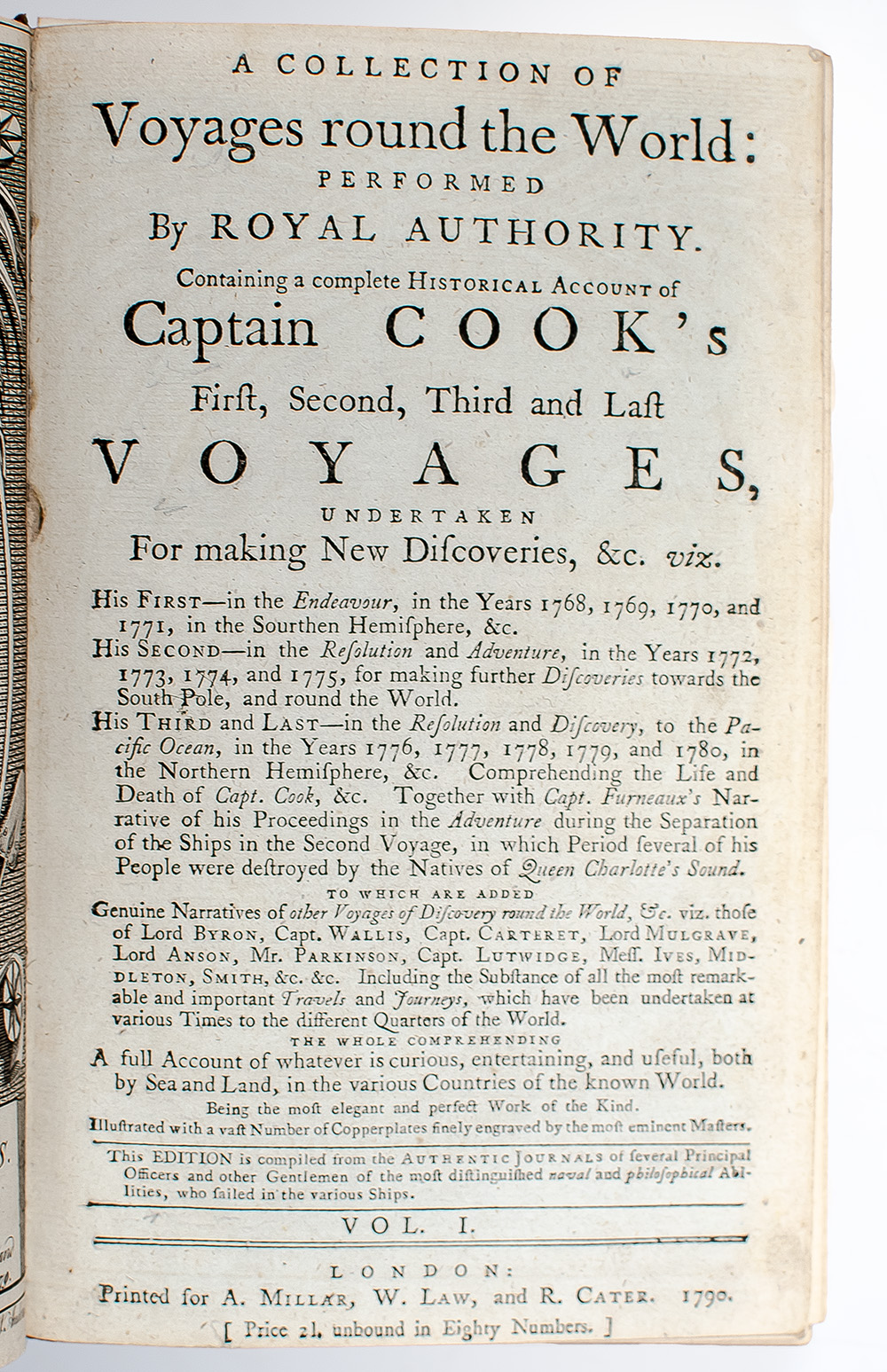
A Collection of Voyages Round the World: Performed By Royal Authority. Containing a complete Historical Account of Captain Cook's First, Second, Third and Last Voyages, Undertaken For making New Discoveries, &c.
London: Printed for A. Millar, W. Law, and R. Cater , 1790.
We're sorry, this item has sold.
+$450
Rare eighteenth century printing of the official accounts of Captain James Cook’s voyages
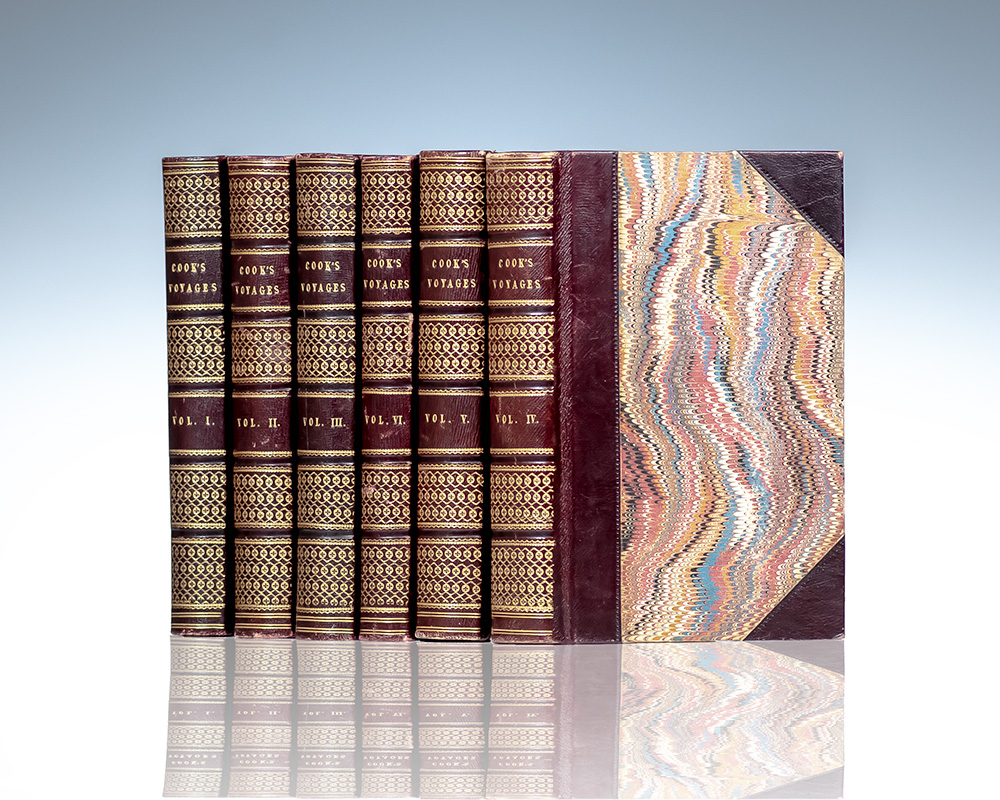
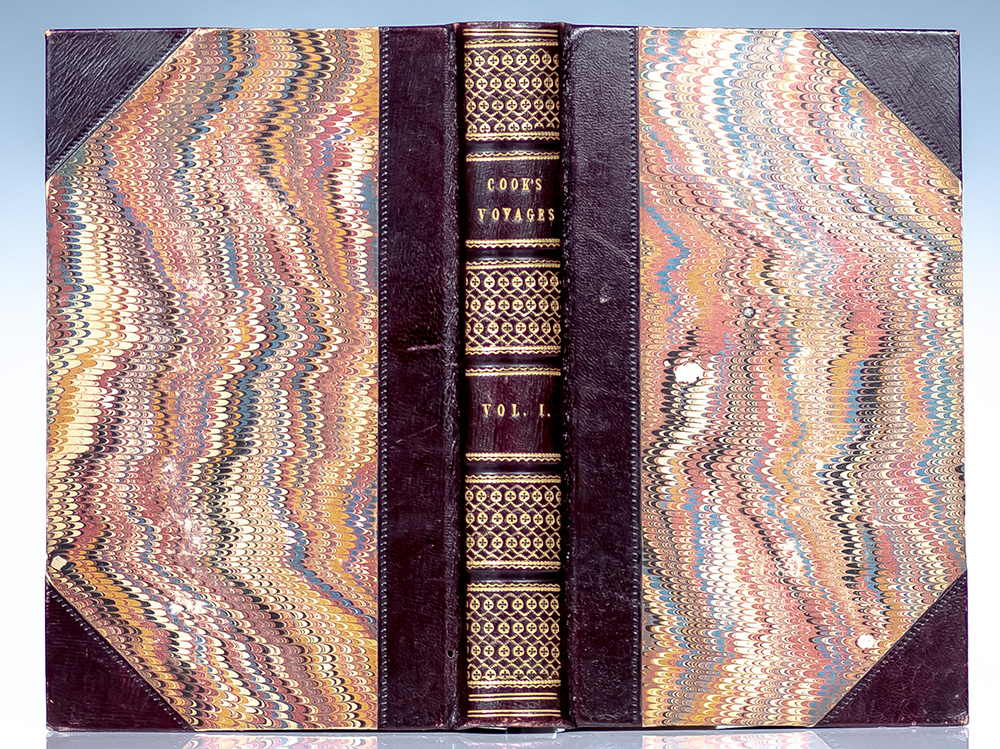
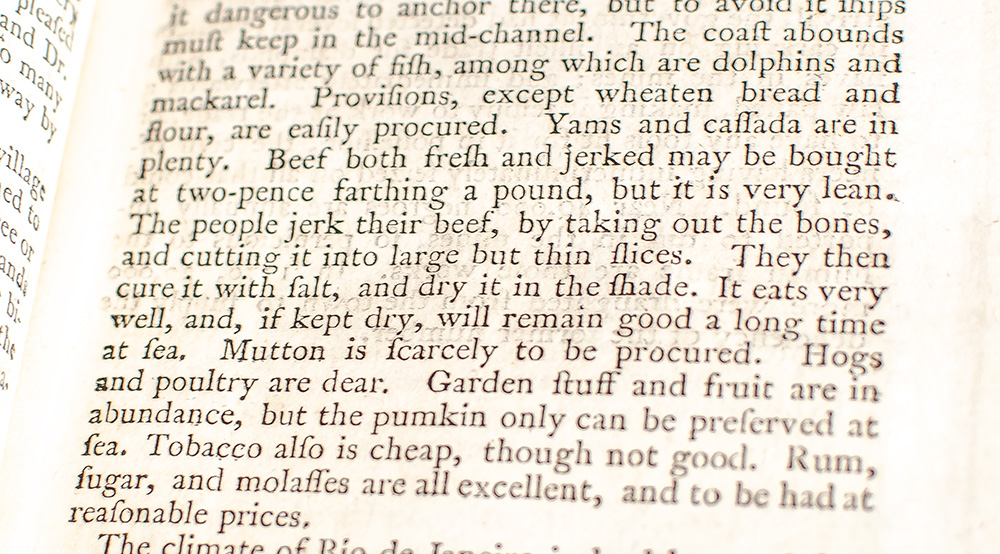
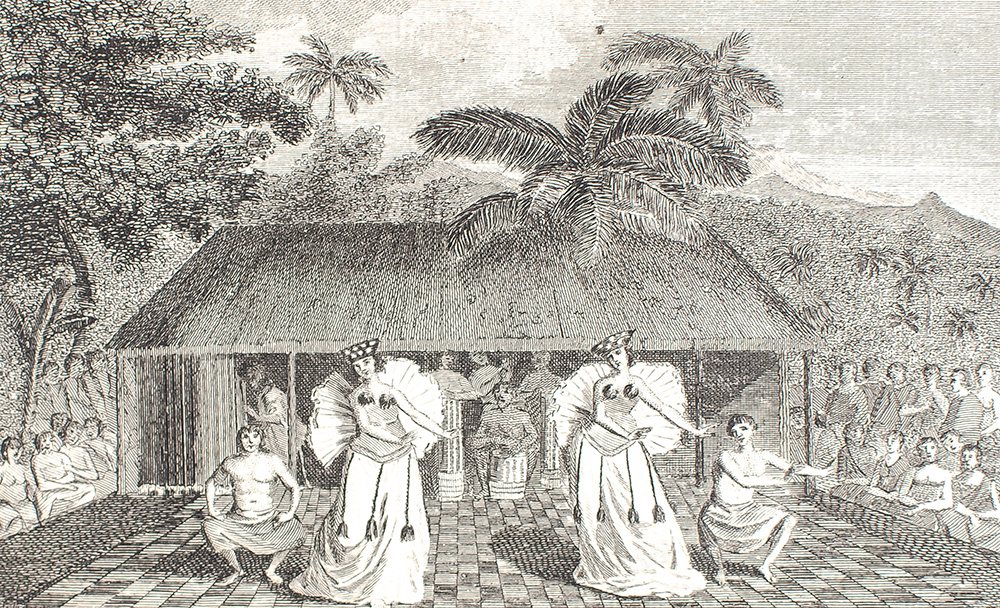
Rare eighteenth century printing of the official accounts of Captain James Cook’s voyages, the foundation of modern knowledge of the Pacific and a cornerstone of the literature of travel and exploration. Beddie 648, 1216, 1543; Hill 782, 358, 361. Octavo, six volumes, bound in three quarter burgundy straight-grain morocco over marbled boards with gilt titles and elaborate gilt tooling to the spine in six compartments within raised bands, illustrated with 129 engraved plates, 29 folding maps and plans. In near fine condition. Several leaves sprung in first, fifth and sixth volumes, some plates trimmed into text, a few instances of light spots, corners rubbed. Provenance: John Vokins: ownership inscription to front free endpaper of vols. I and IV. Originally issued in 80 parts and likely with a spurious imprint. A beautifully bound and profusely illustrated example of this landmark work. Very uncommon.
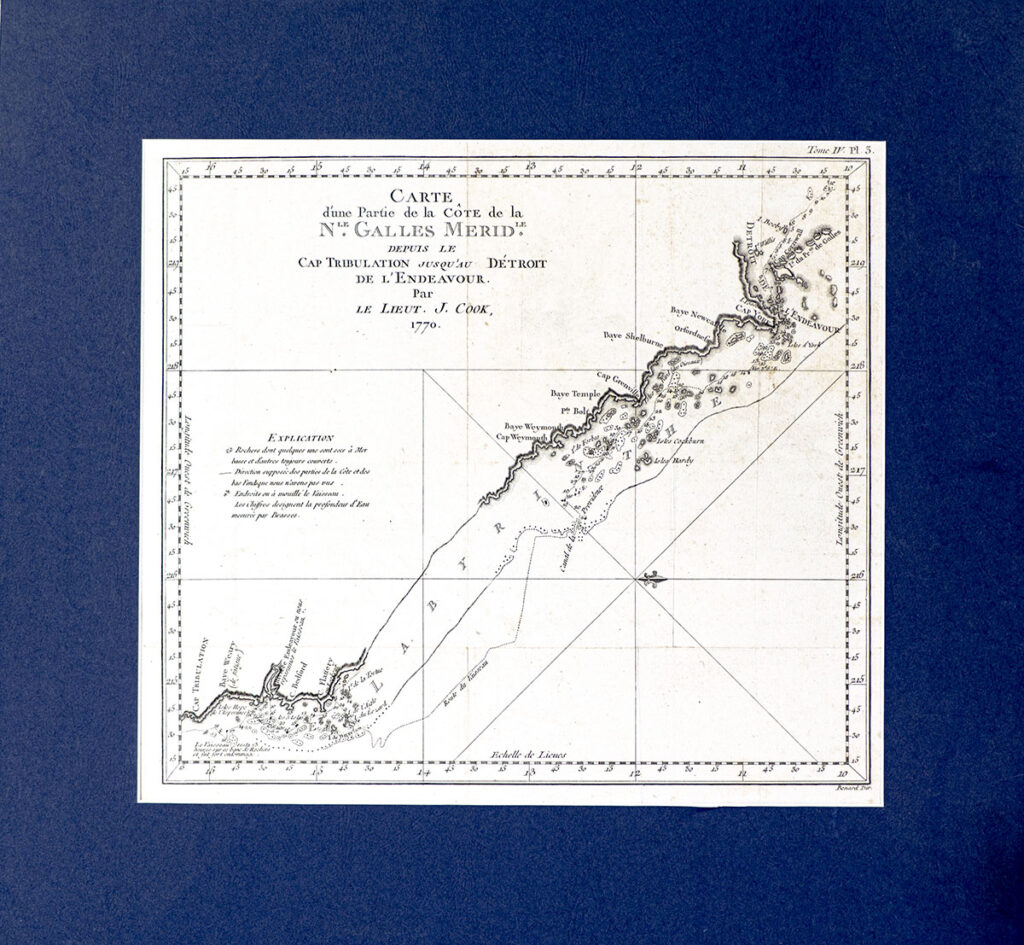
Captain Cook’s Voyages are an iconic symbol of discovery and served not only to contribute to many diverse fields of knowledge, but also to inspire many who followed after him. "He was really the first scientific navigator" (Hill) and the only explorer during this time to lead three circumnavigations. The knowledge accumulated during these explorations greatly expanded the awareness of the world’s geography, and his writings, maps, and drawings significantly aided in future navigations, making sea travel much more certain and educating the general public. Cook’s first voyage sailed from England in 1768, rounded Cape Horn and continued westward to arrive in Tahiiti in April of 1769, where the Royal Society had engaged Cook to observe the transit of Venus across the Sun. He then sailed to New Zealand, mapping the complete coastline and then travelling to Australia, where his expedition became the first recorded Europeans to encounter the eastern coastline. The voyage was fraught with many perils, including being nearly ship-wrecked on the Great Barrier Reef and losing many of the crew to malaria in modern day Indonesia, but they were able to finally sail past the Cape of Good Hope and return to England in 1771. Cook’s second voyage took place between 1772-1775, with a mission to search for the hypothetical Terra Australis. Cook crossed the Antarctic Circle for the first time in history and thought he disproved the existence of the "Great Southern Continent." He actually almost reached Antarctica on one occasion, but then turned towards Tahiti for supplies. In Cook’s third voyage (1776-79), his aim was to search for the North-West Passage through the American continent. He charted the American west coast from Northern California through the Bering Straight. "Cook was the first navigator to accurately map the coast, and, by carrying away a collection of furs, he introduced the fur trade to the English and American traders, whose subsequent expeditions were based upon his discoveries no other contemporaneously printed source narrative is of comparable importance" (Eberstadt). On this voyage, he also discovered the Hawaiian Islands, which he named the Sandwich Islands. Cook died during this third voyage on the Hawaiian islands. With the publication of the first two voyages, and his dramatic death in Hawaii, James Cook became a national hero. So eagerly awaited was his account of the third voyage, that it was sold out a few days after publication. Among his accomplishments Cook discovered New Caledonia, Norfolk Island, the Isle of Pines, Sandwich Land (Hawaii) and rediscovered and charted numerous other lands. He was the first to survey New Zealand where he spent six months. He was also a pioneer in regard to the health of his men. On his second voyage, Cook lost only one man out of 118 in a voyage of more than 1000 days, one of the first to conquer scurvy. As a commander, an observer and a practical physician, his merits were equally great. He won the affection of those who served under him by sympathy, kindness and unselfish care of others, which were as noteworthy as his gifts of discovery and intellect.
A Collection of Voyages Round the World: Performed By Royal Authority. Containing a complete Historical Account of Captain Cook's First, Second, Third and Last Voyages, Undertaken For making New Discoveries, &c.
$1,750.00
Out of Stock