Mark Twain and the Shaping of American Literary Identity.
Lauded by William Faulkner as “the father of American literature,” American writer, humorist, and publisher Mark Twain is widely regarded as one of the most influential figures in American literary history. Active during the latter half of the nineteenth century, Twain fundamentally redefined the American narrative, diverging from European literary models to cultivate a distinctly national voice rooted in realism, vernacular speech, and regional experience.
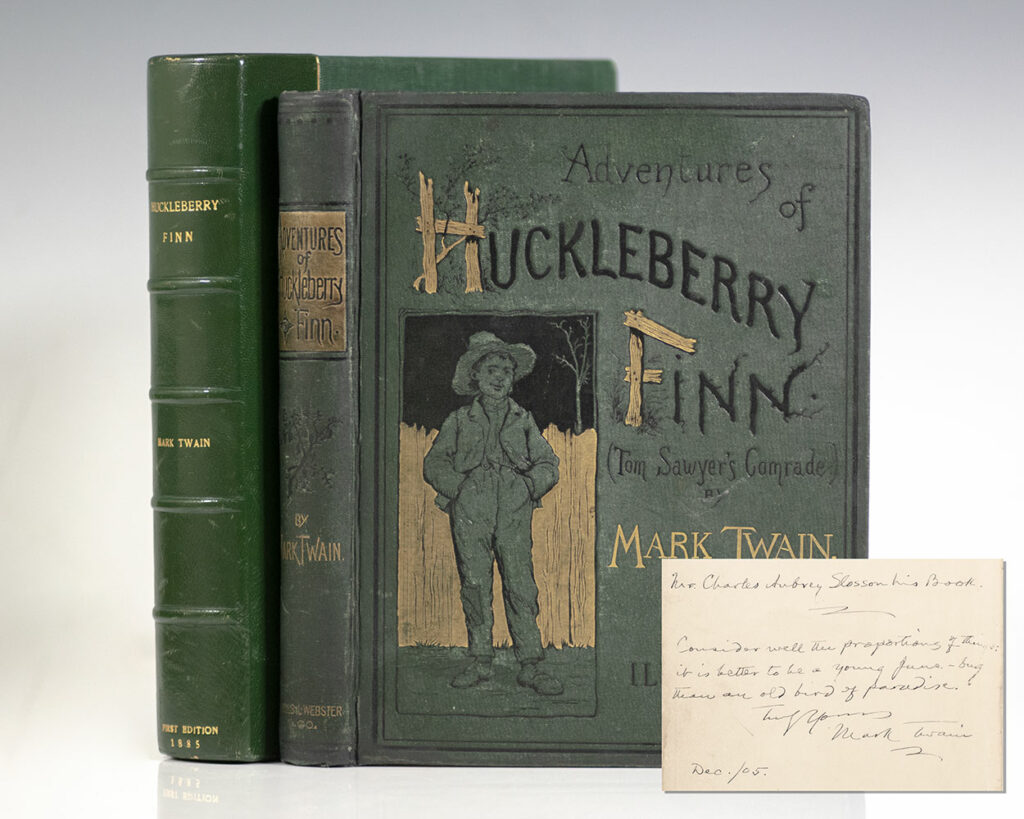
First edition, first issue of Mark Twain’s masterpiece Adventures of Huckleberry Finn; signed and inscribed by Mark Twain
Twain’s significance extends beyond his role as a storyteller. He was a cultural critic who wove satire and social observation into his fiction with remarkable skill, confronting enduring issues such as race, freedom, moral hypocrisy, and social inequality. In Tom Sawyer and Huckleberry Finn, Twain captured the rhythms of everyday speech and the ethical contradictions of a nation still reckoning with its past. In Life on the Mississippi, he chronicled the technological and economic transformations of the riverine South, offering both historical testimony and personal reflection.
Through these and other works, Twain helped shape the very contours of American literary identity. His ability to evoke vivid, psychologically resonant characters—while interrogating the nation’s ideals—ensures his place not only as a literary innovator but as one of the most incisive critics of the American experience. Below is a survey of Twain’s major works including a selection of the finest and most significant first editions we have handled.
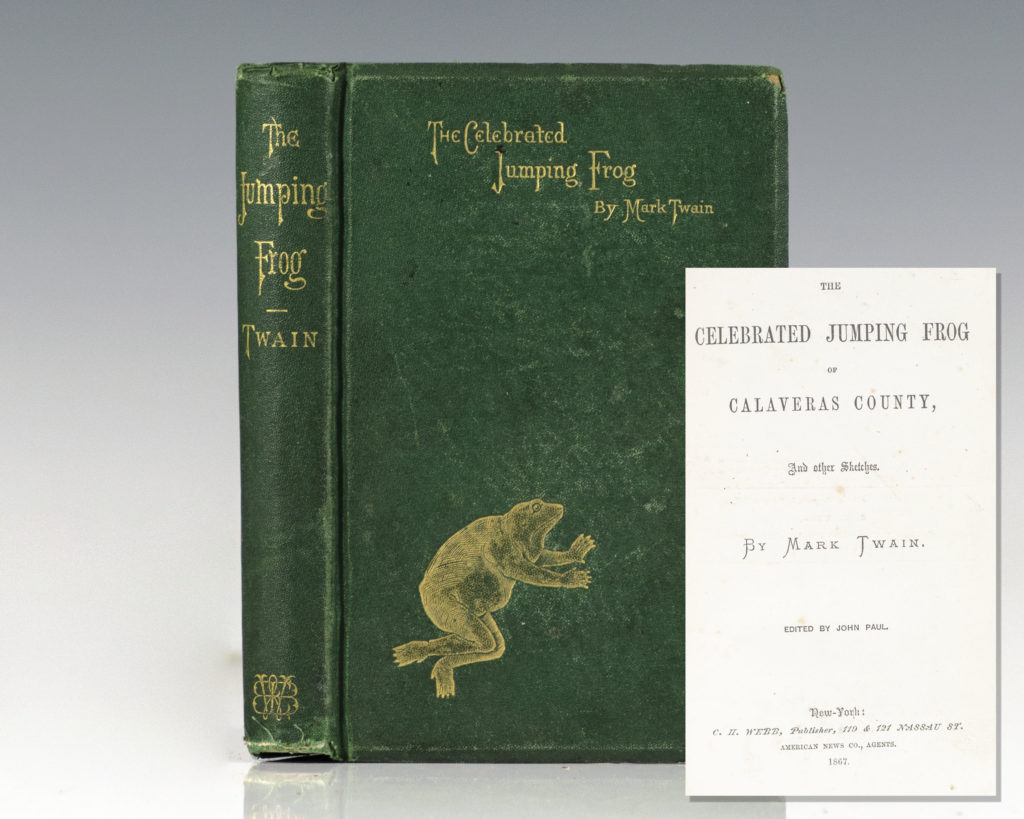
First edition, first printing of Mark Twain’s rare first book The Celebrated Jumping Frog of Calaveras County
The Celebrated Jumping Frog of Calaveras County (1867)
Published in 1867 in Twain’s first collection of short stories, The Celebrated Jumping Frog of Calaveras County was his first major success and brought national recognition to both Twain and the California town it featured.
“Perhaps no short sketch of Twain’s so quickly won wide popularity as did ‘The Jumping Frog.’ Calaveras County, California, is known to thousands who have never seen the Golden State simply because of this gem of humor. This little volume, the author’s first published book, came into being under the sponsorship of Charles Henry Webb-who also edited it under his pseudonym of ‘John Paul.’ To accompany ‘The Jumping Frog’ he chose twenty-six other sketches, of which at least two, ‘Curing a Cold’ and ‘The Story of the Bad Little Boy Who Didn’t Come to Grief,’ later attained the distinction of being incorporated into recitation books for the delectation of even wider audiences” (Zamarano 80 17).
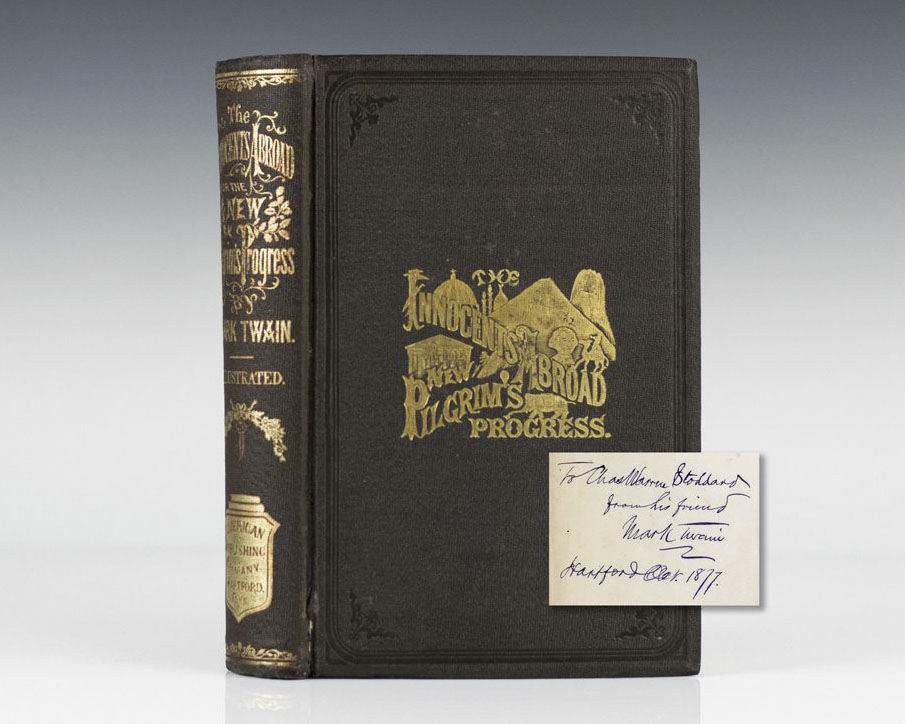
First edition of The Innocents Abroad, Or The New Pilgrims’ Progress; inscribed by Mark Twain
The Innocents Abroad (1869)
Published two years later in 1869, Twain’s first full-length book, The Innocents Abroad was a breakthrough success. Based on his travels through Europe and the Holy Land with a group of American tourists, the book blended sharp observation, humor, and satire to critique both foreign cultures and the attitudes of his fellow travelers. Twain’s irreverent style and candid commentary challenged the romanticized notions of travel common at the time, offering readers a fresh, distinctly American perspective.
The “humorous narrative that assured [Twain’s] position as a leading author and shows his typical American irreverence for the classic and antique” (Hart, 148). “Twain, by turns both savage and gentle, deflates the pretense of the Old World shrines as well as the Americans who worship at them” (MacDonnell, 33).
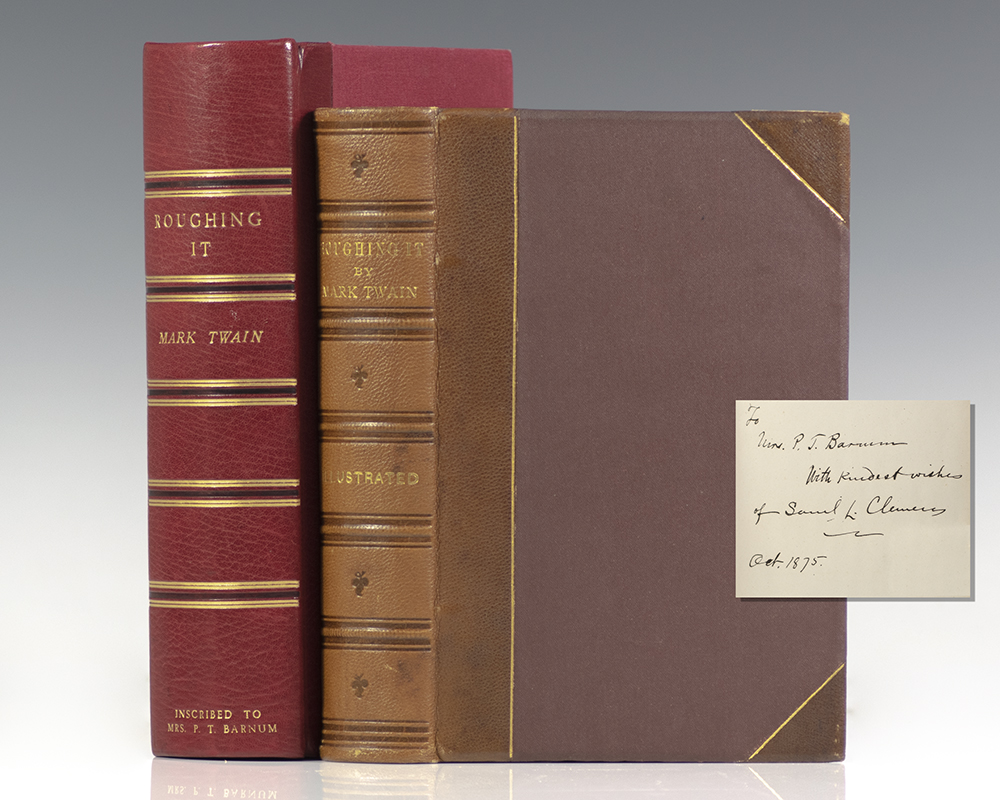
Rare Association Copy of Roughing It; inscribed by Mark Twain to Mrs. P. T. Barnum
Roughing It (1872)
Published in 1872 as a prequel to The Innocents Abroad and a “picture of the frontier spirit and its lusty humor” (Hart, 347), Roughing It emerged from a westward journey taken with his brother Orion, who was appointed Secretary to the Governor of the Nevada Territory in 1861. “Celebrating, lamenting, and castigating life in the territory and in California as Twain had known it, Roughing It vividly documents various aspects of the boom-and-bust American West while reflecting the increasing confidence of the author in his ability to go beyond the recording of impressions to the exploration of meaning” (LeMaster & Wilson, 641).
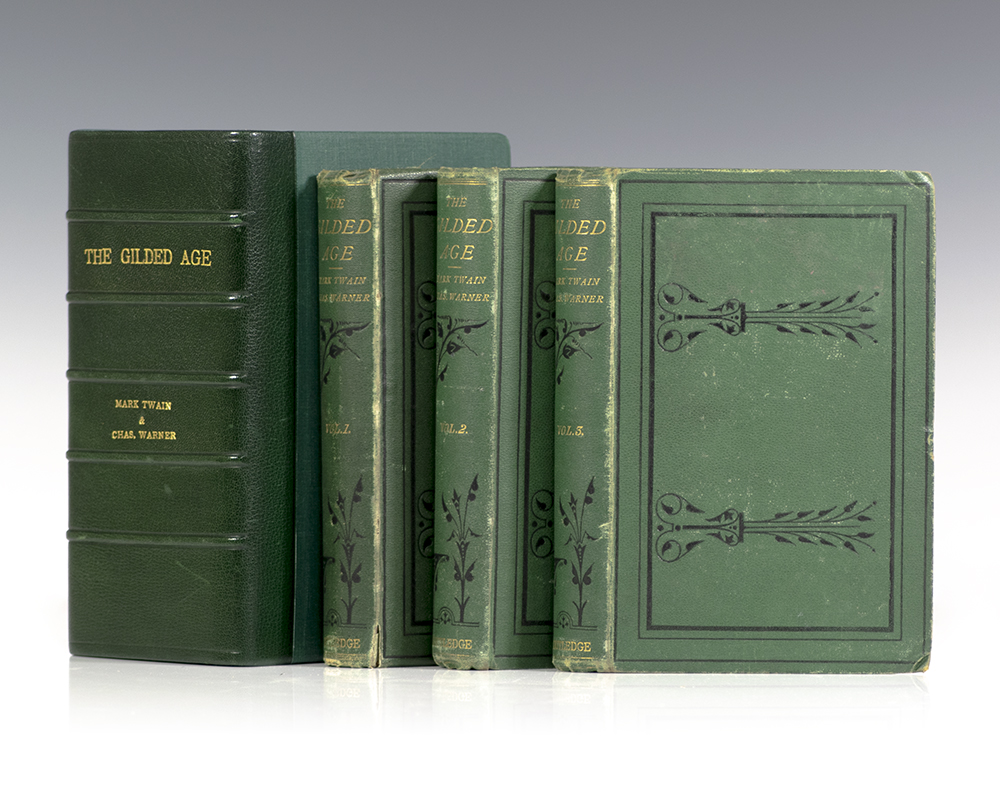
First English edition of Mark Twain and Charles Dudley Warner’s The Gilded Age
The Gilded Age: A Tale of Today (1873)
The only novel Twain wrote with a collaborator and the book that gave the era its name in history, The Gilded Age was the first major American novel to satirize the political milieu of Washington, D.C. and the wild speculation schemes that exploded across the nation in the years that followed the Civil War and its title gave the era its name in history. The only multi-volume work Clemens produced, The Gilded Age remains the rarest of Mark Twain’s major works and the most difficult to obtain. Its rarity is due largely to its format, three volume sets were quite expensive and were produced almost solely for circulating libraries during the Reconstruction era, and so, the books were vigorously read by many readers, generally rebound, and most were pulped in paper drives during the Second World War.
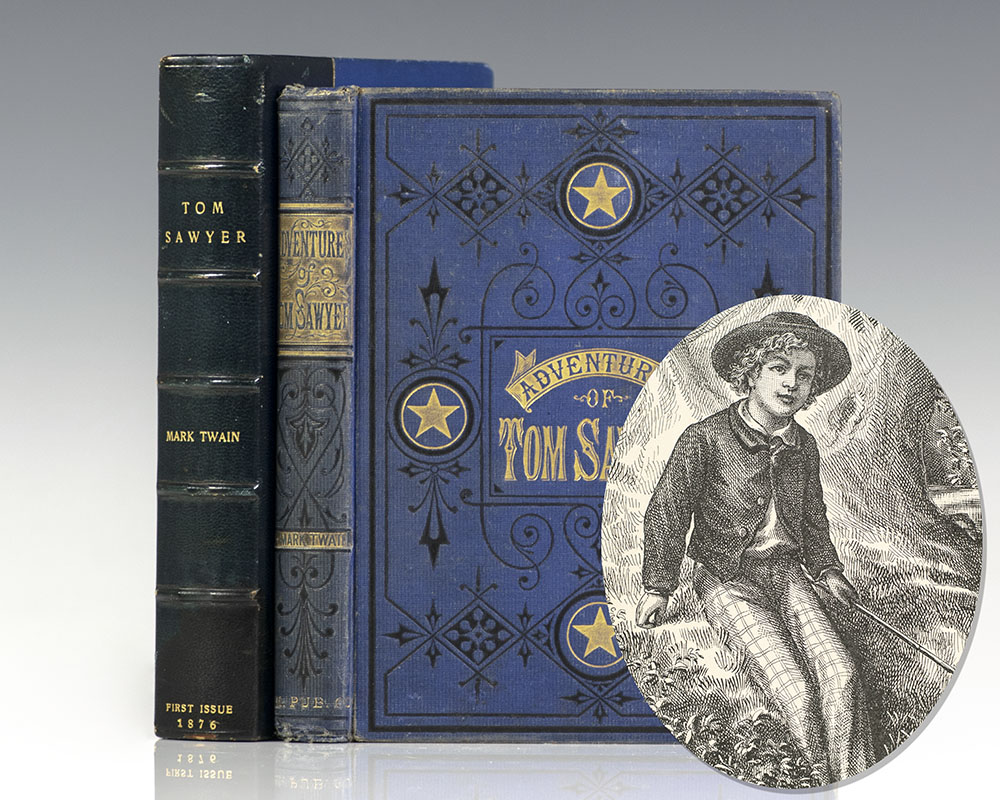
First edition, first printing of Mark Twain’s The Adventures of Tom Sawyer.
The Adventures of Tom Sawyer (1876)
Both wildly popular and controversial at the time of publication in 1876, The Adventures of Tom Sawyer established one of the most memorable characters in American literature, Tom Sawyer, who appeared in three later sequels: Adventures of Huckleberry Finn (1884), Tom Sawyer Abroad (1894), and Tom Sawyer, Detective (1896).
Perhaps Twain’s “most clearly autobiographical novel”, the classic tale of American boyhood arrived when America was celebrating its centennial and, “[b]y the time of Twain’s death, it was his top-selling book. It has been in print continuously since 1876, and has outsold all other Mark Twain works” (Rasmussen, 459).
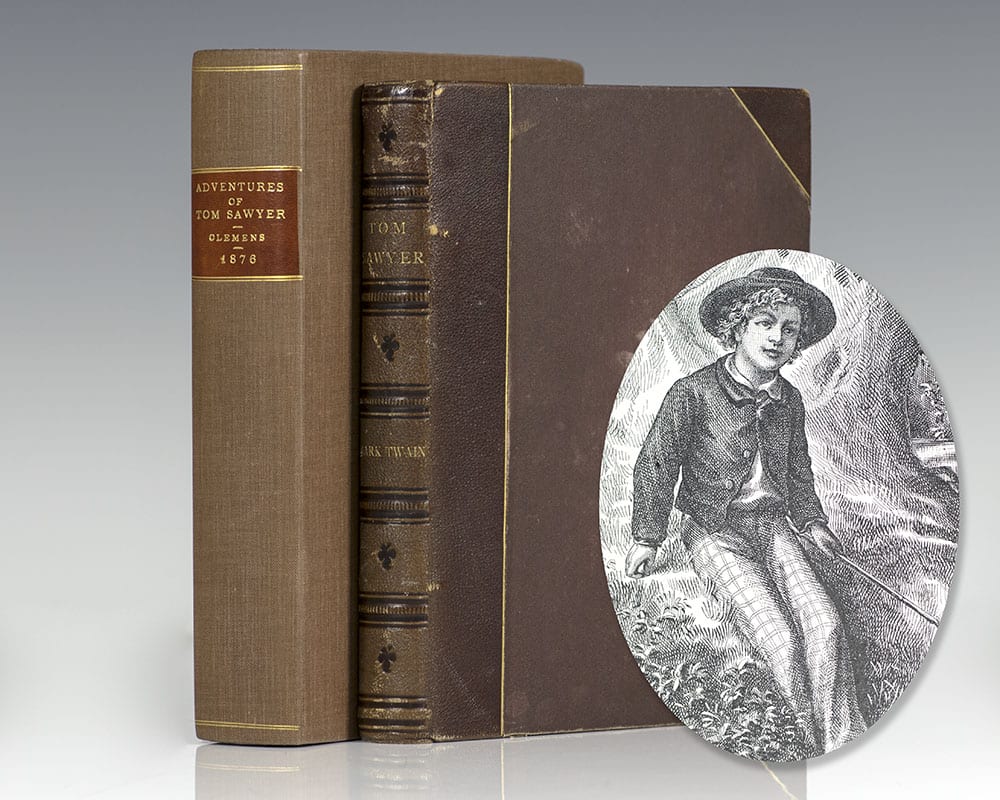
Rare first edition of The Adventures of Tom Sawyer; in the rare publisher’s half morocco binding
The Adventures of Tom Sawyer was first published in London without any illustrations in June of 1876, and subsequently in the United States in December of that same year by American Publishing Company in both a blue pictorial cloth, available to the public, and a deluxe publisher’s half morocco binding sold at a premium by subscription.
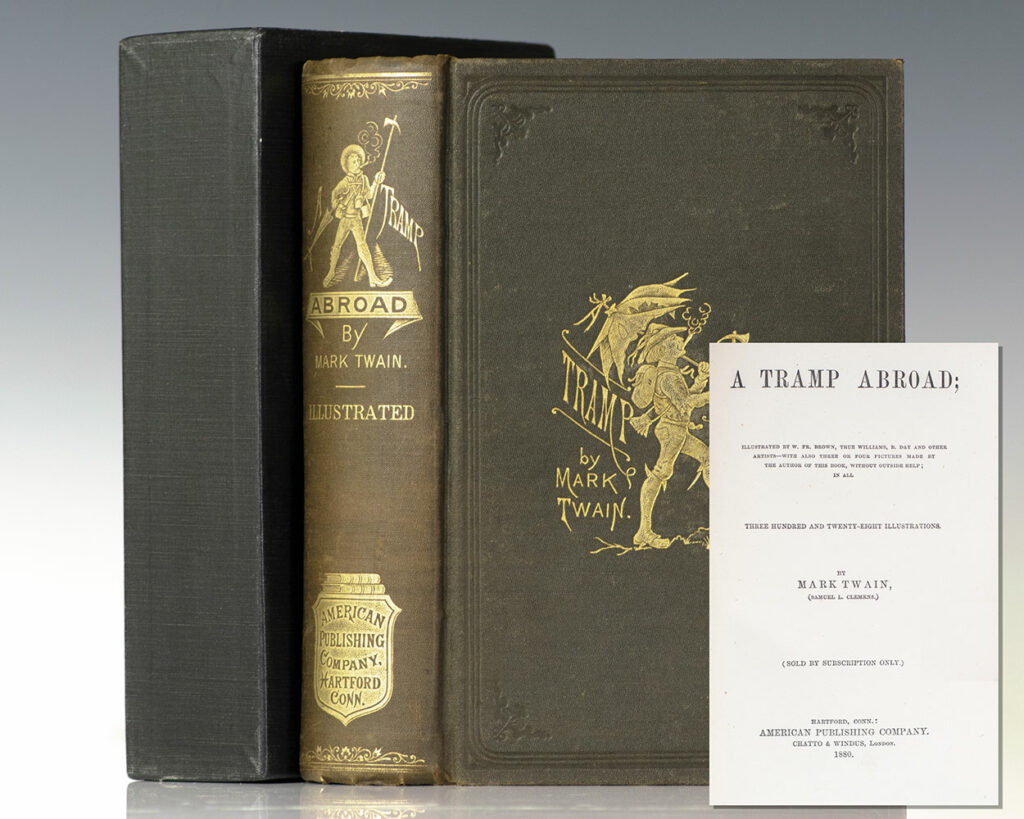
First edition, first state of Mark Twain’s A Tramp Abroad
A Tramp Abroad (1880)
A mixture of autobiography and fictional events, Twain’s A Tramp Abroad was first published in 1880 and details a journey by the author, with his friend Harris (a character created for the book, and based on his closest friend, Joseph Twichell), through central and southern Europe. While the stated goal of the journey is to walk most of the way, the men find themselves using other forms of transport as they traverse the continent. The book is the fourth of Mark Twain’s six travel books published during his lifetime and is often thought to be an unofficial sequel to the first one, The Innocents Abroad (1869).
“Besides his accounts of Germany, Switzerland, France and Italy, Twain includes local folklore (some of which he made up) and slips in several sketches that have little or nothing to do with Europe, including one of his most famous comic tales, ‘Jim Baker’s Bluejay Yarn” (MacDonnell, 42).
First edition, first printing of Mark Twain’s The Prince and the Pauper
The Prince and the Pauper (1881)
Brimming with gentle humor and discerning social scrutiny, The Prince and the Pauper was first published in 1881. A timeless tale of transposed identities, it remains one of Twain’s most popular and best-loved novels. Played out in two very different socioeconomic worlds of 16th-century England, the story follows the lives of two boys born in London on the same day: Edward, Prince of Wales, and Tom Canty, a street beggar. During a chance encounter, the two realize they are identical and, as a lark, decide to exchange clothes and roles — a situation that briefly, but drastically, alters the lives of both youngsters.
According to Twain, Harriet Beecher Stowe once told him, “I am reading your Prince and the Pauper for the fourth time… And I know it is the best book for young folks that was ever written” (Kaplan, 240).
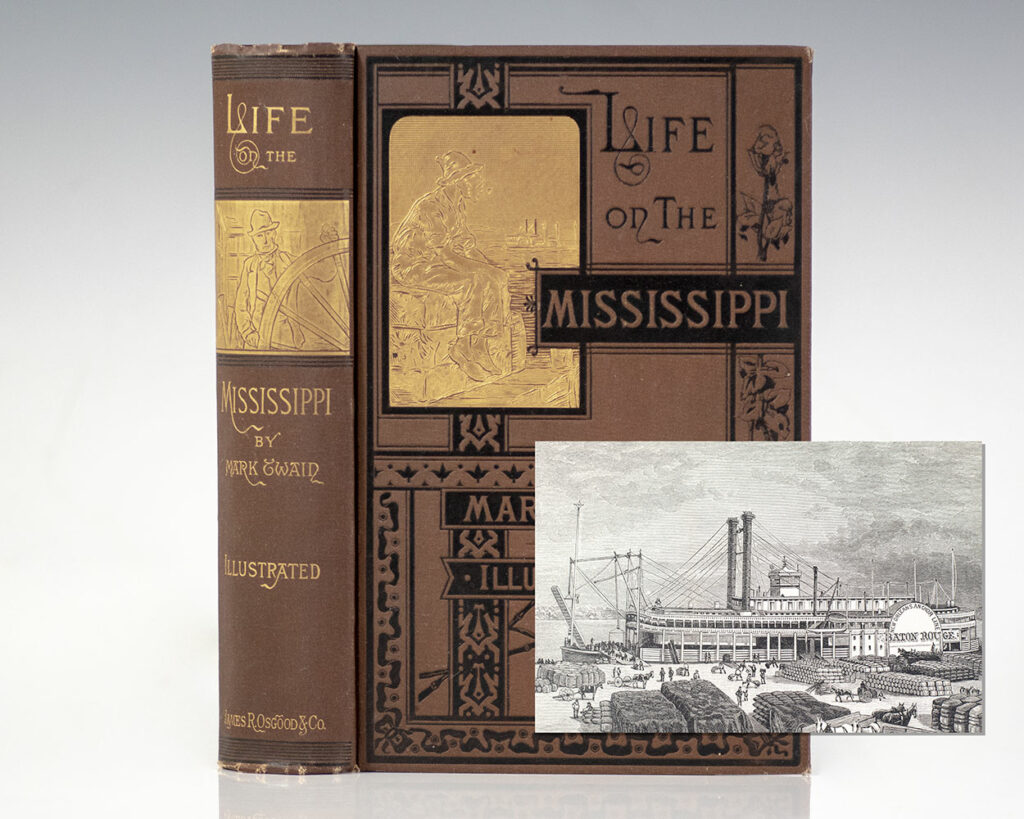
First edition of Mark Twain’s Life On The Mississippi
Life on the Mississippi (1883)
During an 1872 visit to the Midwest, Twain “was struck by the great diminution of steamboat traffic on the Ohio River and became anxious to document the steamboat era before it vanished altogether… [The resulting volume, Life on the Mississippi] is widely regarded as both one of Mark Twain’s major works and a classic on the Mississippi itself. Its early chapters especially are unrivaled in evoking the excitement of their time… According to Howells, Mark Twain regarded Life on the Mississippi as his greatest book. His regard for it is attested to by the fact that it is the only book that he attempted to rewrite after publication” (Rasmussen, 283, 291-2).
Part memoir, part travelogue, it expresses the full range of Twain’s literary personality, and remains the most vivid, boisterous and provocative account of the cultural and societal history of the Mississippi Valley, from ‘the golden age’ of steamboating to the violence wrought by the Civil War.
Mark Twain’s masterpiece Adventures of Huckleberry Finn; inscribed by Mark Twain and in the publisher’s original green cloth binding
Adventures of Huckleberry Finn (1885)
Written over an eight-year period, Twain’s Adventures of Huckleberry Finn was controversial from the outset, attacked by critics for its crudeness, coarseness and vulgarity. Upon issue of the American edition in 1885, several libraries, including the Concord and Brooklyn Public Libraries, banned it from their shelves. Twain later remarked to his editor, “Apparently, the Concord library has condemned Huck as ‘trash and only suitable for the slums.’ This will sell us another twenty-five thousand copies for sure!”
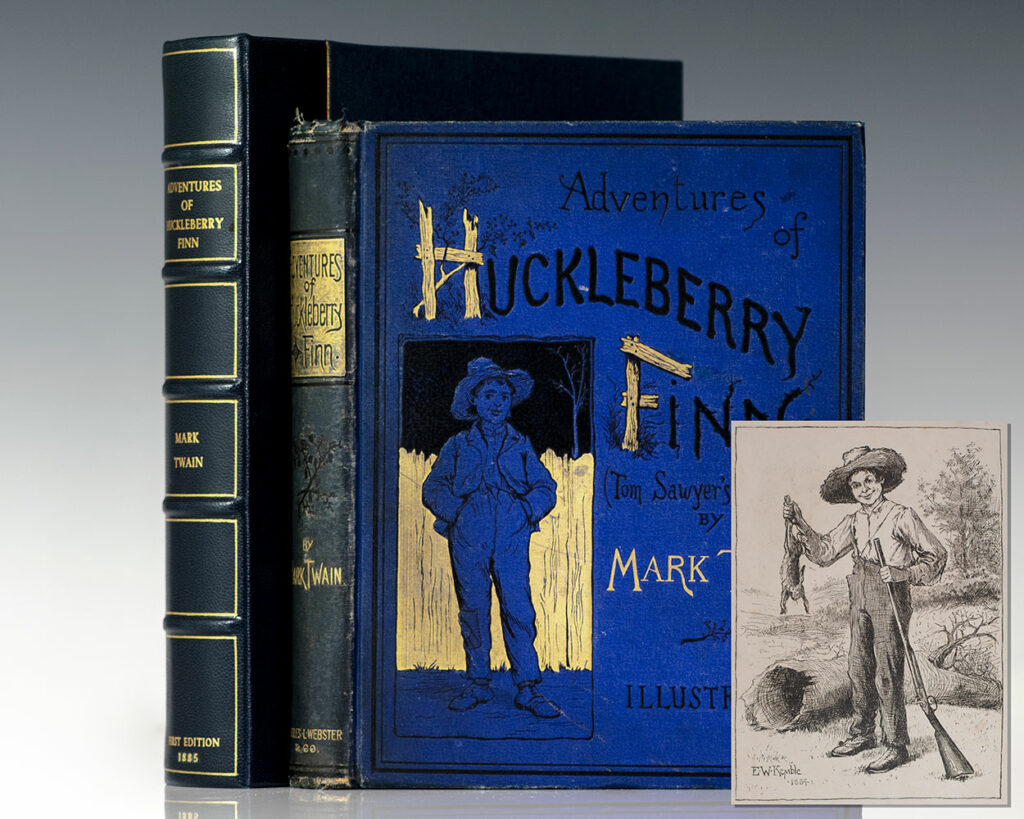
First edition of Mark Twain’s masterpiece Adventures of Huckleberry Finn; in the publisher’s very rare variant blue cloth binding
The book nevertheless emerged as one of the defining novels of American literature, prompting Ernest Hemingway to declare: “All modern literature comes from one book by Mark Twain. It’s the best book we’ve had. All American writing comes from that. There was nothing before. There has been nothing since.”
The Adventures of Huckleberry Finn was published in the United Kingdom in December of 1884, and shortly after in the United States in February of 1885. Sold by subscription by Charles L. Webster and Company in the U.S., 20,000 copies were produced in a pictorial cloth binding, 2,500 in sheep, and 500 in half morocco. Subscribers were also invited to request a blue cloth binding, as opposed to the the publisher’s standard green, to match that of Tom Sawyer. The blue pictorial cloth is now roughly twenty times more rare than the green.
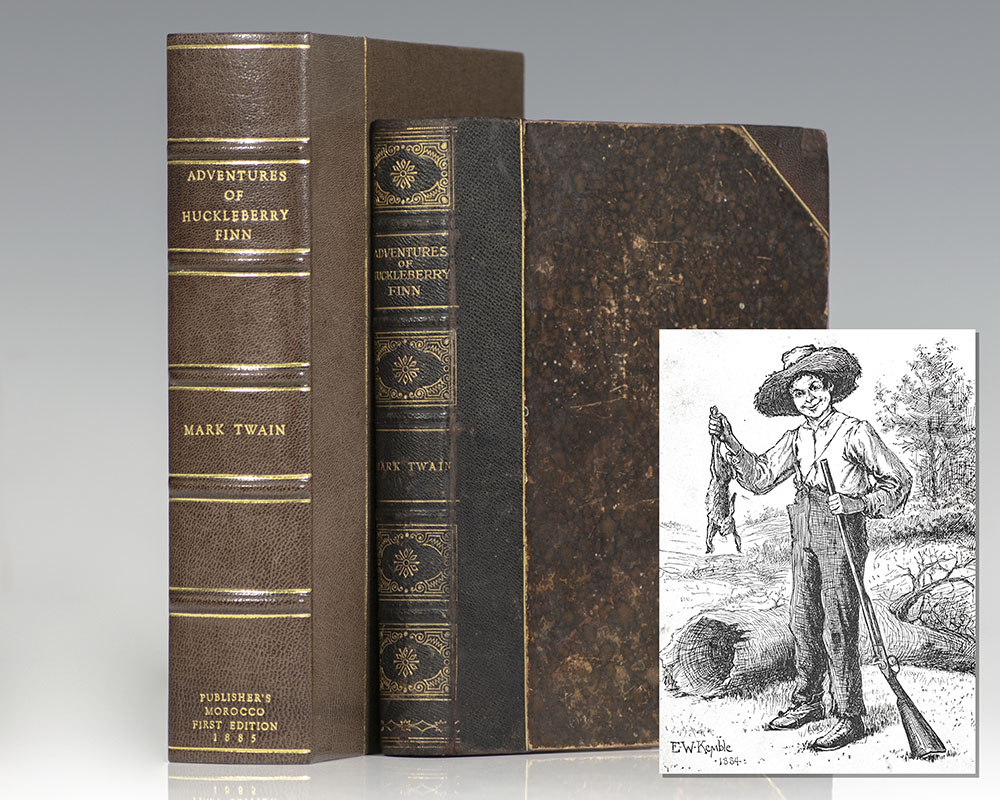
First edition, first issue of Adventures of Huckleberry Finn; one of approximately 500 copies bound in publisher’s three-quarter leather binding
Twain initially conceived of the work as a sequel to The Adventures of Tom Sawyer that would follow Huckleberry Finn through adulthood, but after several years of revisions he abandoned this plan and revised it as a scathing satire of the Antebellum South. “It is Twain at his most brilliant, funny, and scathing—a great book about American identity and racial hypocrisy” (Toni Morrison). “Huck Finn is a masterpiece not because it is about race, but because it is about freedom” (Shelley Fisher Fishkin).
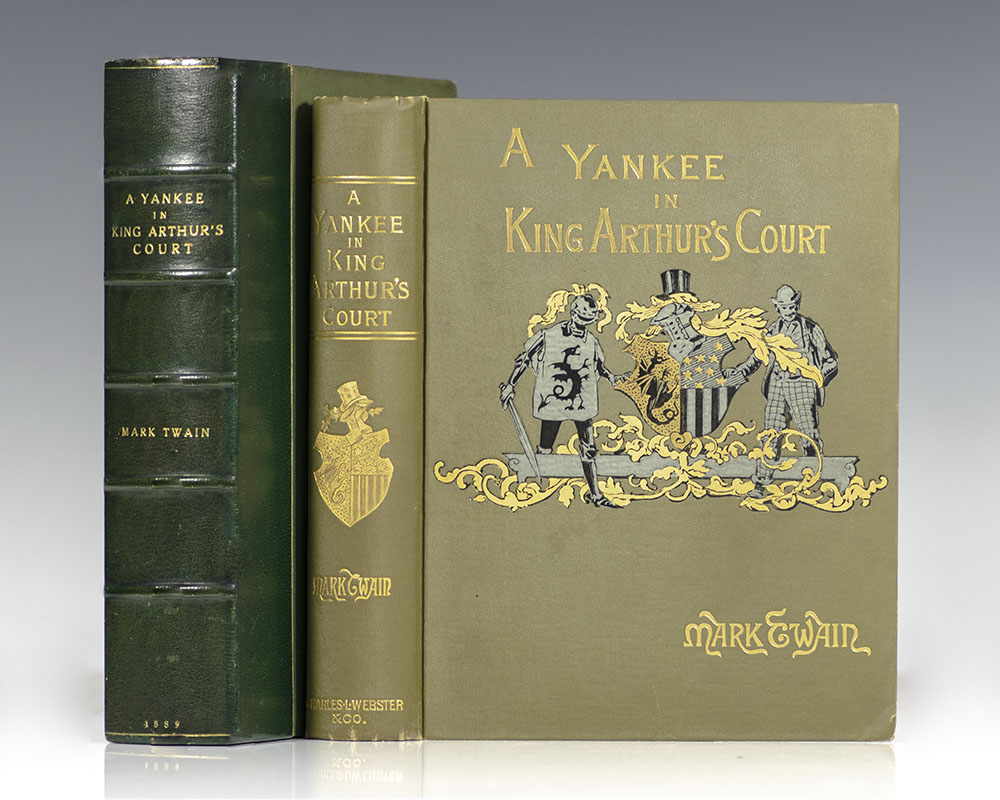
First edition of Mark Twain’s A Yankee in King Arthur’s Court
A Connecticut Yankee in King Arthur’s Court (1889)
Twain wrote A Connecticut Yankee after reading Malory’s Morte d’Arthur, exploring “a number of implicit parallels between Arthur’s England and the American South: slavery; an agrarian economy which came into armed conflict with an industrial economy; a chivalric code which, Clemens said, was secondhand Walter Scott and kept the South mawkish, adolescent, verbose, and addicted to leatherheaded anachronisms like duels and tournaments. In both frameworks a civil war destroys the old order, and the Yankee has as acute a sense of loss as Mark Twain did” (Kaplan, 297).
“The novel is a characteristic Twainian amalgam of fantasy and fun, observation and satire, that both amuses and provokes powerful reflection as it confronts the customs of olden times with the brash values of the New World” (Lacy, 478).
First edition of Twain’s last completed novel Personal Recollections of Joan of Arc
Personal Recollections of Joan of Arc (1896)
Presented as a translation by Jean Francois Alden of Joan of Arc’s page and secretary the Sieur Louis de Conte’s memoirs, Twain’s Personal Recollections of Joan of Arc first appeared as a serial in Harper’s Magazine beginning in April of 1895. Twain, aware of his reputation as a humorist, asked that each installment appear anonymously as he desired that readers treat the piece seriously. Regardless, his authorship soon became known, and the present volume was published by Harper and Brothers in May 1896 crediting Twain as the author. It was Twain’s final completed novel, published when he was 61 years old.
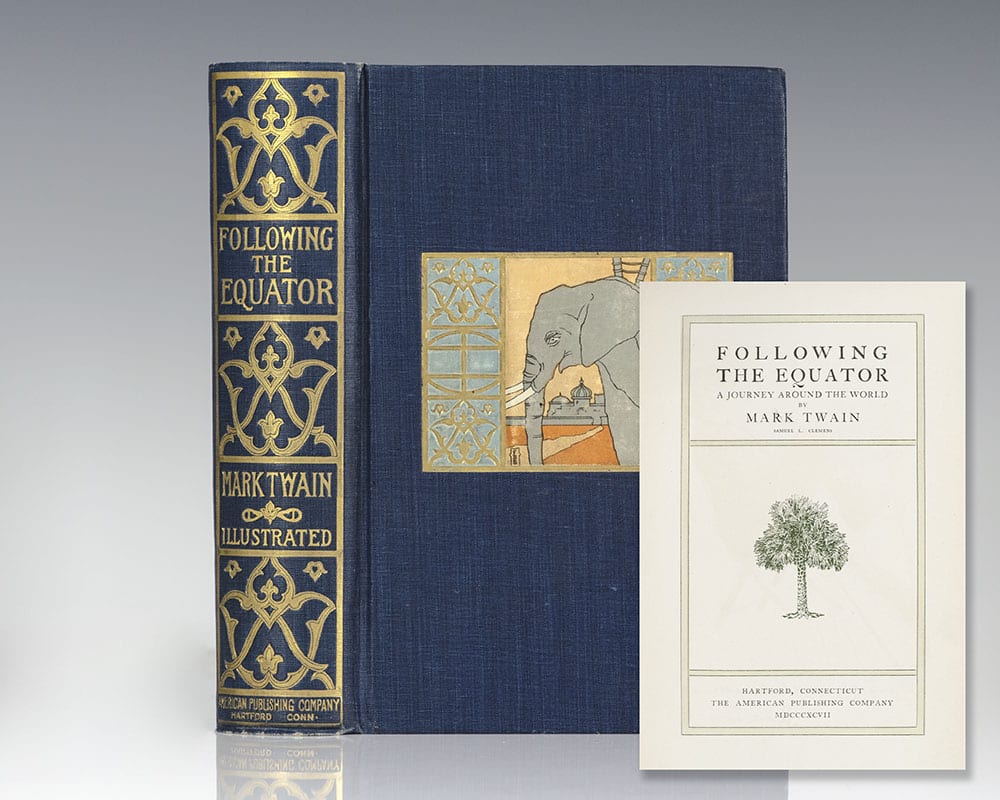
First edition, first issue of Mark Twain’s Following the Equator: A Journey Around the Globe
Following the Equator: A Journey Around the World (1897)
Twain toured the British Empire in 1895, during which he began concocting a travelogue about the experience that was published in 1897. Twain’s narrative spans the globe, from Australia to Hawaii. Full of tall-tales and real-life criticisms of imperialist arrogance, it is written with Twain’s characteristic wit and enthusiasm for a good, entertaining story. Following the Equator was Twain’s last travel book, and “also his most serious… He relates the narrative as himself… The serious tone in some ways makes this is best travel narrative” (MacDonnell, 53).
The Stormfield limited edition of The Writings of Mark Twain; bound in three-quarter morocco by Bayntun
The Writings of Mark Twain
In addition to the rare first editions featured above, our collection currently includes several editions of The Writings of Mark Twain as well as numerous finely bound examples and first editions of additional works.
“To understand America, read Mark Twain. No matter what new craziness pops up in America, I find it described beforehand by him. He was never innocent, at home or abroad” (Garry Wills).
In the spring of 2026, PBS’s Emmy Award-winning Made With Love series turned its attention to a question that has rarely felt more timely: in a country marking the 250th…
On May 14, 2026, Raptis Rare Books and Churchill Cigar Company had the extraordinary privilege of hosting legendary musician, musical director, and rock icon Mark Rivera for an…
May 18, 2026 BY VALERIE STAGGS FLORIDA WEEKLY CORRESPONDENT Inside Raptis Rare Book Store on Worth Avenue, stacks of FOX News Commentator Dana Perino’s new book, “Purple…
Join our growing list of satisfied clients who have leveraged
our multi-cloud and hybrid cloud strategies to achieve greater
agility and efficiency in their operations.